Bill of materials (BOM)
A bill of materials (BOM) is a structured list of every raw material, component, sub-assembly, and quantity required to manufacture a finished product. It's the master document your factory uses to source, cost, and build what you sell.
For an Ecommerce brand manufacturing in Asia, the BOM is the single source of truth that connects product design to production cost. It defines what goes into a product, how much of each input is needed, what each input costs, and where it comes from. Get the BOM right and your factory can quote accurately, source on time, and build to spec. Get it wrong and you'll see it surface as cost overruns, missed ship dates, quality issues, or all three.
Most founders treat the BOM as a back-office document. It isn't. It's the foundation of your unit economics, your lead time, your landed cost, and your ability to scale.
What a bill of materials actually contains
A complete BOM goes well beyond a parts list. At minimum, you should expect to see:
- Part number or SKU for each component
- Component name and description
- Quantity required per finished unit
- Unit of measure (pieces, meters, grams)
- Supplier or source for each input
- Unit cost and extended cost
- Lead time per component
- Reference designators or assembly notes
The more specific your BOM, the less room there is for factory interpretation — which is where most quality and cost surprises originate.
Types of BOMs you'll encounter
Different stages of product development call for different BOM formats. According to Investopedia's overview of bills of materials, the two most common structures are single-level and multi-level BOMs.
Single-level BOM. A flat list of all components needed to make the finished product. Works for simple products with few sub-assemblies.
Multi-level BOM. A hierarchical structure that breaks the product into sub-assemblies, each with their own component lists. Standard for electronics, complex apparel, and any product with modular construction.
Engineering BOM (EBOM). Built by the design team. Reflects the product as designed, not necessarily as manufactured.
Manufacturing BOM (MBOM). Built by the production team. Reflects what's actually needed on the factory floor, including consumables and packaging.
For most DTC brands shipping from Asia, the MBOM is what governs the purchase order (PO), the minimum order quantity (MOQ), and the final unit cost you'll pay.
Why the BOM drives your unit economics
Your BOM is the spine of your COGS. Every line item is a cost input. Every cost input affects your gross margin. And every change to the BOM — a fabric swap, a different zipper supplier, a thicker box — flows directly to your P&L.
This is where most early-stage brands lose money without realizing it:
- Suppliers substitute components without flagging it, and the BOM falls out of sync with what's actually being built
- Costs drift over time as input prices change, but the BOM isn't updated
- Packaging and accessories get added to the build without being added to the BOM, hiding costs in the factory's quote
- Multi-level BOMs aren't reconciled, so sub-assembly costs are double-counted or missed entirely
A clean, version-controlled BOM is the only way to actually know your cost per unit. Without it, you're guessing.
How the BOM affects lead time and inventory risk
Every component on your BOM has its own lead time. The longest one sets the floor for how fast your factory can produce. A 60-day fabric lead time means your finished goods are 60 days away, no matter how fast assembly runs.
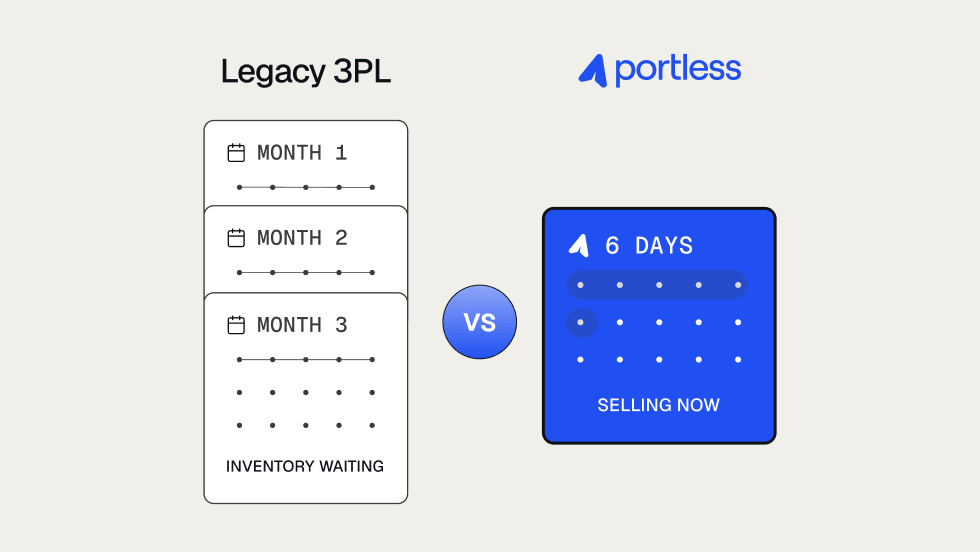
This is one of the biggest reasons brands over-order: they build safety stock around the worst-case component lead time, then sit on inventory for months. That capital is trapped in dead stock or slow-moving SKUs, which is exactly the problem the legacy bulk-freight model compounds.
A well-managed BOM lets you:
- Identify which components are the bottleneck and pre-position them
- Negotiate framework agreements on long-lead inputs
- Build smaller, more frequent production runs instead of one massive order
- Match production cadence to actual demand, not forecast guesses
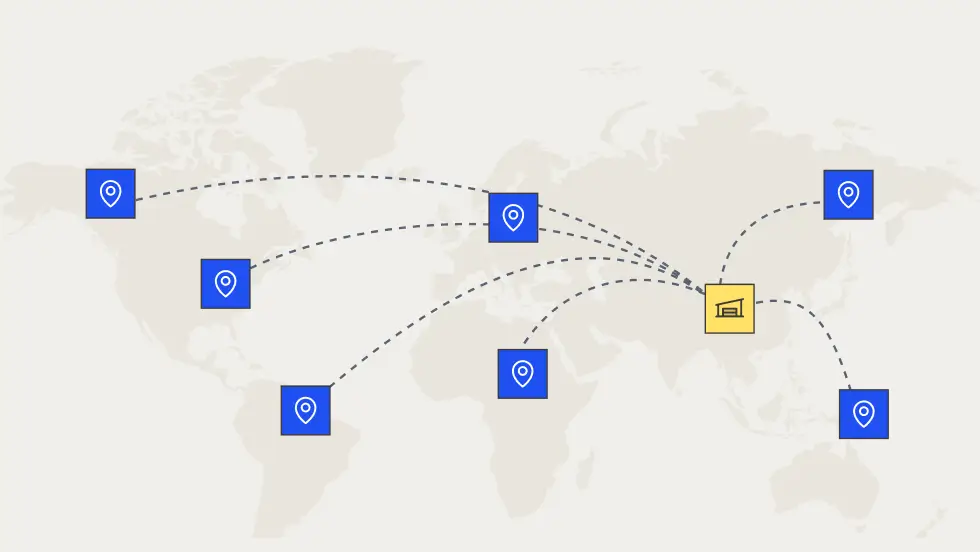
That last point is where direct fulfillment changes the math. When inventory ships from the factory to the customer in five to eight days, you don't need to build six months of stock to cover an ocean voyage and domestic warehouse intake. You build to current demand and ship as you go.
BOMs, customs, and compliance
Your BOM also feeds your customs documentation. Component origin determines your harmonized system code (HS code or HTS code), your duty rate, and your eligibility for trade programs. A BOM that doesn't track country of origin per component leaves you exposed to misclassification — and the tariff bills that follow.
For brands manufacturing in multiple countries or sourcing components globally, BOM-level origin tracking is what makes accurate duty calculation possible. It's also what enables tariff engineering: the legal practice of structuring sourcing and production to qualify for lower duty rates.
Common BOM mistakes that cost brands money
The legacy way most DTC brands manage BOMs — spreadsheets emailed between the founder, the designer, and the factory — falls apart at scale. The most expensive mistakes:
- Treating the BOM as static when materials, suppliers, and costs change constantly
- Not version-controlling the BOM, so the factory builds to an old spec
- Excluding packaging, inserts, and consumables, which can add 5–15% to true unit cost
- Ignoring scrap and yield rates, especially on cut-and-sew apparel
- Failing to reconcile the EBOM and MBOM before production starts
The fix isn't more software. It's discipline: one source of truth, version-controlled, reviewed before every PO.
How Portless brands use BOM accuracy to ship faster and free up cash
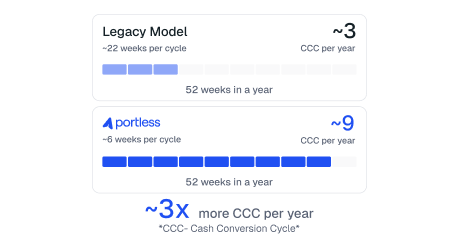
A clean BOM is the prerequisite for the model Portless runs: producing closer to real demand, fulfilling direct fulfillment from the factory, and skipping the months of capital tied up in ocean freight and domestic warehousing. When you know your true cost per unit and your true component lead times, you can build production runs that match your sales velocity instead of your forecast. That's how brands cut cash conversion cycle (CCC) and stop paying duties on inventory that hasn't sold. Contact us to see how direct fulfillment changes what your BOM is actually worth.
← Back to the Ecommerce supply chain glossary