Minimum order quantity (MOQ)
Minimum order quantity (MOQ) is the smallest number of units a supplier or manufacturer will produce or sell in a single purchase order. MOQs are set by suppliers to cover fixed production costs and protect margin on small runs.
For DTC Ecommerce brands manufacturing in Asia, MOQ is one of the most consequential numbers in your supply chain. It determines how much cash you commit upfront, how much inventory risk you carry, and how quickly you can test new products. A 5,000-unit MOQ at $4 per unit means $20,000 locked into a single SKU before a single customer sees it — and that's before freight, duties, and warehousing.
MOQs exist because manufacturers have setup costs: machine calibration, material sourcing, line changeovers, and labor allocation. A factory running a 200-unit batch absorbs the same setup overhead as a 5,000-unit batch, so they push minimums up to protect per-unit economics. That logic makes sense for the factory. It rarely makes sense for a growing brand.
How suppliers set MOQs
Suppliers calculate MOQs based on a few inputs: raw material minimums from their own upstream suppliers, machine setup time, labor cost per run, and target margin per order. Custom products, private label runs, and items requiring specialized tooling almost always carry higher MOQs than off-the-shelf goods.
Common MOQ ranges by category:
- Apparel: 300–1,000 units per style/colorway
- Beauty and skincare: 1,000–5,000 units (often driven by filling line minimums)
- Electronics: 500–2,000 units per SKU
- Home goods: 200–1,000 units depending on tooling
- Custom packaging: 3,000–10,000 units
These aren't fixed rules. Suppliers will often quote a "first order MOQ" that's lower as a relationship test, then raise it for reorders. Others negotiate down if you commit to multiple SKUs or volume over time.
Why MOQs are a cash flow problem
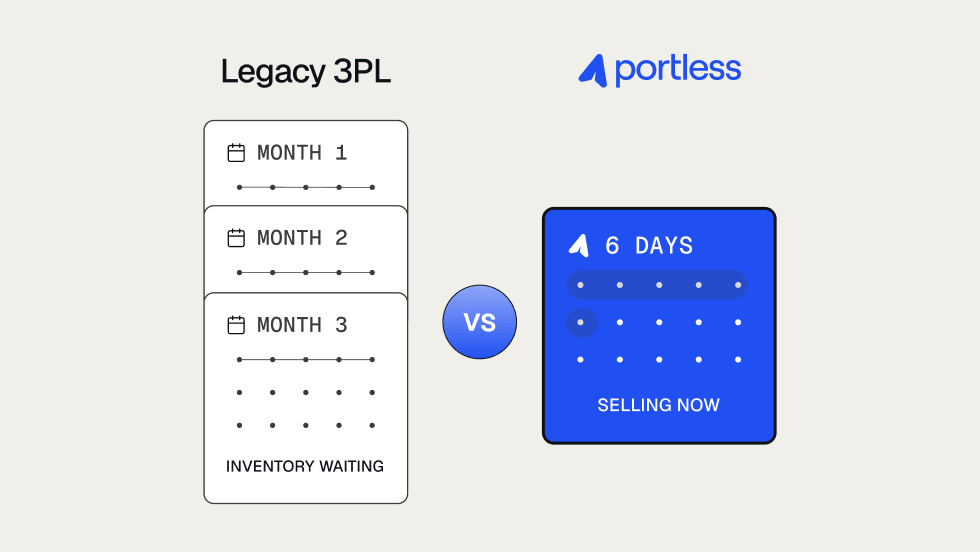
The legacy supply chain forces you to treat MOQs as the cost of doing business. You commit capital months before revenue, send a container by ocean freight for 45 to 60 days, pay duties on every unit (sold or not), and then store inventory in a domestic 3PL while you wait for it to sell.
The math gets brutal fast. A $1–15M brand placing a 5,000-unit MOQ at $5 per unit, plus $1.50 in freight and 25% duties, is sitting on roughly $40,000 of working capital per SKU. Multiply that across 10 SKUs and you have $400,000 locked up — capital that can't fund ads, hire, or fuel growth.
According to McKinsey's analysis of working capital optimization, inventory is one of the largest sources of trapped cash for mid-market companies. MOQs are the mechanism that traps it.
How MOQs increase inventory risk
The bigger your MOQ, the further out you're forecasting. A 5,000-unit order at 200 units sold per month is a 25-month inventory cycle. That's not inventory planning — that's a bet on demand staying flat for over two years.
When the bet is wrong, you get one of two outcomes:
- Dead stock that ends up liquidated at 40–60% off, wiping out margin
- Stockouts on winning SKUs because cash was tied up in losers
This is the exact dynamic that drives the test-small, scale-winners approach used by Shein and Temu. Shein reportedly orders initial runs of 100–200 units, validates demand with real sales data, then scales production only on proven winners. Their per-SKU capital risk is 70–80% lower than the traditional MOQ model.
How to negotiate lower MOQs
You don't need Shein's 3,000-factory network to push back on MOQs. A few tactics that work for $1–15M brands:
- Offer to pay a higher per-unit price in exchange for a smaller first run
- Commit to a reorder schedule (e.g., "100 units now, 500 in 60 days if sell-through hits 3 units/day")
- Bundle multiple SKUs under one order to hit factory minimums on materials
- Use pre-orders to fund the MOQ before placing it
- Build long-term relationships — most factories drop minimums for repeat customers
The trade-off is usually unit cost. A factory that normally runs 1,000-unit MOQs at $4 may quote $4.80 for 300 units. That's a real cost, but it's a fraction of the cost of dead stock.
How direct fulfillment changes the MOQ equation
The MOQ itself is set by your factory — Portless doesn't change that number. What changes is how quickly an MOQ becomes revenue.
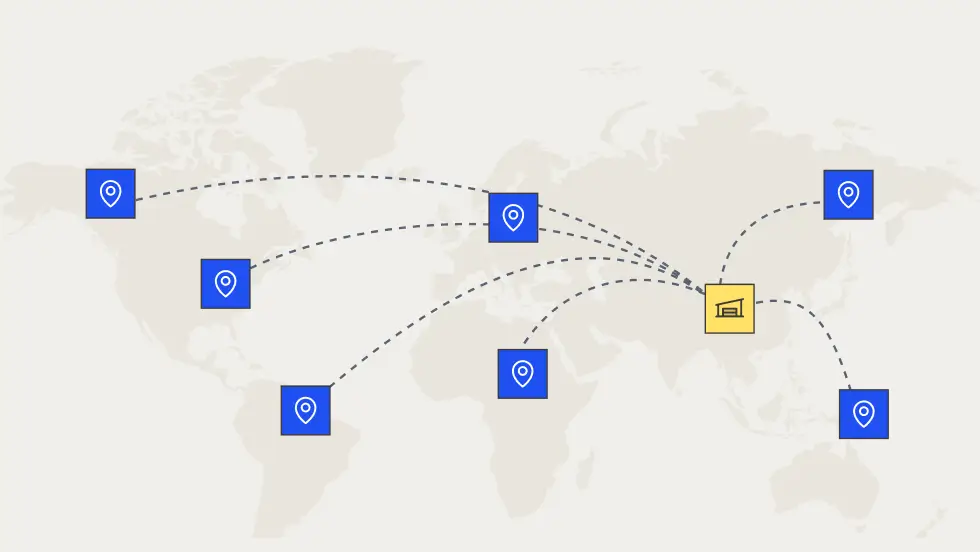
In the legacy model, the 60–90 day gap between paying for inventory and selling it is what makes MOQs financially dangerous. With direct fulfillment from manufacturers, inventory becomes sellable within days of production. You're not waiting on ocean freight or domestic 3PL inbounding. Orders ship from our Asia-based hubs directly to customers in five to eight days.
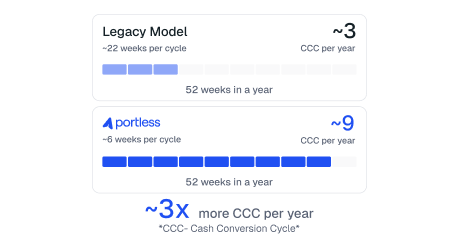
The result: a 5,000-unit MOQ that used to tie up cash for 90+ days before generating revenue now starts converting to cash within a week. Your cash conversion cycle compresses, your inventory turnover rises, and the same MOQ stops being a capital trap.
Turn MOQ commitments into faster cash with Portless
MOQs aren't going away. Factories will keep setting minimums, and brands will keep negotiating them. What you can change is how long that inventory sits between production and revenue. Portless ships your products directly from manufacturers in Asia to customers in 85+ countries, turning MOQ commitments into sellable revenue in days instead of months. Contact us to see how direct fulfillment compresses the cost of every MOQ you place.
← Back to the Ecommerce supply chain glossary