Private label
Private label is a sourcing model where products are manufactured by a third party and sold exclusively under your brand. You control the branding, packaging, pricing, and positioning, while the factory handles production.
Private label has become the default sourcing model for DTC Ecommerce brands launching in categories like beauty, supplements, apparel, home goods, and electronics. Instead of building a factory or developing products from scratch, you contract a manufacturer to produce goods to your specifications, then sell them under your own label. The math is appealing: lower upfront capital, faster time to market, and full control over the customer-facing brand. The trade-off is that the operational model behind private label — long production cycles, large minimum order quantities, ocean freight, and domestic warehousing — locks up cash and forces you to bet on demand months in advance.
This page breaks down how private label actually works, where the model is strong, where it breaks down, and how direct fulfillment changes the economics.
How private label works
The mechanics are straightforward. You identify a product category, find a contract manufacturer (most commonly in China), agree on specifications, and place a purchase order. The factory produces the goods under your brand, labels them with your packaging, and ships them to you or your fulfillment partner.
The standard private label workflow looks like this:
- Source a manufacturer that already produces a base product in your category
- Customize the product (formula, materials, design, packaging) to your specs
- Agree on MOQ, pricing, and lead time through a purchase order
- Pay a deposit (typically 30%) to start production
- Pay the balance before or upon shipment
- Move goods via ocean or air freight to a warehouse
- Sell through your DTC channel, marketplace, or retail partners
The brand owns the customer relationship, the IP on packaging and branding, and the pricing power. The manufacturer owns the production infrastructure.
Private label vs. white label vs. dropshipping
These three terms get used interchangeably, but they describe different models with different margin profiles and control levels.
Private label. Custom product made for one brand. You control formula, design, and packaging. The same factory may produce for competitors using different specs, but your SKU is exclusive to you.
White label. A generic product sold to multiple brands, each of which slaps their own label on it. Lower customization, faster to launch, but no real product differentiation.
Dropshipping. No inventory ownership. Orders are forwarded to a supplier who ships directly to the customer, usually in generic packaging with long transit times. Low risk, low margin, low brand control.
Private label sits in the middle: more control and margin than white label or dropshipping, but more capital risk than either.
Why brands choose private label
The appeal is clear when you compare it to building products from scratch:
- Faster speed-to-market — most private label products launch in 60 to 120 days
- Lower R&D cost — the factory already has the base formula or design
- Margin expansion — you skip wholesale markups by manufacturing direct
- Brand equity — you build a customer relationship around your label, not someone else's
- Category flexibility — you can launch adjacent SKUs without building new infrastructure
For a brand doing $1–15M in revenue, private label is often the only realistic path to owning a category position without venture-scale capital.
Where the private label model breaks down
The product side of private label works. The supply chain side is where most brands lose money.
The legacy playbook goes like this: place a large PO to hit MOQ, pay duties upfront on the full shipment, wait six to ten weeks for ocean freight, store the inventory in a domestic 3PL, and hope your demand forecast was accurate. According to the U.S. International Trade Commission, tariffs on many imported categories have climbed substantially in recent years, which means the duties you prepay on a private label PO are a much bigger line item than they were five years ago.
The cash flow math is brutal:
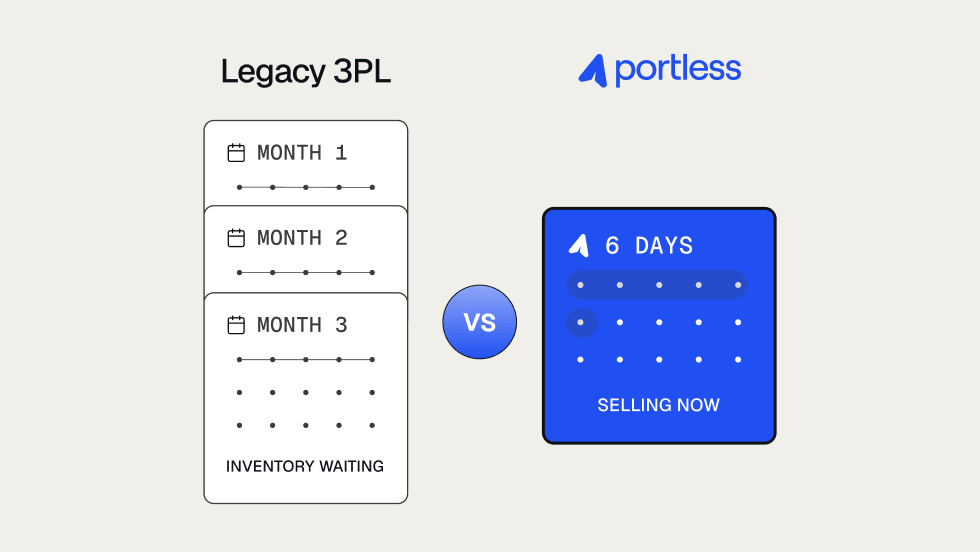
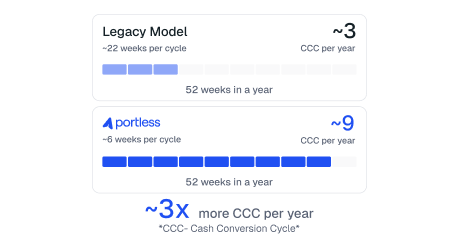
- Capital is locked up in inventory for 60 to 120 days before the first unit sells
- Duties are paid on 100% of the shipment, including units that may never sell
- Dead stock from forecast misses gets liquidated at a loss
- Reorder cycles are slow, so you stock out on winners and overstock on losers
This is the legacy model that most private label brands inherit by default. It works at scale, but it punishes brands that are still learning what their customers want.
How direct fulfillment changes private label economics
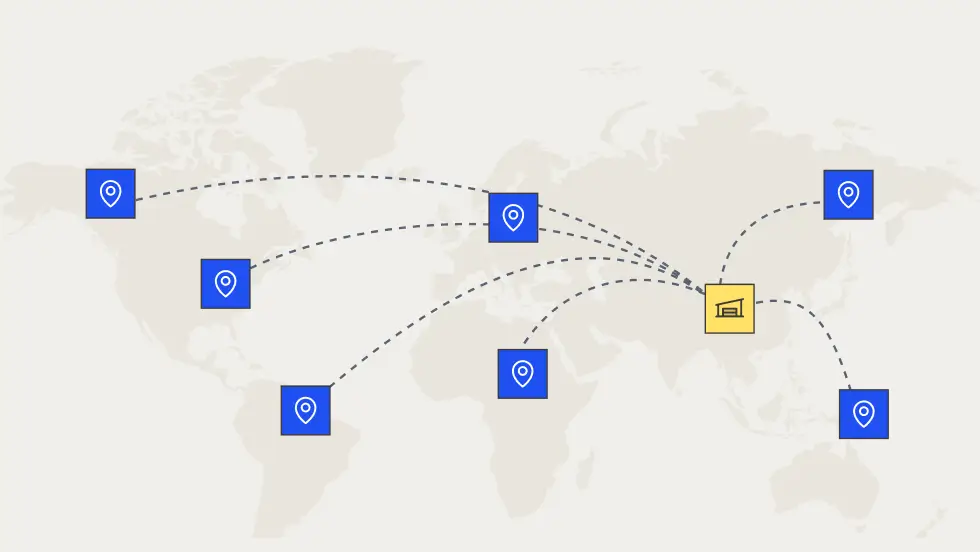
Direct fulfillment ships individual orders from a facility adjacent to your manufacturer in Asia straight to your customer's door. The product is still your private label SKU, made by your contract manufacturer. What changes is everything that happens after production.
Instead of producing a full PO and shipping it via ocean freight to a domestic warehouse, you produce smaller batches and start selling them within days. Portless has helped brands reduce lead inventory times by up to 90% and make inventory available for sale days after it comes off the production line.
What this means for a private label brand:
- Pay duties only on units sold, via the Delivered Duty Paid (DDP) model
- Test new SKUs with smaller production runs before committing to a full PO
- Reorder winners faster — measured in days, not months
- Free up working capital that was previously trapped in transit and storage
- Expand to 85+ countries without standing up domestic warehouses in each market
Shein and Temu built their businesses on this exact principle: test small, scale winners, ship direct. The model is now accessible to brands at the $1–15M range.
How to evaluate a private label opportunity
Before placing your first PO, run the numbers on the full landed cost, not just the unit price from the factory. A $4 product becomes a $9 product once you factor in freight, duties, warehousing, and 3PL pick-and-pack fees. Use a landed cost calculator to model the real number.
Then ask:
- What's the MOQ, and can you sell through it in 90 days at projected velocity?
- What's the lead time from PO to receivable inventory?
- How much capital are you willing to lock up before validating demand?
- Can you reorder fast enough to chase a winner, or will you stock out?
If the answers point to a slow, capital-heavy cycle, the fulfillment model is the lever to change — not the product.
Private label is the product strategy. Direct fulfillment is the supply chain strategy.
Private label gives you a brand. Direct fulfillment gives you the cash flow and speed to actually grow it. If you're already manufacturing in Asia, you don't need a domestic 3PL and ocean freight to reach your customers. You can ship direct, pay duties only on what sells, and reinvest the freed-up capital into the next product launch.
Contact us to see how direct fulfillment fits your private label brand.
← Back to the Ecommerce supply chain glossary