Purchase order (PO)
A purchase order (PO) is a formal document a buyer issues to a supplier authorizing the production or delivery of goods at agreed-upon terms — including quantity, unit price, delivery date, and payment conditions. It's the legal backbone of the buyer-supplier relationship and the financial commitment that kicks off every production run.
For Ecommerce brands manufacturing in Asia, the purchase order is more than paperwork. It's the moment cash leaves your balance sheet and gets locked into inventory — often months before that inventory turns into revenue. A PO defines what you're buying, when it ships, what you'll pay, and who's accountable if something goes wrong. Get the terms right and you protect margin, cash flow, and quality. Get them wrong and you've underwritten a problem you won't see for 60 days.
This page breaks down what a PO contains, how it functions in a DTC supply chain, and why the legacy bulk-PO model creates more risk than most operators realize.
What a purchase order includes
A standard PO issued to a contract manufacturer typically contains:
- Buyer and supplier details, including legal entity names and addresses
- PO number for tracking and accounting reference
- Product description, SKU, and specifications tied to the bill of materials (BOM)
- Quantity ordered, often constrained by the supplier's minimum order quantity (MOQ)
- Unit price and total order value
- Payment terms (deposit percentage, balance trigger, net days)
- Delivery date and Incoterms governing risk transfer
- Quality standards, inspection requirements, and acceptance criteria
- Packaging, labeling, and shipping instructions
The PO becomes a binding agreement once the supplier accepts it. From that point forward, both parties are legally obligated to perform under the terms specified. The International Trade Administration treats the PO as foundational evidence in cross-border trade disputes.
How POs work in the DTC supply chain
Here's the typical sequence for a brand manufacturing in Asia:
- You forecast demand and calculate a reorder quantity based on lead time and sell-through rate
- You issue a PO to the factory, usually with a 30% deposit upfront
- The factory schedules production, sources raw materials, and begins manufacturing
- You pay the balance (often 70%) when goods are ready to ship or pass pre-shipment inspection
- Goods leave the factory under the agreed Incoterm
- The PO is closed once goods are received, inspected, and invoices reconciled
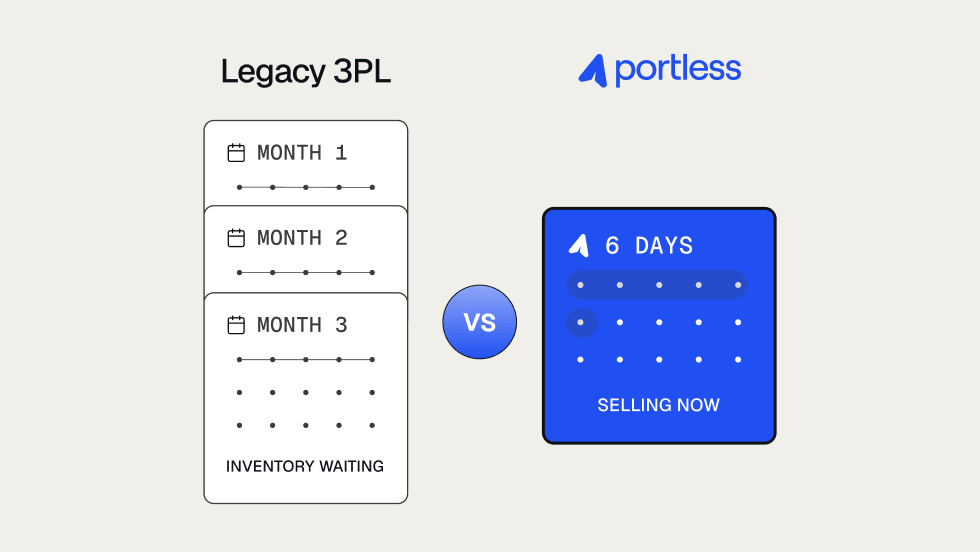
In the legacy model, that sequence stretches over 60 to 90 days before a single unit reaches a customer. The PO is the trigger — the moment your capital becomes inventory and stops being available for ads, payroll, or product development.
Why PO size is a cash flow decision, not a procurement decision
Most brands treat the PO as a procurement task: how many units do we need, at what price, by when? But the size of the PO is really a cash flow decision dressed up as an operations one.
A large PO gives you better unit economics and protects you from stockouts. It also locks 60 to 90 days of working capital into a single bet on demand you haven't validated yet. If that bet is wrong, you're carrying dead stock, discounting to clear it, or paying carrying cost on inventory that should have been smaller from the start.
A small PO preserves cash and flexibility but typically pushes your unit cost up, and many factories won't accept orders below their MOQ.
This is the trap of the legacy bulk-freight model: you're forced to commit to large POs months in advance because the only economical way to move goods is by full container. The PO size isn't optimized for demand — it's optimized for ocean freight economics.
The hidden costs of the legacy PO cycle
Three costs compound every time you issue a large PO under the legacy model:
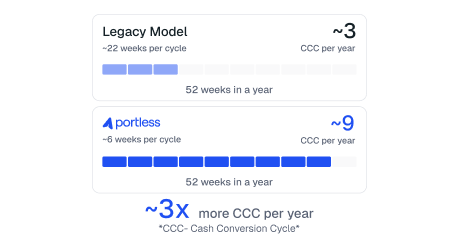
Capital lockup. You pay the supplier deposit on day one. Cash doesn't return until day 79 or later, after ocean freight, port clearance, domestic receiving, and the time it takes to actually sell through inventory. With $200,000 in working capital, four turns per year is $800,000 in throughput. Faster cycles change that math entirely.
Quality risk discovered too late. Defects found in a domestic 3PL six weeks after production are expensive to fix. Returning units to the factory often costs more than scrapping them. The 1-10-100 rule — fix it at the source for $1, during fulfillment for $10, after delivery for $100 — applies directly here.
Forecast risk. A PO placed in September for Q4 inventory is a bet on demand 90 days out. If the bet is wrong, you can't unwind it without taking a loss.
How direct fulfillment changes the PO cycle
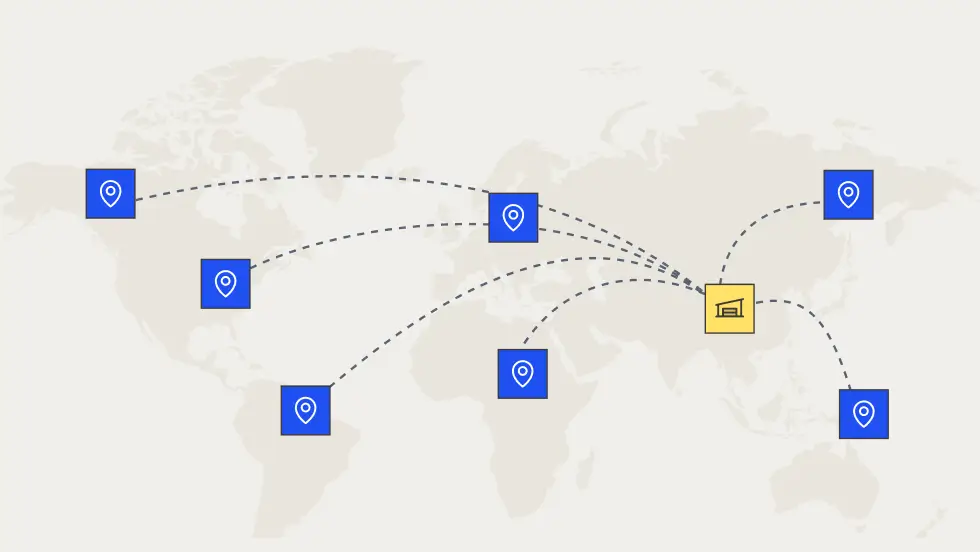
Portless changes what a PO actually commits you to. Instead of issuing a single large PO to fund three months of inventory sitting in a domestic warehouse, you can issue smaller, more frequent POs that move directly from your factory in Asia to a fulfillment center hours away from production. Inventory becomes available for sale within days of leaving the factory, not weeks.
That shifts the PO from a speculative bet into a responsive replenishment decision. You test new SKUs at 250 units instead of 2,500. You catch quality issues at receiving — the same day, not six weeks later. You shrink your cash conversion cycle from 79 days to 26 days, freeing capital to fund growth instead of underwriting forecast errors.
Rethink the PO as a working capital decision
The purchase order is the single document where supply chain meets finance. Every PO you issue is a choice about how much cash to lock up, how long to lock it up for, and how much demand risk to absorb. The legacy model forces you to choose poorly — large POs, long cycles, late quality feedback. Direct fulfillment from your point of manufacture gives you a different set of options.
If you want to see how shorter PO cycles and faster inventory turns change your margins, contact our team or model your own numbers with the direct fulfillment ROI calculator.
← Back to the Ecommerce supply chain glossary