FOB shipping
If you've ever signed a purchase order with a factory in Shenzhen or Ho Chi Minh City, you've seen "FOB" stamped on it. FOB shipping is one of the most widely used terms in international trade, but most Ecommerce founders treat it as boilerplate. That's a mistake. The FOB clause determines who pays for freight, who carries the risk if a container falls off a ship, and where your landed cost calculation actually begins. Get it wrong, and you're either underestimating your true cost of goods or absorbing liabilities you never agreed to.
This page breaks down what FOB shipping means, the difference between FOB Origin and FOB Destination, how it compares to other Incoterms like EXW and DDP, and why FOB matters more than ever for brands manufacturing in Asia.
What FOB shipping actually means
FOB stands for "free on board." The International Chamber of Commerce defines it as one of 11 Incoterms — standardized trade terms that allocate responsibilities between buyer and seller for international shipments.
Under a FOB agreement, the seller is responsible for the goods up to a specific point in the journey. After that point, the buyer takes over. The "point" is what changes based on the variant:
- FOB Origin (or FOB Shipping Point): risk and cost transfer to the buyer the moment goods are loaded onto the carrier at the seller's location
- FOB Destination: risk and cost stay with the seller until the goods arrive at the buyer's specified destination
FOB technically applies to sea and inland waterway freight. For air or ground shipments, FCA (Free Carrier) is the correct term under Incoterms 2020 — though in practice, many brands and suppliers still use "FOB" loosely across modes.
FOB Origin vs. FOB Destination
The distinction matters because it changes who pays and who's liable when something goes wrong.
FOB Origin (FOB Shipping Point)
- Buyer pays freight from the port of origin
- Buyer assumes risk of loss or damage in transit
- Buyer records inventory on their balance sheet as soon as goods are loaded
- Most common for brands importing from Asia
FOB Destination
- Seller pays freight to the buyer's specified location
- Seller assumes risk until delivery
- Buyer records inventory only when goods arrive
- Less common in international Ecommerce sourcing
If you're buying from a factory in China and the PO says "FOB Shenzhen," you're on the hook for ocean freight, insurance, customs clearance, and any damage from the moment the container is loaded. The factory's job ends at the port.
FOB vs. EXW, CIF, and DDP
FOB is one of several Incoterms you'll encounter. Each shifts the responsibility line:
- EXW (Ex Works): seller makes goods available at their facility. Buyer handles everything else — including inland transport in the origin country
- FOB: seller delivers goods to the port and loads them onto the vessel. Buyer takes over from there
- CIF (Cost, Insurance, Freight): seller pays freight and insurance to the destination port, but risk still transfers when goods are loaded
- DDP (Delivered Duty Paid): seller handles everything — freight, duties, taxes, last-mile delivery
For most DTC brands sourcing from Asia, FOB is the default. But it pushes a lot of complexity downstream onto the buyer — booking freight forwarders, paying duties, coordinating customs, and managing 3PL receiving. That's where the legacy model breaks down.
Why FOB matters for your landed cost
FOB is the starting line for landed cost calculations. Your factory's FOB price covers the product itself plus loading at the origin port. From there, you're adding:
- Ocean or air freight
- Marine insurance
- Import duties and tariffs (now meaningful for most brands after the end of the $800 de minimis threshold)
- Customs brokerage fees
- Drayage and inland transport
- Warehouse receiving fees
Brands that quote margins off the FOB price alone consistently underestimate true unit economics. Two products with identical FOB prices can have wildly different landed costs depending on weight, dimensions, HS code, and routing.
FOB and customs valuation
U.S. Customs uses transaction value — typically the FOB price you pay your supplier — as the primary basis for customs valuation. This is the dutiable amount, not your retail price.
Declaring retail price instead of FOB price is one of the most expensive valuation mistakes brands make. A product with a $6.45 FOB cost and a $32 retail price faces duty on $6.45, not $32. Getting this right protects margin and keeps you compliant with CBP's "reasonable care" standard.
How FOB fits the legacy supply chain model
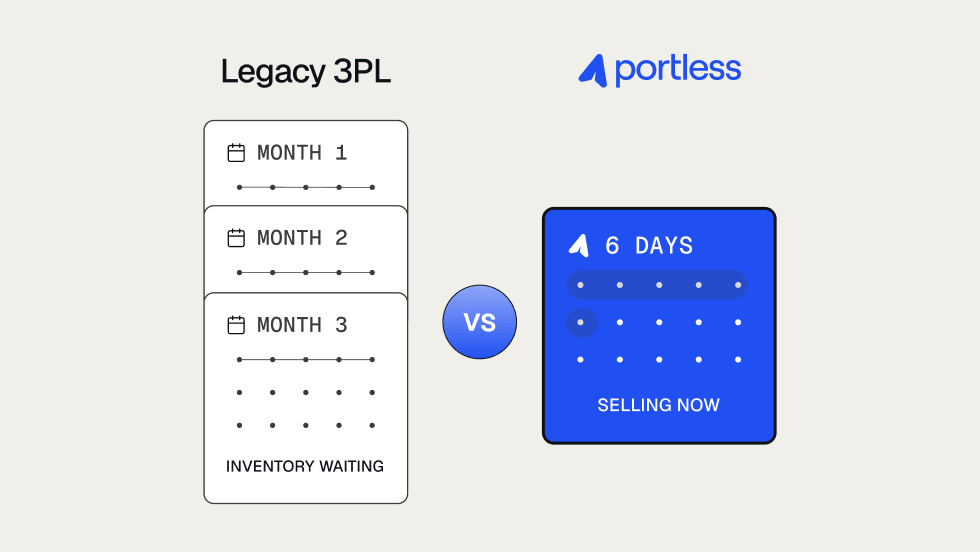
In the legacy model, FOB Origin terms set up a long, expensive chain: factory → port of origin → ocean freight (3–6 weeks) → port of entry → drayage → domestic 3PL → pick and pack → last-mile carrier → customer. Each handoff adds time, cost, and risk. You pay duties on the entire container upfront, store inventory for months, and only start collecting cash when products finally sell.
That model was built for a world of large bulk shipments and predictable demand. It's a poor fit for Ecommerce brands trying to test SKUs, respond to demand signals, and protect cash flow.
How Portless changes the equation after FOB
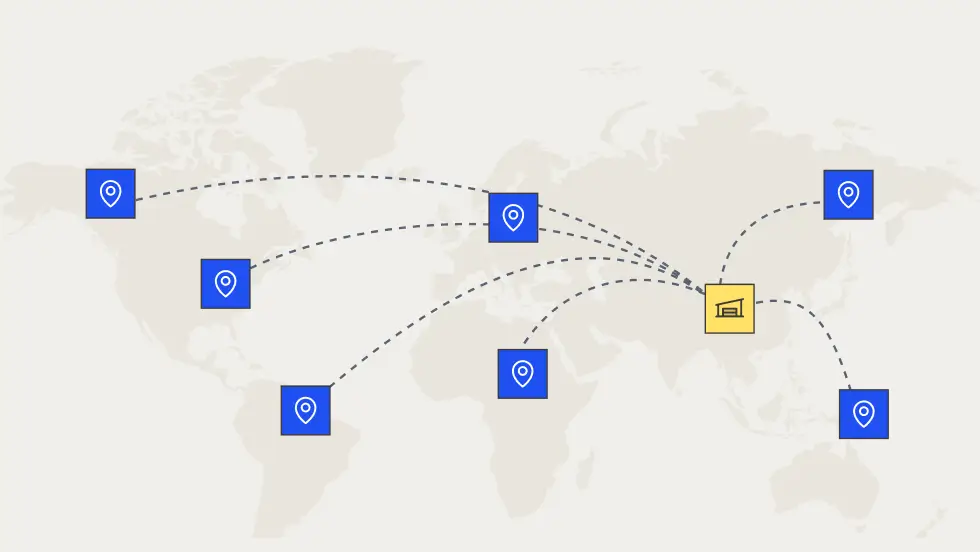
Portless doesn't eliminate FOB — your factory still sells to you on FOB terms. What changes is what happens next. Instead of booking ocean freight, paying duties on a full container, and waiting weeks for goods to land at a domestic 3PL, your inventory moves directly into our factory-adjacent fulfillment center in Asia. From there, individual orders ship directly to your customers in five to eight days, with duties paid per order under a DDP model — not on unsold inventory sitting in a warehouse.
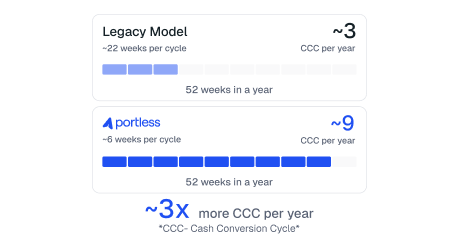
The result: faster cash conversion, lower inventory risk, and no capital locked up in a warehouse betting on a demand forecast. If you want to model the impact on your own numbers, run the math through our direct fulfillment ROI calculator or contact us to talk through your supply chain.
← Back to the Ecommerce supply chain glossary