Economic order quantity (EOQ)
Economic order quantity (EOQ) is the order size that minimizes the total cost of ordering and holding inventory. It balances per-order costs (freight, setup, processing) against carrying costs (storage, capital, obsolescence) to find a single replenishment quantity.
EOQ is a classic inventory management formula developed by Ford W. Harris in 1913. It answers a specific question: assuming stable demand and known costs, how many units should you order at a time to minimize total inventory cost? The formula is √(2DS/H), where D is annual demand, S is the fixed cost per order, and H is the annual holding cost per unit. The output is a single number — the "optimal" reorder size — that sits at the point where ordering costs and carrying costs intersect.
For DTC brands manufacturing in Asia, EOQ shows up in every conversation about minimum order quantities, container utilization, and reorder cadence. But the formula was built for a world of predictable demand and cheap warehousing. Neither describes modern Ecommerce.
How the EOQ formula works
The EOQ calculation requires three inputs:
- Annual demand (D): total units sold per year for a given SKU
- Order cost (S): fixed cost per purchase order, including freight, customs brokerage, and processing
- Holding cost (H): annual cost to hold one unit in inventory, typically 20–30% of unit cost when you include warehousing, insurance, capital cost, and shrinkage
Plug those into √(2DS/H) and you get the order quantity that minimizes total cost. If you sell 12,000 units per year, your order cost is $2,000, and your holding cost is $5 per unit per year, your EOQ is √((2 × 12,000 × 2,000) / 5) = 2,191 units per order.
That number assumes demand is flat, lead times are fixed, and holding costs are stable. In practice, none of those hold for an Ecommerce brand selling across multiple channels and geographies.
Why EOQ breaks down for modern DTC brands
EOQ was designed for manufacturers ordering raw materials with predictable consumption. Apply it to a DTC brand running Meta ads, TikTok campaigns, and seasonal drops, and the assumptions fall apart fast.
Demand isn't stable. A viral moment can 10x velocity in a week. A creative miss can flatline a SKU for a month. EOQ assumes a smooth demand curve that doesn't exist in Ecommerce.
Holding costs are higher than brands realize.Carrying cost includes warehouse fees, insurance, depreciation, shrinkage, and the opportunity cost of capital. According to research from IHL, inventory distortion (overstocks plus stockouts) costs retailers $1.77 trillion globally — most of it tied up in carrying inventory that doesn't sell.
Ordering costs aren't what they used to be. Legacy freight and customs brokerage made each PO expensive, which pushed EOQ outputs toward larger batches. Direct fulfillment from the point of manufacture changes that math entirely.
Cash flow matters more than ordering efficiency. A "mathematically optimal" order of 2,000 units that ties up $40,000 in capital for six months is not optimal for a brand with $200,000 in working capital. EOQ doesn't see your balance sheet — only your order math.
EOQ assumes a legacy supply chain
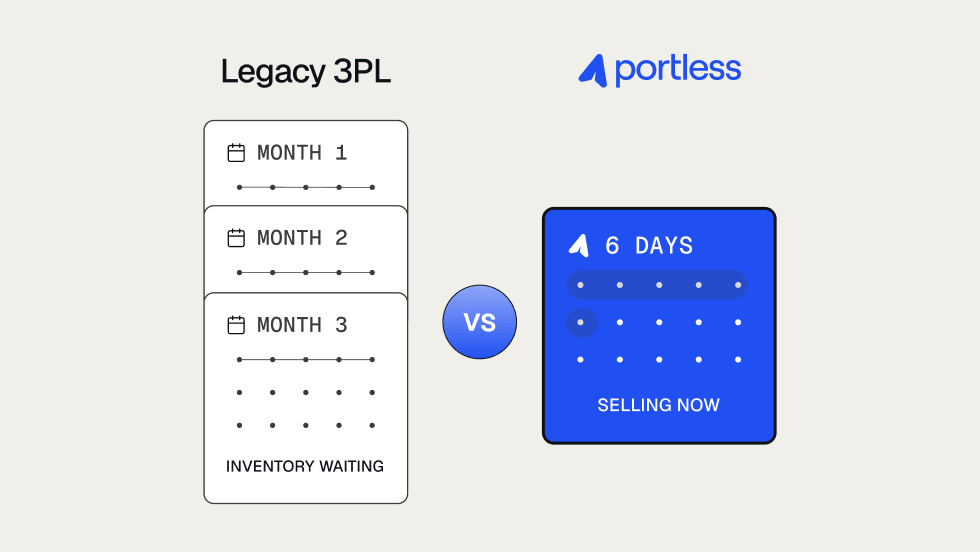
The deeper problem: EOQ optimizes for a supply chain that moves slowly. When lead time from PO to warehouse is 90–120 days via ocean freight, you have no choice but to order in large batches. Each PO is a six-figure bet on a demand forecast made months in advance.
That's why brands using sea freight to a domestic 3PL end up with EOQ outputs in the thousands of units. The formula isn't wrong — it's just optimizing within a broken model. The real fix isn't a better EOQ. It's a faster supply chain that makes smaller, more frequent orders economically viable.
This is the operating model SHEIN and Temu built their businesses on: micro-batch production, weekly replenishment cycles, and direct fulfillment that compresses the time between paying for goods and selling them.
When EOQ is still useful
EOQ isn't useless. It's a reasonable starting point when:
- Demand is genuinely stable (think replenishable consumables, not fashion)
- You're working with a minimum order quantity (MOQ) and want to validate it against your cost structure
- You need a defensible reorder size for finance or operations planning
- You're modeling the cost of switching from large bulk orders to smaller, more frequent ones
Treat EOQ as a diagnostic, not a prescription. If your calculated EOQ requires you to commit $50,000 of working capital to a single SKU, the right answer often isn't "order that much." The right answer is to redesign the supply chain so smaller orders make economic sense.
A better question than "what's my EOQ"
Instead of asking "what's the optimal order size given my current cost structure," ask: "what would it take to order smaller batches more often without increasing total cost?"
That's a supply chain design question, not an inventory math question. The answer usually involves:
- Compressing lead time from months to weeks
- Reducing the fixed cost per PO by removing freight forwarders and 3PL receiving fees
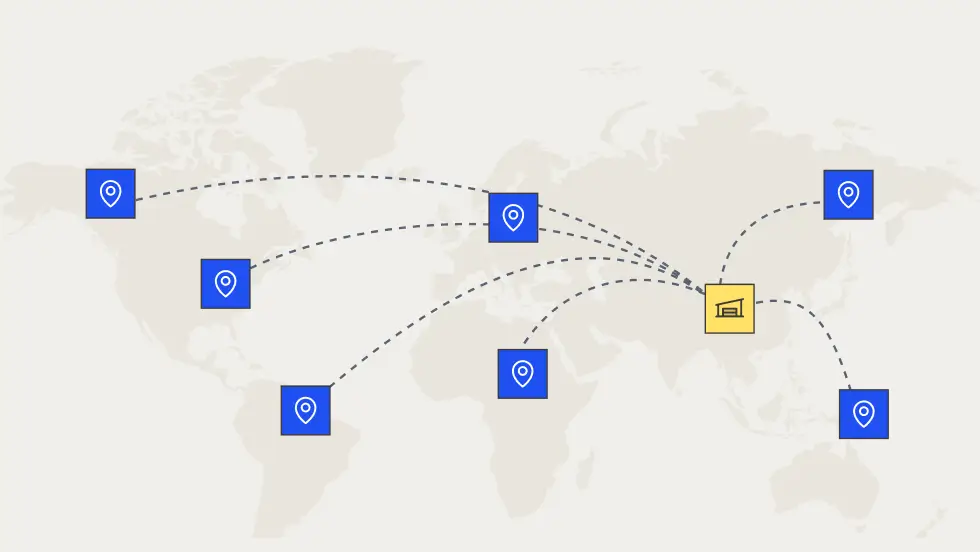
- Shipping orders directly from the point of manufacture instead of pre-positioning bulk inventory
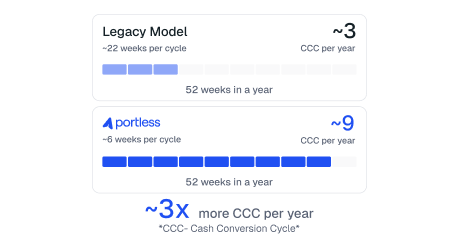
- Shortening the cash conversion cycle (CCC) so capital recycles faster
When you can replenish in two-week cycles instead of two-quarter cycles, EOQ stops being the constraint. Demand signal becomes the constraint, which is where it should be.
How Portless changes the EOQ equation for DTC brands
EOQ rewards brands that can place small, frequent orders without paying a premium for each one. That's exactly what direct fulfillment from the point of manufacture enables — orders ship from factory-adjacent hubs in Asia directly to customers in 85+ countries, in five to eight days, without the bulk freight and domestic warehousing that force legacy brands into oversized POs. The result: smaller batches, less inventory risk, and capital that recycles in days instead of months. Contact us to see how the math changes.
← Back to the Ecommerce supply chain glossary