"We generated $70K in package protection revenue in a single quarter by adding a simple $4 protection option at checkout — plus an additional $12K from cashbacks. Customers get peace of mind, and we're making a profit on every protected order with zero effort."
"We generated $70K in package protection revenue in a single quarter by adding a simple $4 protection option at checkout — plus an additional $12K from cashbacks. Customers get peace of mind, and we're making a profit on every protected order with zero effort."
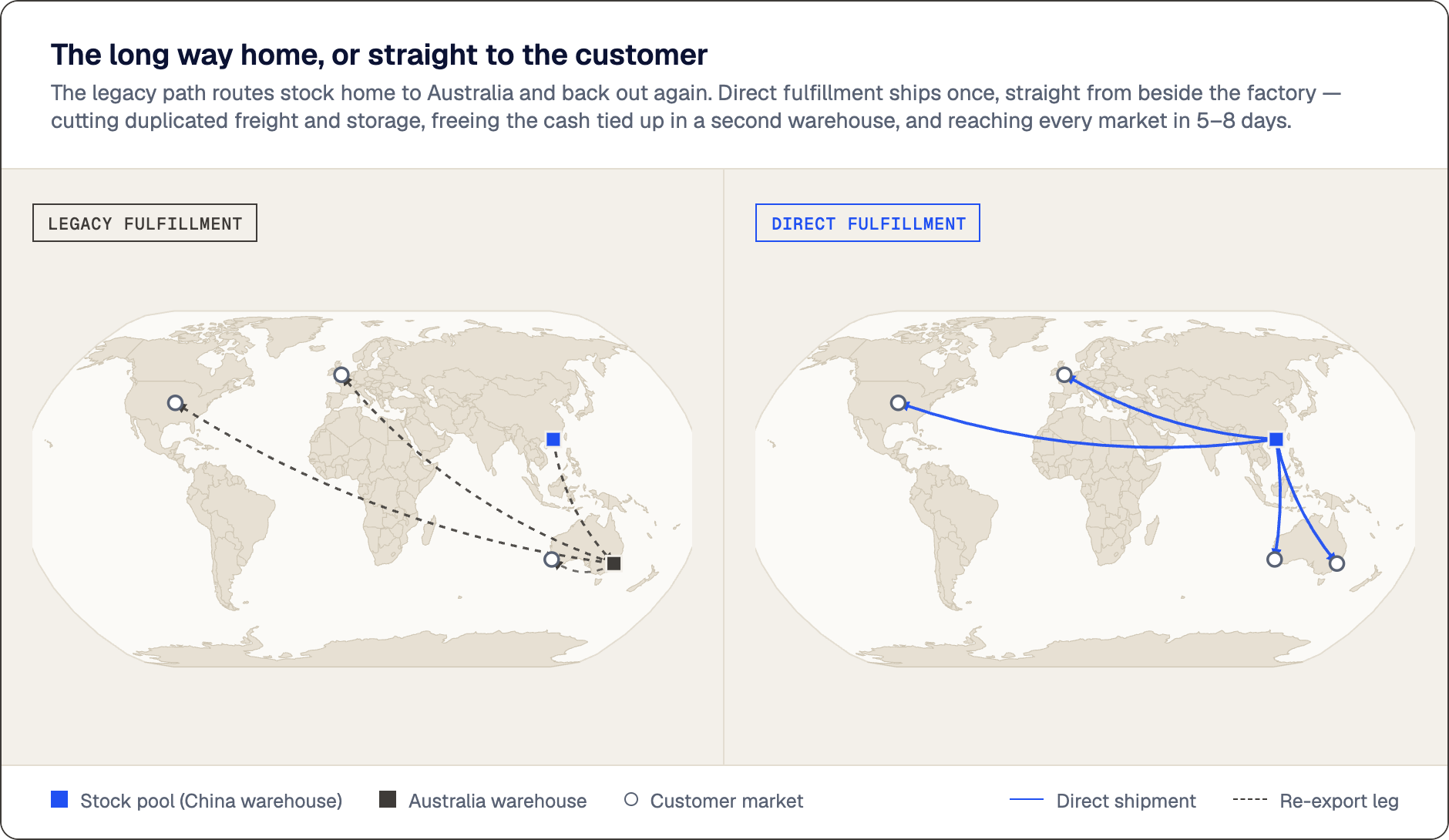
Australian brands carry a fulfillment burden most of their competitors never think about. They manufacture in China or other parts of Asia, ship the goods thousands of miles home to Australia, then ship many of them back out again to customers in the US and the rest of the world. The same units get handled, stored, and freighted twice. Add a home market small enough that most Australian brands expand overseas early, and a country so spread out that sending a parcel across it can cost more than shipping between two east-coast capitals, and fulfillment quietly eats more margin and more time for Australian brands than for almost anyone.
That's why direct fulfillment fits Australian brands better than almost any market in the world. This guide covers why, how the model works, the options available to you, and what to look for in a partner.
Why is Ecommerce fulfillment so hard for Australian brands?
Three structural realities make fulfillment harder for Australian brands than for most.
You manufacture far from home. Most Australian DTC brands produce in China. The traditional path sends that inventory home to an Australian warehouse first, then back out to overseas customers, so you pay to freight and store the same goods twice. Routing through a domestic hub can even mean paying import handling on units that were always destined to leave again.
Your customers are spread across a vast country. Australia has a small population scattered across a continent. Domestic delivery is slow and priced by distance, so serving the whole country from one local warehouse is expensive by design.
Your home market is small, so you go global early. Australian brands hit the ceiling of domestic demand faster than US or UK brands, and expansion into the US, UK, and beyond usually comes early in the growth curve. That makes multi-market fulfillment something they confront on day one, well before a US or UK brand would.
"Running an online business from Perth and fulfilling from Perth makes no logistical sense at all. We're sending products halfway across the world and then across the other side of the country." — Ryan De Gennaro, founder, Privacy Clo
What are the fulfillment options for Australian brands?
Australian brands generally choose between three models. Each one handles the manufacture-in-China, sell-everywhere reality differently.
::table
Model;Where inventory sits;Cash tied up upfront;Serving multiple markets
Local warehouse and export per order;An Australian 3PL or your own space;High, months of stock bought ahead;Slow and costly, every export ships from Australia
Freight to an overseas 3PL;A US or other in-market warehouse;High, and duplicated per market;Each market needs its own stock pool and forecast
Direct fulfillment;One pool near your factory in China;Low, you replenish as you sell;One pool ships direct to every market
:table
The first two models both force you to commit cash to inventory months ahead and lock that stock into one location. Direct fulfillment is the only one of the three built around Australian brands' actual geography.
What is direct fulfillment?
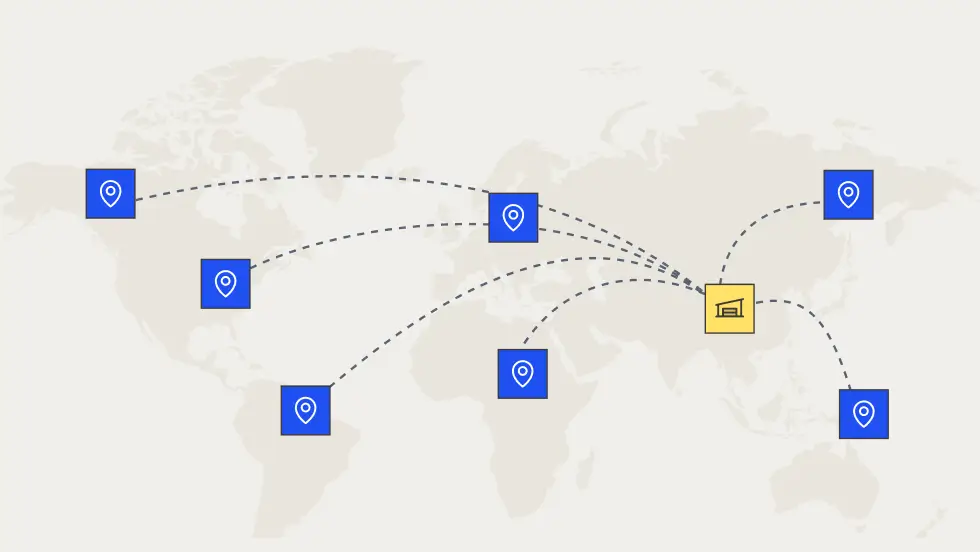
Direct fulfillment holds your inventory near your factory, typically in China, and ships orders straight to each customer by air. It skips the sea-freight-and-domestic-warehouse step entirely. One stock pool serves every market, so an Australian order and a US order draw from the same shelf and ship direct to the shopper's door in Australia, the US, or more than 85 other countries.
A direct fulfillment order typically reaches a customer in Australia, the US, Canada, the UK, or the EU in five to eight days. You aren't pre-buying and warehousing months of stock before you've sold a single unit, and you aren't forecasting each market separately. For the full mechanics, see our guide to direct fulfillment 101.
Why do Australian brands benefit from direct fulfillment more than most?
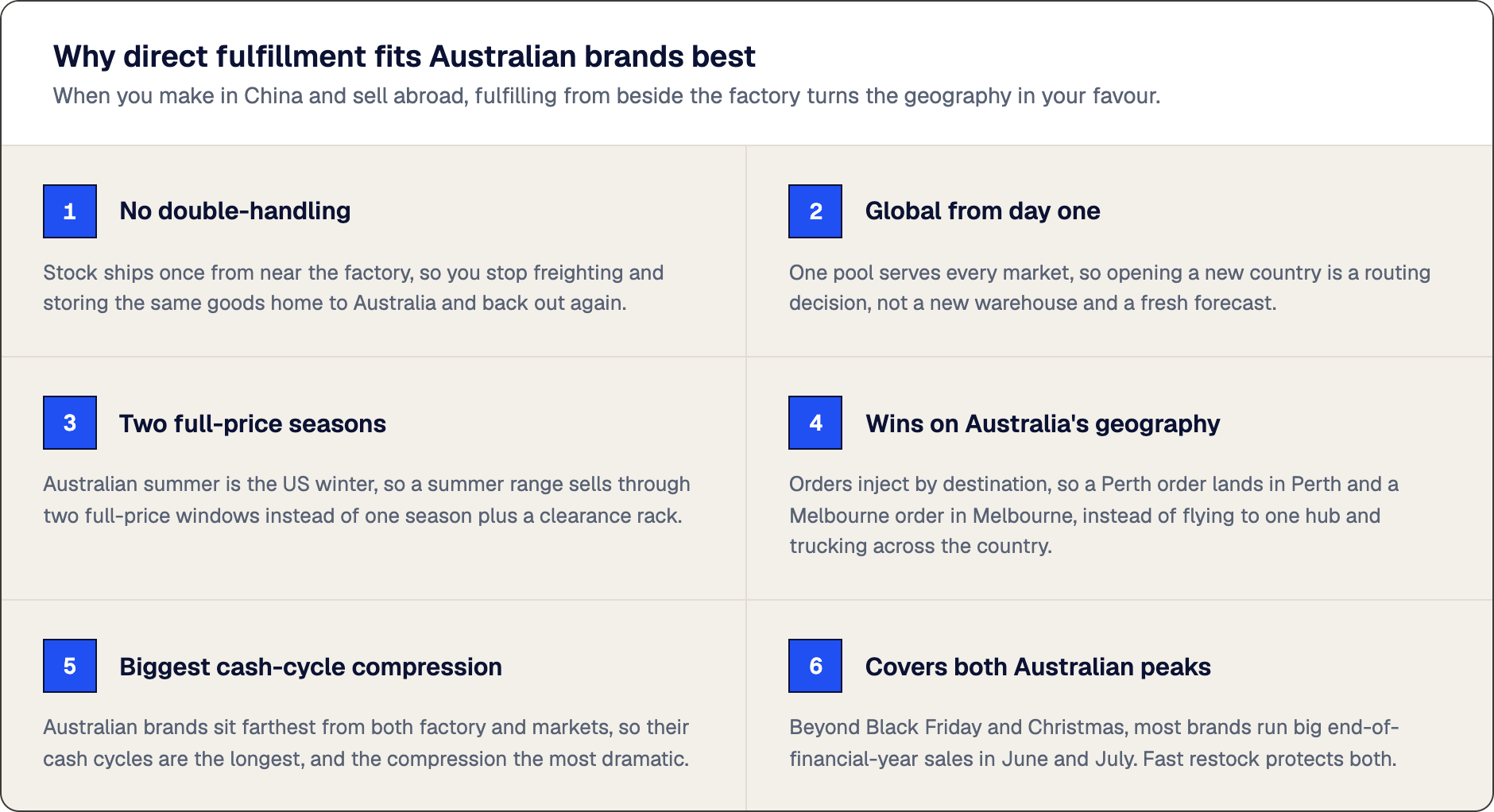
Every structural disadvantage above flips into an advantage once you fulfill from beside the factory. Seven reasons stand out.
It removes the double-handling. Because inventory ships once, straight from near the factory, you stop paying to send goods home to Australia and back out to the world. For brands that make in China and sell abroad, that erases an entire freight-and-storage leg and the duplicated costs that come with it.
One stock pool makes you global from day one. A single pool serves every market, so opening a new country becomes a routing decision rather than a new warehouse and a fresh forecast. (Privacy Clo went from roughly 90% Australian revenue to selling into 17 new countries after the switch.)
The seasonal inversion becomes two full-price seasons. Australian summer is the US winter, so a summer range peaks in Australia from December to February, then the same styles sell into the US summer from around May. With one pool feeding both, that range sells through two full-price windows a year instead of one season plus a clearance rack. Industry estimates put unsold apparel at roughly 20 to 30% of inventory each season, so a second full-price home for that stock protects real margin.
It beats domestic delivery on Australia's own geography. Instead of flying stock to one Australian warehouse and trucking it across the country, orders inject by destination. A Melbourne order lands in Melbourne, a Perth order in Perth, on one international flight rather than an international leg plus a domestic one. That is often faster and cheaper than fulfilling Australia from inside Australia.
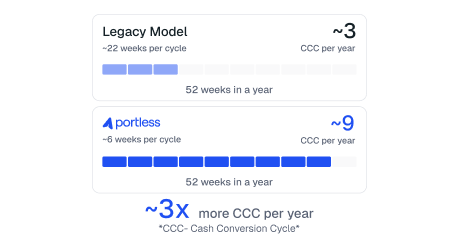
It compresses the cash conversion cycle the most. Australian brands sit far from both their factories and their export markets, so their sea-freight cash cycles are among the longest anywhere, which means the compression is the most dramatic. (Craft Club tripled its growth after moving to direct fulfillment, matching a 3x drop in its cash conversion cycle. memobottle cut a 120-day cash cycle to near immediate and consolidated six global warehouses into one.)
It covers both Australian peaks. Australian brands run two big demand spikes a year. Beyond Black Friday and Christmas, most run large end-of-financial-year sales in June and July. Fulfillment that can flex to a fast restock protects both.
What results have Australian brands seen?
Australian brands are among Portless's clearest proof points, precisely because the model solves so much of their specific problem.
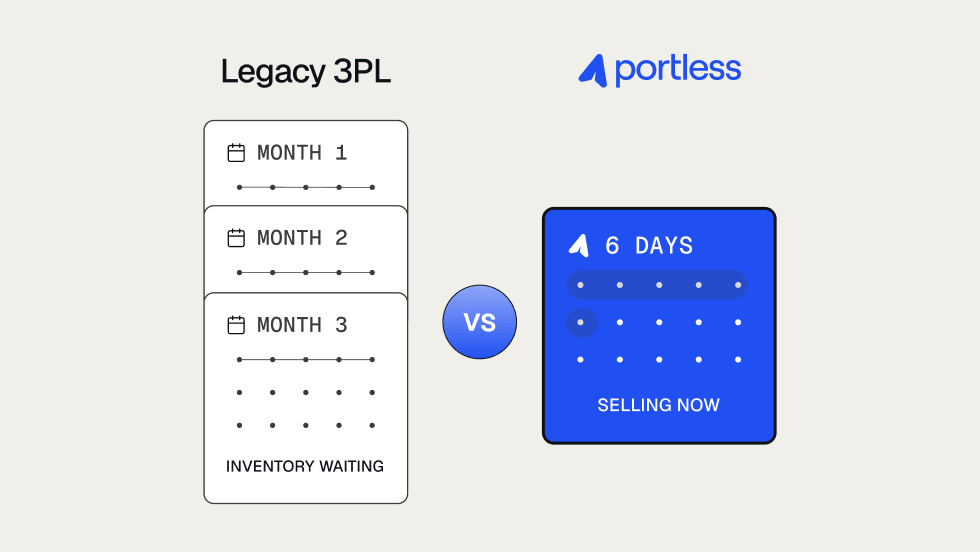
Privacy Clo cut inventory inbounding from 90 days on sea freight to sellable within 24 hours, and opened 17 new markets from a single stock pool.
Craft Club tripled its growth, matching a 3x drop in its cash conversion cycle, and moved from constant stockouts to reliably in stock.
memobottle consolidated six global warehouses into one and turned a 120-day cash cycle into a near-immediate one.
What should Australian brands look for in a fulfillment partner?
Judge a partner on whether it can serve every market from one stock pool, not only on headline rates. Four criteria matter most.
Customs and duty handling. The partner should clear and pay duties as orders ship, rather than locking up capital in upfront import costs.
Delivery speed to both home and export markets. Confirm transit times to Australia and to your export markets, not one or the other. Direct fulfillment should land both in roughly five to eight days.
Minimum order volumes. Check that the minimum order quantity and per-order economics fit your run sizes.
Platform integration. Orders should flow automatically from your Shopify or other store into the partner's system, with tracking synced back.
Serve every market from one stock pool
Australian brands don't have a demand problem. They have a fulfillment model that makes them pay for their own geography. Making in China, warehousing at home, and re-exporting to the world ships and stores the same stock twice, ties up cash for months, and traps inventory in the wrong hemisphere. Direct fulfillment holds it in one place and points it at whichever market is buying. If you're an Australian brand selling at home and abroad, book a demo and we'll map a direct fulfillment model against your current setup.
FAQ
What is Ecommerce fulfillment for Australian brands?
It's how an Australian brand stores inventory and gets orders to customers at home and overseas. You can warehouse stock locally and export per order, freight stock to an overseas 3PL, or use direct fulfillment to ship straight from a fulfillment center near the factory to shoppers in every market. The last option lets one stock pool serve every country you sell in.
Why is fulfillment more expensive for Australian brands?
Australian brands usually manufacture in China, warehouse at home, and sell to customers spread across a large country and overseas. That means paying to freight and store goods more than once, holding months of inventory, and covering high distance-based domestic delivery. Direct fulfillment removes the extra legs by shipping once from near the factory.
How does the Australia-US seasonal inversion help apparel brands?
Australia and the US run six months apart, so a summer range that peaks in Australia from December to February can sell into the US summer from May to August. The same stock gets two full-price selling windows instead of one, which cuts end-of-season markdowns.
Is direct fulfillment the same as dropshipping?
No. Direct fulfillment ships your own branded inventory, held near your factory, straight to the customer. Dropshipping ships a third party's generic products you never own. With direct fulfillment you keep brand control, custom packaging, and quality standards.
How fast can direct fulfillment deliver to Australian and overseas customers?
A direct fulfillment order typically reaches a customer in Australia, the US, Canada, the UK, or the EU in five to eight days, shipped from a fulfillment center near the factory in China. Portless ships to more than 85 countries this way.
What should Australian brands look for in a fulfillment partner?
Check customs and duty handling, delivery speed to both Australia and your export markets, minimum order volumes, and store-platform integration. For selling into multiple markets, the partner should let you serve them all from a single stock pool.
Frequently asked questions
Heading
Lorem ipsum dolor sit amet, consectetur adipiscing elit. Suspendisse varius enim in eros elementum tristique. Duis cursus, mi quis viverra ornare, eros dolor interdum nulla, ut commodo diam libero vitae erat. Aenean faucibus nibh et justo cursus id rutrum lorem imperdiet. Nunc ut sem vitae risus tristique posuere.
Get operator-level supply chain insights
Thank you! Your submission has been received!
Oops! Something went wrong while submitting the form.






%20(1).avif)

.jpg)
.jpg)
.jpg)