“We generated $70K in package protection revenue in a single quarter by adding a simple $4 protection option at checkout — plus an additional $12K from cashbacks. Customers get peace of mind, and we're making a profit on every protected order with zero effort."
“We generated $70K in package protection revenue in a single quarter by adding a simple $4 protection option at checkout — plus an additional $12K from cashbacks. Customers get peace of mind, and we're making a profit on every protected order with zero effort."
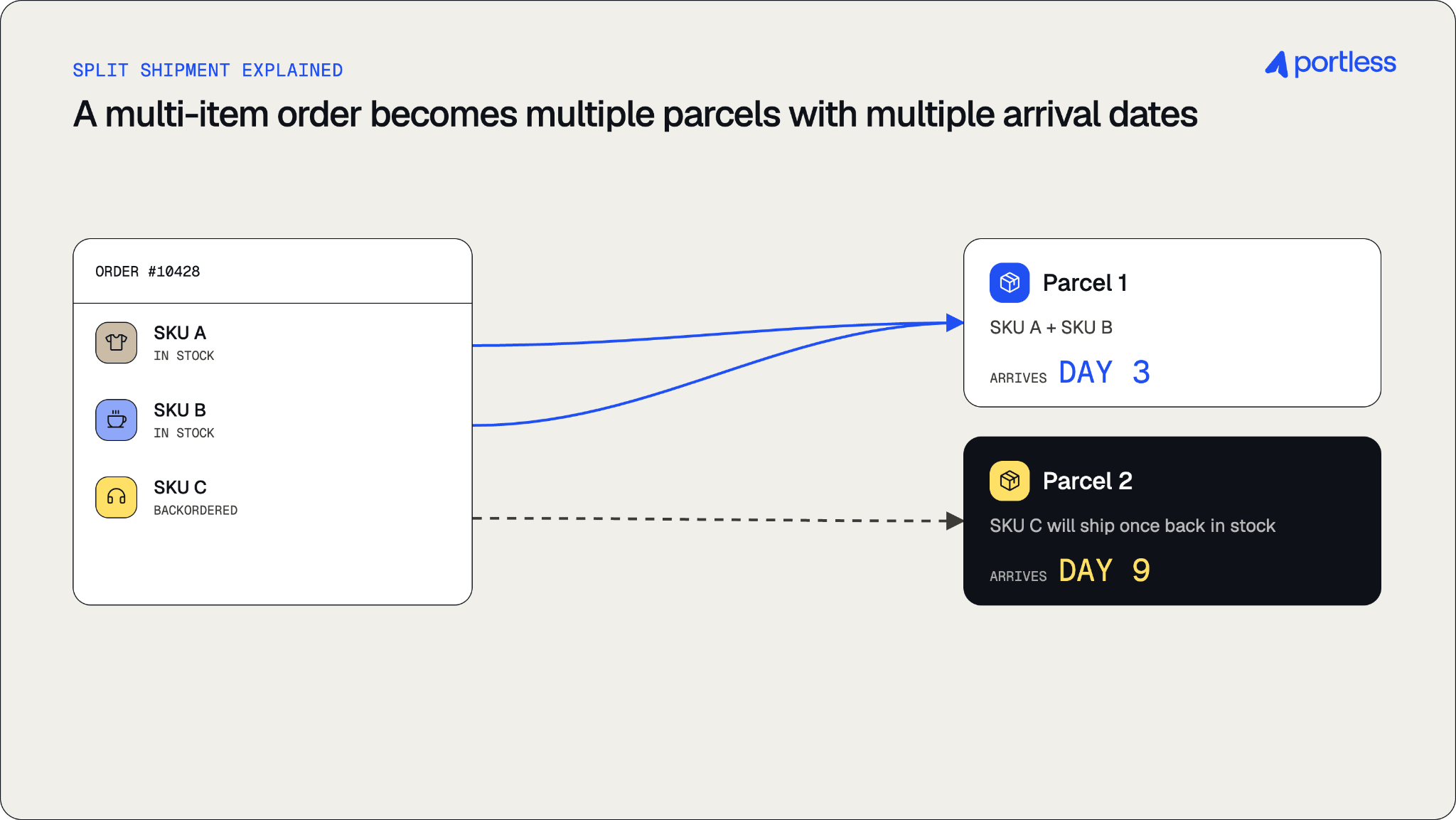
A customer orders three items on Monday. Two arrive Thursday. The third turns up nine days later in a second box, with a second tracking number. Nobody warned them, so they open a ticket asking where the rest of their order went.
That's a split shipment. Most guides treat it as a defect to eliminate, and often that's right. But some orders should be split deliberately, and telling those two cases apart is the difference between a fulfillment problem and a fulfillment decision.
What is a split shipment?
A split shipment is one customer order that ships in two or more separate deliveries, each with its own package and tracking number. It also goes by partial shipment, which is what most order statuses call it.
The order doesn't change. Your customer paid once, at one checkout, for one basket. What changes is the number of parcels that basket travels in, and the number of dates your customer has to track.
Splits happen at the fulfillment layer, not the order layer. Your order system still holds one record. Your warehouse creates two shipment records against it, and your customer gets two emails about it.
Split shipment vs. split shipping
These two terms get swapped often enough to muddy both. A split shipment is one order arriving in more than one parcel, decided by where your inventory sits.
Split shipping is a checkout setting. It lets a shopper pick a separate shipping method for each part of an order, or send parts of one order to different addresses. The first is an operational outcome. The second is a control that shows the shopper that outcome before they pay.
What causes a split shipment
If you run one warehouse, splits come from stock you don't have. If you run several, they come from stock in the wrong place. Either way, the cause sits in your inventory rather than in your checkout.
The order mixes in-stock, pre-order, and backordered items
A basket that mixes available and unavailable stock splits by default in most order management systems. Pre-order items, subscription items, and items assigned to different shipping profiles all trigger it.
This is the split your merchandising creates. Put a pre-order SKU on the same collection page as your bestsellers and you've guaranteed mixed baskets.
Your inventory sits in more than one location
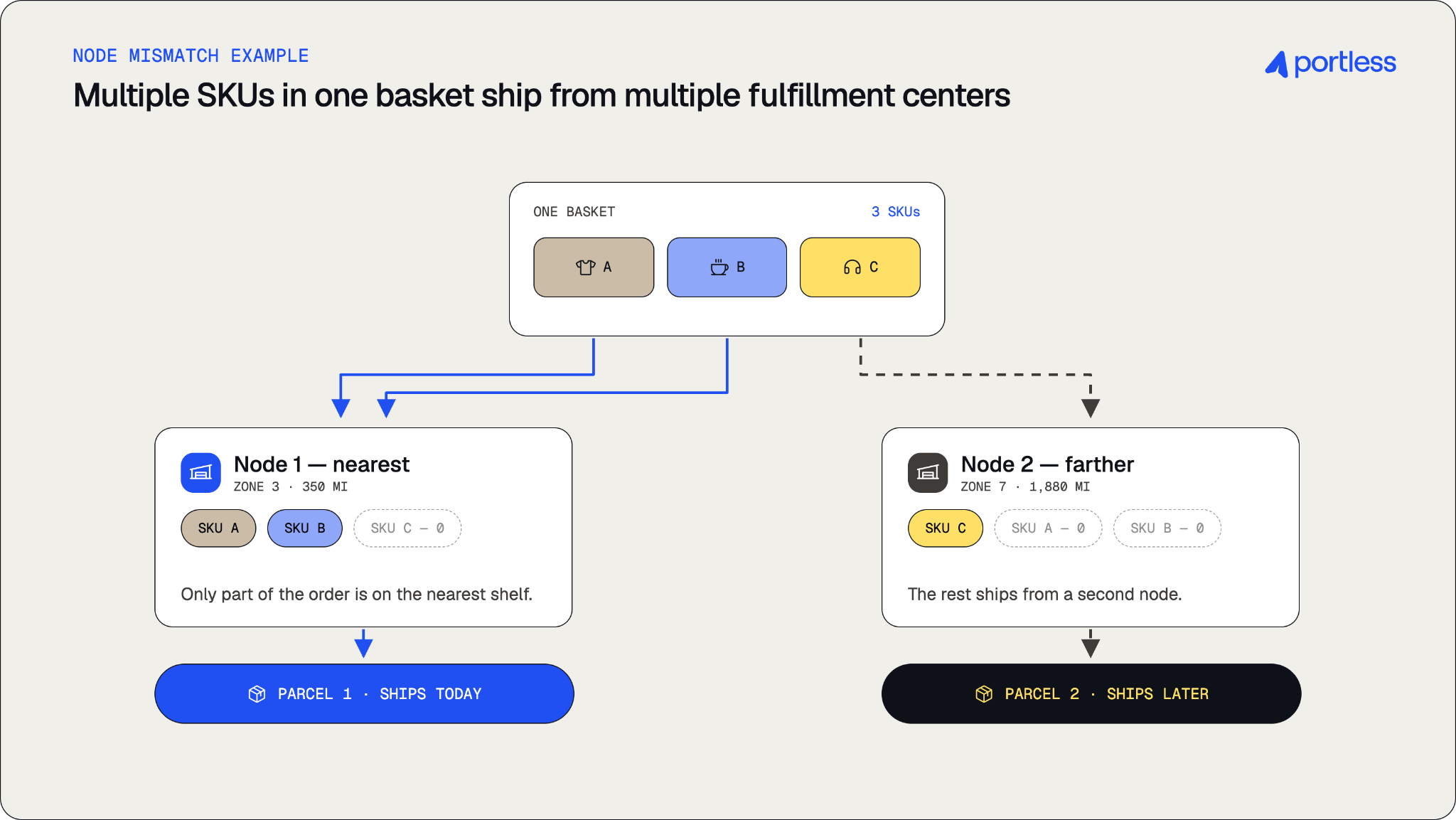
Multi-node fulfillment is the largest single cause of split shipments. When you hold stock across two or three Ecommerce fulfillment centers, any basket touching SKUs in different nodes ships from each node separately.
Distributed inventory buys you shorter final-mile zones, and it thins the stock in each node. The more nodes you add, the more often a multi-item order finds only part of itself on the nearest shelf.
The items can't physically or legally travel together
Oversized items, aerosols, liquids past carrier volume limits, and lithium batteries all carry packing rules that force a second parcel or a second carrier. These splits aren't negotiable, and they're the smallest slice of the problem.
The customer is sending one order to more than one address
Multi-address orders are split shipments your customer asked for, and they spike in Q4. Report them separately. The customer already knows what to expect and won't open a ticket about it.
::table
Cause;What your customer sees;Who controls it
Pre-order or backorder in the basket;An order stuck at "partially shipped";You, through catalog and checkout rules
Stock split across fulfillment nodes;Two tracking numbers, often days apart;You, through inventory placement
Carrier or packing restrictions;A separate parcel, sometimes a different carrier;The carrier
Item too large for one box;Several boxes, usually the same day;Product dimensions
Multiple delivery addresses;Exactly what they chose at checkout;Your customer
:table
What split shipments cost you
Every extra parcel adds a full round of pick, pack, box, label, and carrier minimum. The second parcel carries its own base rate and its own dimensional weight calculation, which puts the marginal cost of a split closer to a second order than to a rounding error.
That cost lands somewhere. You either absorb it against margin or pass it to the customer, and passing it along runs into the reason most carts fail. Baymard Institute puts the documented average cart abandonment rate at 70.22% across 50 studies, with 40% of abandoning shoppers naming extra costs like shipping, tax, and fees.
The experience cost is harder to see on a P&L and it's larger. AlixPartners' 2026 Home Delivery Survey found 94% of US consumers say free shipping affects their purchase decisions, and that shoppers now expect free delivery in an average of 2.7 days. More than 85% said a poor delivery experience makes them less likely to buy again.
A split order misses that expectation twice, and in the gap your customer contacts support. Unplanned splits are a reliable driver of Where is my order? (WISMO) volume, which is why branded tracking cuts WISMO tickets faster than adding headcount. If you're auditing where parcel spend leaks, splits belong on the list next to the other common mistakes that increase carrier costs.
When you would want to split a shipment on purpose
Split an order deliberately when holding it back costs more than splitting it. That's the rule. If one line item will drag the whole basket past the delivery date you promised, splitting protects that promise for everything else in it.
Part of the order is ready and part is on pre-order
Ship what's in stock and let the pre-order follow. Holding a full basket for a SKU that lands in six weeks turns a good order into a six-week wait and invites a cancellation. Say it at checkout, not at fulfillment. A shopper who sees "arrives separately" before paying won't open a ticket about it later.
One SKU is made to order or on a long lead time
Custom, personalized, and made-to-order items should ship on their own clock. Engraving and made-to-measure work adds days that have nothing to do with the rest of the basket, and coupling them slows every other item to the pace of the slowest one. Brands running made-to-order Ecommerce build the split into the model.
The basket mixes a small parcel item with a bulky or freight item
Splitting by parcel class beats shipping to the largest item. Put a 40-pound item and a pair of socks in one box and you pay freight-class handling on the socks. Two parcels, correctly rated, usually cost less than one oversized one, and the small item reaches your customer days earlier.
You're shipping internationally and the items travel different routes
Cross-border baskets split when items move under different routes, methods, or documentation. Some SKUs qualify for air and some don't. Some carriers serve a destination that others don't. Splitting along those lines keeps the eligible portion moving instead of parking the whole basket behind one line item.
It's peak season and the delivery date is the product
In Q4 the date carries more weight than the parcel count. A gift that arrives on the 22nd in two boxes beats a complete order arriving on the 27th. Peak is the one window where a customer forgives a second parcel and won't forgive a missed date.
Your customer asked for it
Offer the split as a choice and it stops being a service failure. Most checkouts can present shipping options per shipment, which puts the tradeoff in the shopper's hands. Some will pay for speed on one item and wait on the rest.
::table
Situation;Default call;Why
Second item lands within 24 to 48 hours;Hold;One parcel, one arrival, no extra cost
Second item is on pre-order or backorder;Split;A long hold turns into a cancellation
One SKU is made to order or personalized;Split;Custom work shouldn't gate stock items
Basket mixes parcel and freight-class items;Split;Rating each parcel correctly costs less
Peak season, promised date at risk;Split;The date matters more than the parcel count
Customer selected multiple addresses;Split;Your customer already chose it
Split caused only by node mismatch;Fix upstream;This is an inventory placement problem
:table
How to cut the split shipments you don't want
Unwanted splits are an inventory problem wearing a checkout costume. Better messaging softens the customer impact. The volume only falls when the stock stops being in the wrong place.
Shorten the lead time that creates backorders
Backorder splits are lead time splits. When replenishment takes 60 to 90 days by ocean, stockouts are frequent and long, and every stockout on a popular SKU turns co-purchases into split orders. Cutting inventory lead time reduces how often a basket contains something you can't ship today.
Fix inventory position before you fix checkout logic
Look at which SKU pairs appear in the same basket most often, then check whether those SKUs are stocked together. If your top 10 co-purchased pairs sit in different warehouses, you've found your split rate. Rethinking where your 3PL inventory sits moves the number further than any checkout rule will. Poor inventory placement is rarely the only culprit. It's one of several common 3PL problems that quietly inflate your split rate.
Make the split a choice at checkout, and say it in the confirmation
Give shoppers the option and most splits stop generating tickets. Present the tradeoff plainly: everything together on a later date, or the available items now and the rest to follow. Then repeat it in the confirmation email, with its own estimated date. By the time a customer reads a shipping notice listing two of their three items, they've already assumed the order arrives once.
Track your split rate as a metric
Define split rate as the share of orders shipping in more than one parcel, and review it monthly against parcel spend. Break it into two lines: splits your customer chose, and splits your operation caused. Only the second line carries a target. Most teams find the causal number sits well above what they assumed before they measured it.
Where the split rate goes when everything ships from one origin
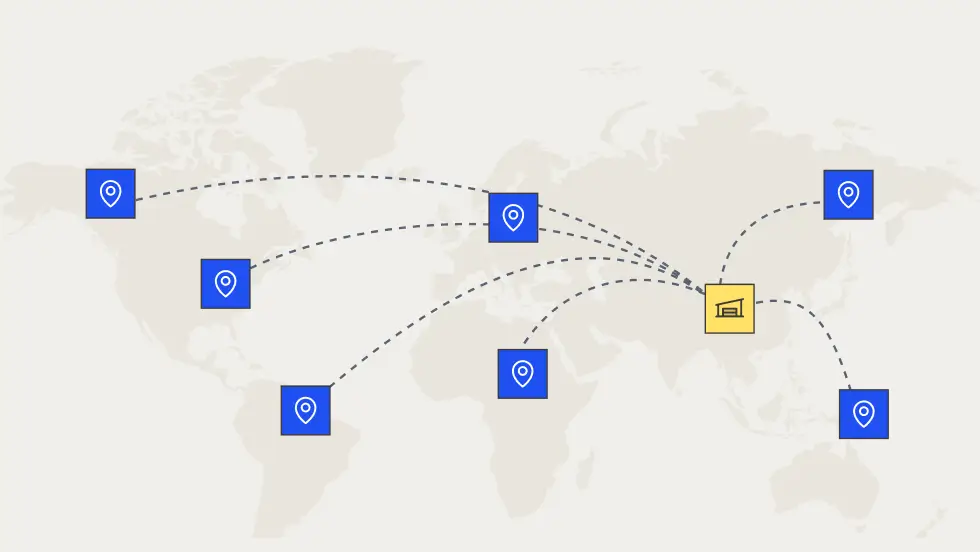
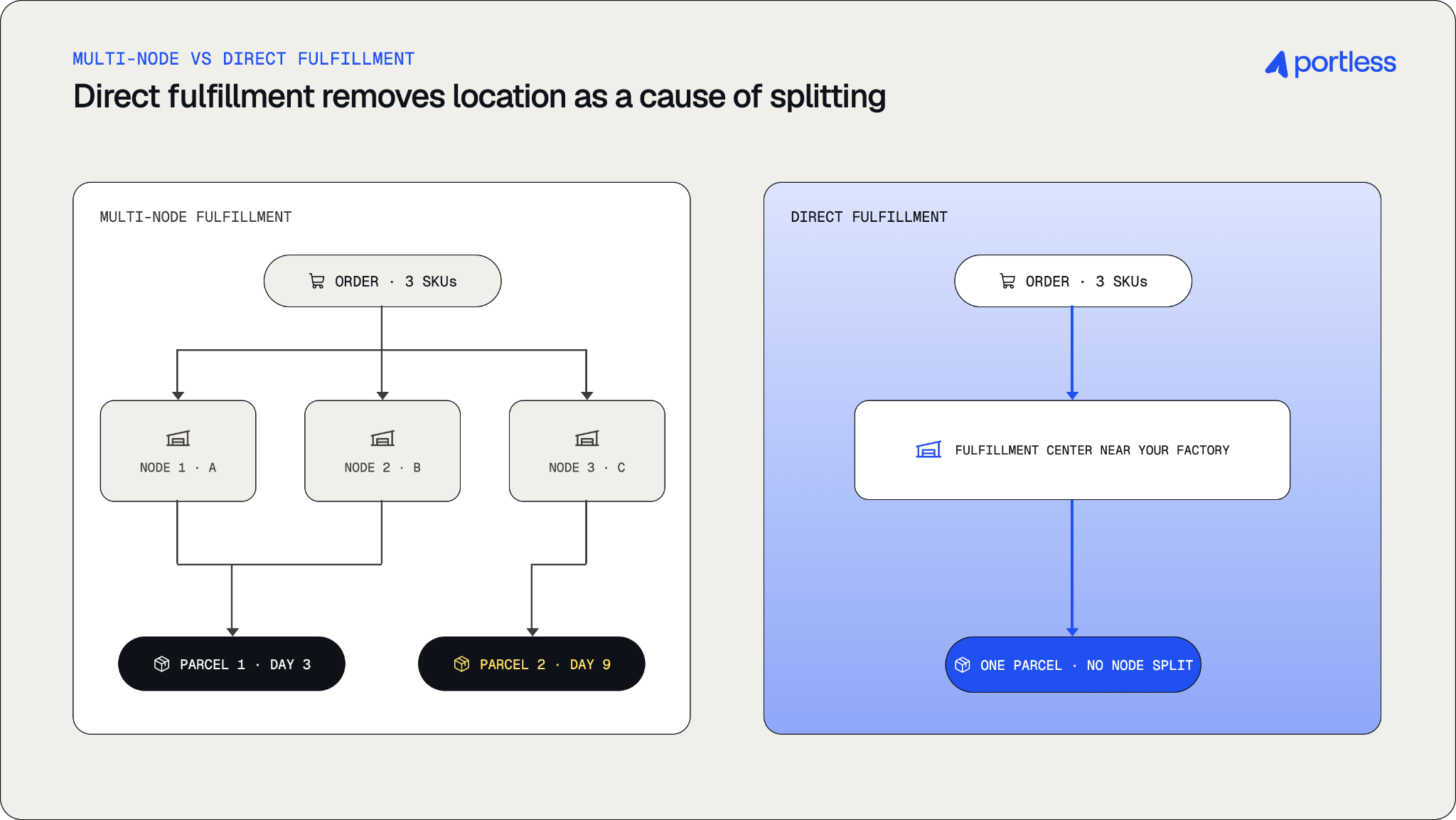
When every SKU ships from a single origin point, the largest cause of split shipments disappears. There's no second node for an item to sit in, so a basket either ships complete or it's waiting on production rather than on geography.
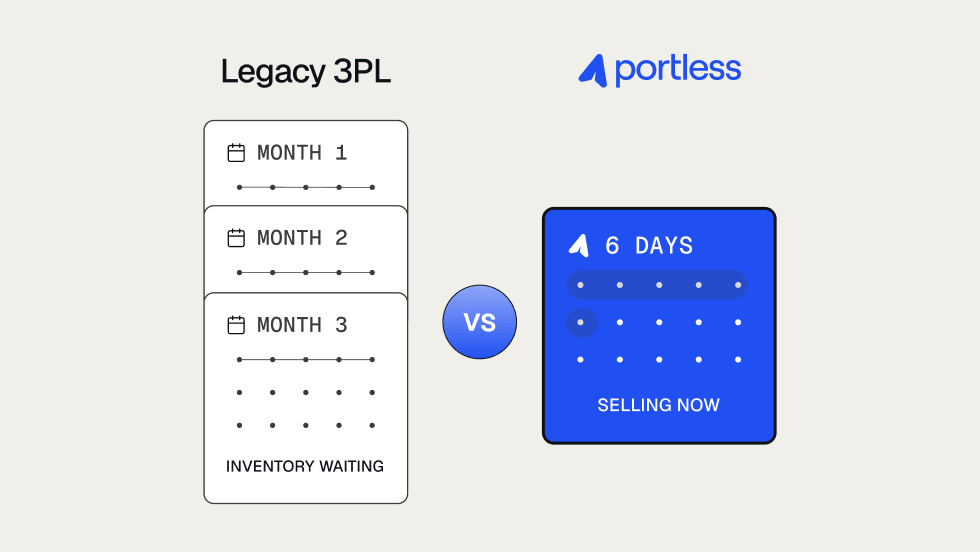
That's how direct fulfillment works. Inventory stays at the point of manufacture instead of being pushed into domestic warehouses months ahead of demand, and orders ship individually by air. Portless delivers in five to eight days to 85+ countries.
It doesn't remove every split. Carrier restrictions, oversized items, and multi-address orders still apply and always will. What it removes is the node mismatch split, which is the one that surprises customers, generates the tickets, and shows up as an unbudgeted second parcel on your carrier invoice.
See how Portless works
Split shipments are a symptom. If yours come mostly from stock scattered across warehouses, the durable fix is changing where the inventory sits. Another rule at checkout only hides the problem. Portless ships DTC orders directly from the point of manufacture, which removes the node mismatch behind most unplanned splits. To see what your split rate would look like under our model, request a demo.
FAQ
Can you turn off split shipments?
Not entirely. Your platform splits an order when the cart holds items it can't fulfill in one shipment, and no setting overrides that. What you control is what creates the condition: which SKUs share a shipping profile, where stock is allocated, and whether pre-order items sit alongside in-stock ones. Fix those and the splits stop being generated at all.
Do split shipments cost the customer more?
Not directly. Most brands charge shipping once at checkout, so the extra parcel lands on your margin. Your customer feels it later, through higher free-shipping thresholds and higher prices, because the cost has to be recovered somewhere.
Does splitting an order slow delivery down?
No. The available items arrive sooner than they would if you held the whole basket, and the delayed item arrives when it was always going to arrive. What changes is your customer's perception, which is why the split has to be disclosed before they pay rather than discovered in a tracking email.
What's the difference between a split shipment and a split delivery?
A split shipment divides one order into separate parcels, usually because of stock location. A split delivery is a scheduling arrangement, more common in B2B and wholesale, where an agreed quantity arrives across several dates. The first is reactive. The second is written into the order from the start.
Frequently asked questions
Heading
Lorem ipsum dolor sit amet, consectetur adipiscing elit. Suspendisse varius enim in eros elementum tristique. Duis cursus, mi quis viverra ornare, eros dolor interdum nulla, ut commodo diam libero vitae erat. Aenean faucibus nibh et justo cursus id rutrum lorem imperdiet. Nunc ut sem vitae risus tristique posuere.
Get operator-level supply chain insights
Thank you! Your submission has been received!
Oops! Something went wrong while submitting the form.







.jpg)

.avif)