You have built a product people want. Orders are climbing. But every time you look at your supply chain, you see the same problem: inventory sitting in a warehouse for weeks, cash locked up before a single package ships, and customers waiting longer than they should.
An Ecommerce fulfillment center is supposed to fix that. The pitch is simple: hand off storage, order processing, and shipping to a third party so you can focus on growth. But the model most brands default to — bulk manufacturing, ocean freight, domestic warehousing — comes with a hidden cost that does not show up on any pricing sheet.
This guide breaks down how Ecommerce fulfillment centers work, what they cost, how to choose one, and whether the legacy model is still the best option for your brand.
What is an Ecommerce fulfillment center?
An Ecommerce fulfillment center is a facility operated by a third-party logistics (3PL) provider that stores your inventory, processes customer orders, and ships products on your behalf. Unlike a basic warehouse that simply holds goods, a fulfillment center handles the full order lifecycle, from the moment a customer clicks "buy" to the moment the package lands on their doorstep.
The Ecommerce fulfillment services market was valued at over $123 billion in 2024, and it is growing fast. That growth tracks with the rise of online shopping itself: Ecommerce accounts for over 20% of worldwide retail sales, and global B2C Ecommerce revenue is expected to grow to $5.5 trillion by 2027.
For DTC (direct-to-consumer) brands, fulfillment centers promise to handle the operational side of Ecommerce shipping so you can focus on product and marketing. But the legacy fulfillment model comes with trade-offs that are worth understanding before you sign a contract. If you are already evaluating providers, our guide to assessing 3PL providers is a good starting point.
How does the Ecommerce fulfillment process work?
Most Ecommerce fulfillment centers follow the same core workflow. Here's what each step looks like operationally.
Receiving inventory
You ship bulk inventory, usually via ocean freight, to your fulfillment center. The facility logs each SKU into a warehouse management system (WMS), inspects for damage, and assigns storage locations. This step can take days or weeks depending on the provider's receiving queue.
Warehousing and inventory management
Your products sit in the fulfillment center until a customer orders them. The WMS tracks stock levels, locations, and reorder points. Good inventory management here is critical: stockouts mean lost sales, and overstocking ties up cash.
Pick and pack
When an order comes in, a warehouse worker (or automated system) picks the correct items from storage, packs them into shipping materials, and prepares the package for handoff to a carrier. Pick and pack speed directly affects how fast your customers get their orders.
Shipping
The fulfillment center hands the package to a carrier (USPS, UPS, FedEx, DHL, or a regional service) for last mile delivery. Many fulfillment centers negotiate bulk carrier rates, which can lower your per-shipment cost.
Returns management
When a customer sends a product back, the fulfillment center receives the return, inspects the item, restocks it if sellable, and updates your inventory. Returns management is often the most overlooked piece of order fulfillment — and one of the most expensive. Learn more about Ecommerce fulfillment risk and how to reduce it.
Here is a quick summary of the entire process:
::table
Step;What happens;Key metric
1. Receiving;Inventory arrives, gets inspected, logged into WMS;Time to shelf
2. Warehousing;Products stored, stock levels tracked;Inventory accuracy
3. Pick and pack;Items pulled, packed, labeled for shipping;Order accuracy and speed
4. Shipping;Package handed to carrier for delivery;Transit time and cost
5. Returns;Returned items received, inspected, restocked;Return processing time
:table
The average cart abandonment rate hovers around 70%, and slow or expensive shipping is one of the top reasons. Your fulfillment process directly affects your conversion rate. Research shows almost 90% of consumers are willing to wait up to three days for delivery, but not much longer, so speed is a real differentiator.
What is the difference between a fulfillment center and a warehouse?
People use these terms interchangeably, but they describe different operations. A warehouse stores goods. A fulfillment center stores goods and processes individual customer orders.
Here is a side-by-side comparison:
::table
Feature;Fulfillment center;Warehouse
1. Primary purpose;Process and ship individual orders;Store bulk inventory
2. Services;Receiving, pick and pack, shipping, returns;Receiving and storage
3. Technology;WMS with order management, carrier integration;Basic inventory tracking
4. Speed;Optimized for fast order turnaround;Not designed for speed
5. Cost model;Per-order and per-unit fees;Per-square-foot storage fees
6. Typical client;DTC Ecommerce brands;Wholesalers, retailers, manufacturers
:table
A distribution center sits somewhere in between. Distribution centers typically handle large-volume shipments to retail stores or regional hubs rather than individual consumer orders. If you are shipping directly to customers, a fulfillment center — not a warehouse or distribution center — is the standard model.
The real question is not “fulfillment center vs. warehouse.” It is whether you need to store inventory domestically at all. More on that below.
How much does an Ecommerce fulfillment center cost?
Pricing varies widely across 3PL providers, but the cost structure follows a predictable pattern. Here are the main fee types:
::table
Fee type;What it covers;What drives cost up
1. Storage fees;Monthly charge per pallet, shelf, or bin;More SKUs, larger items, longer storage time
2. Pick and pack fees;Per-order charge for pulling and packing items;Multi-item orders, custom packaging, kitting
3. Shipping fees;Carrier cost per package;Heavier packages, faster service, remote zones
4. Receiving fees;Charge for processing inbound inventory;Disorganized shipments, labeling requirements
5. Technology fees;WMS access, integrations, reporting;Custom integrations, API access
6. Returns processing;Per-return handling fee;High return rates, inspection requirements
:table
Most fulfillment centers do not publish flat-rate pricing. You will get a custom quote based on your order volume, SKU count, average order size, and shipping destinations.
When comparing quotes, ask about minimum order commitments, long-term storage surcharges, and peak-season rate increases. These hidden costs can add up fast.
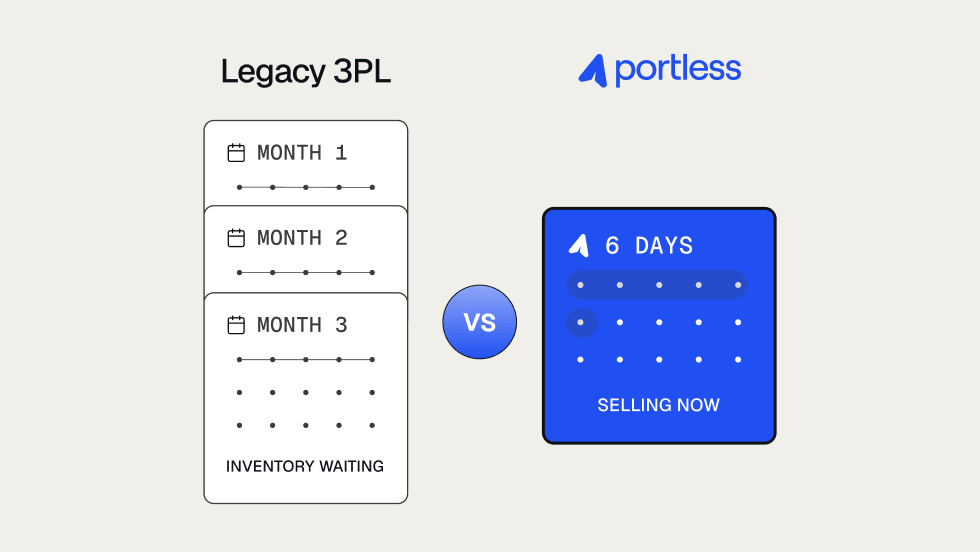
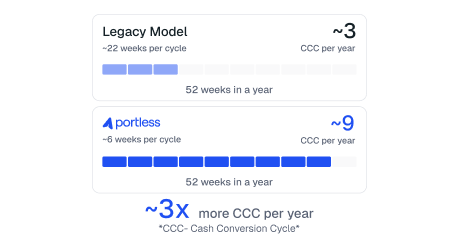
There is one cost that rarely shows up on a 3PL pricing sheet: capital tied up in inventory. This is what we call the DTC cash flow trap. The legacy fulfillment model requires you to manufacture products, ship them by ocean freight (four to eight weeks), warehouse them domestically, and then wait for orders. That means your cash is locked up in unsold inventory for months before you see a return.
The true cost of a fulfillment center is not just the fees you pay. It is the capital trapped in a slow, front-loaded supply chain.
How to choose the right Ecommerce fulfillment center
If you decide a fulfillment center is the right fit, here is what to evaluate:
- Location and shipping zone coverage. Where are your customers? A fulfillment center closer to your buyers means faster, cheaper shipping. If you sell internationally, ask how the provider handles cross-border orders
- Technology and integrations. Does the provider integrate with your Ecommerce platform (Shopify, WooCommerce, etc.)? A solid warehouse management system should sync orders, inventory, and tracking in real time
- Scalability. Can the provider handle your peak-season volume without delays? Ask about capacity limits and SLAs during high-demand periods
- Shipping speed commitments. What delivery windows can you promise your customers? Get specifics — not vague claims about “fast shipping”
- Returns handling. How does the provider process returns? What are the fees? How quickly do returned items get restocked?
- Pricing transparency. Ask for a full fee breakdown. Watch for hidden charges like account setup fees, minimum order requirements, and long-term storage penalties
- Customer support. When something goes wrong — and it will — how fast can you reach a real person?
Request references from brands similar to your size and product type. A 3PL that works well for large enterprise brands may not be the right fit for a growing DTC business. The best fulfillment center for your brand depends on where your customers are, how fast they expect delivery, and how much capital you can afford to lock up in inventory.
Direct fulfillment is the alternative to legacy fulfillment centers
The legacy Ecommerce fulfillment model follows a fixed pattern: manufacture in bulk, ship by ocean freight, warehouse domestically, then fulfill orders one by one. It works, but it is slow, capital-intensive, and hard to scale internationally.
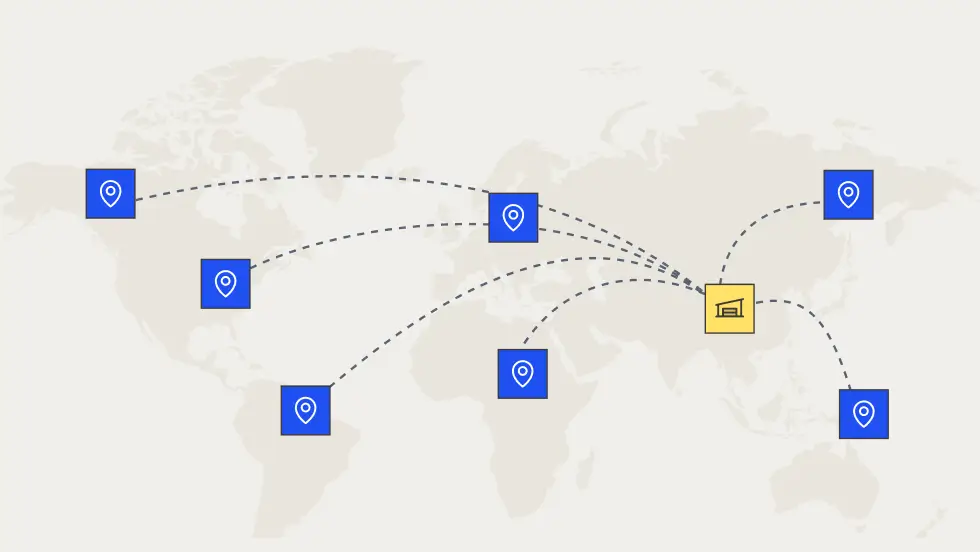
Direct fulfillment flips this model. Instead of shipping inventory to a domestic warehouse, products move from a fulfillment center in China — located close to your manufacturer — directly to the end customer. There is no ocean freight leg, no domestic warehouse, and no months of inventory sitting on shelves.
Here is how it works in practice:
- Your manufacturer sends finished goods to a Portless warehouse in China, located near the factory
- When a customer orders, Portless picks, packs, and ships directly to them via express air, skipping ocean freight and domestic warehouses
- You pay duties upfront through a Delivered Duty Paid (DDP) model, so your customer never sees a surprise customs charge
- You deliver in five to eight days, on par with domestic Ecommerce shipping speeds
This is the model companies like Shein and Temu built their supply chain around. Portless makes the same approach available to DTC brands of all sizes. You can read more about how direct fulfillment from China actually works inside our operations.
Here is what the Portless model does differently:
- Portless removes the ocean freight leg entirely. Products ship from Portless warehouses in China, close to your manufacturer, cutting out the four-to-eight-week cycle that slows legacy fulfillment
- Portless moves inventory into your sales cycle faster. Products can reach customers days after production, not months, because there is no domestic warehouse stage
- Portless ships to 85+ countries without requiring warehouse space in every market
- Portless integrates with your existing stack. The platform connects with Shopify, WooCommerce, and other major Ecommerce platforms
- Portless includes tracking and DDP on every order. Customers see shipment visibility and duties are paid upfront across supported markets
Direct fulfillment is not the right fit for every product or every brand. If you sell heavy, bulky items or need same-day delivery, a local fulfillment center still makes sense. But for DTC brands selling lightweight goods and looking to scale internationally without front-loading inventory costs, direct fulfillment is worth a serious look.
Use the Portless ROI calculator to see how direct fulfillment could affect your supply chain costs. Or try the landed cost calculator to estimate duties and shipping for specific products and destinations.
Escape the DTC cash flow trap
The legacy fulfillment model locks up your cash before a single order ships. You manufacture in bulk, pay for ocean freight, warehouse your inventory domestically, and wait, sometimes months, for the cycle to pay out. Every step adds time. Every step adds cost. And every dollar tied up in unsold inventory is a dollar you cannot put into product, marketing, or growth.
Direct fulfillment breaks that cycle. Products move from manufacturer to Portless warehouse to customer in days, not months. You only pay for what you sell. Your capital stays in the business instead of sitting on a shelf.
Get in touch with our team to see what your cash flow looks like on a direct fulfillment model.
FAQ
What is an Ecommerce fulfillment center?
An Ecommerce fulfillment center is a third-party facility that stores your inventory, processes individual customer orders (pick and pack), ships packages, and handles returns on your behalf. It differs from a warehouse, which only stores goods without managing the order lifecycle.
How is a fulfillment center different from a warehouse?
A fulfillment center handles the full order lifecycle — receiving inventory, picking and packing orders, shipping to customers, and processing returns. A warehouse stores goods in bulk but does not process individual consumer orders or manage shipping.
How much does Ecommerce fulfillment cost?
Costs depend on storage fees, pick and pack fees, shipping rates, receiving charges, technology fees, and returns processing. Most 3PL providers offer custom quotes based on your order volume, SKU count, and shipping destinations rather than flat-rate pricing.
What is direct fulfillment and how does it work?
Direct fulfillment ships products from a warehouse near the manufacturer directly to the end customer, bypassing domestic warehouses entirely. This model is designed to reduce lead times, free up working capital, and make international expansion possible without local warehouse infrastructure.
How long does it take for an Ecommerce fulfillment center to ship an order?
Most legacy fulfillment centers process and hand off orders to carriers within one to three business days. Actual delivery time depends on the carrier and shipping method. Direct fulfillment providers like Portless deliver in five to eight days from China to customer.
Do I need a fulfillment center if I sell internationally?
Not necessarily. Legacy fulfillment requires warehouses in each market you serve, which is expensive and complex to manage. Direct fulfillment models can reach 85+ countries from a single manufacturing origin, with duties handled upfront through a DDP model.







.jpg)
.jpg)
.jpg)