“We generated $70K in package protection revenue in a single quarter by adding a simple $4 protection option at checkout — plus an additional $12K from cashbacks. Customers get peace of mind, and we're making a profit on every protected order with zero effort."
“We generated $70K in package protection revenue in a single quarter by adding a simple $4 protection option at checkout — plus an additional $12K from cashbacks. Customers get peace of mind, and we're making a profit on every protected order with zero effort."
A customer in Germany orders a $90 jacket from your store. Before it reaches her, someone declares it leaving China, someone else clears it into the EU and pays the duty, and someone else collects the VAT she owes.
Each of those jobs belongs to a different legal role. In this article, we’ll break down all three — the exporter of record, the importer of record, and the merchant of record — and what each one is responsible for.
What's the difference between EOR, IOR, and MOR?
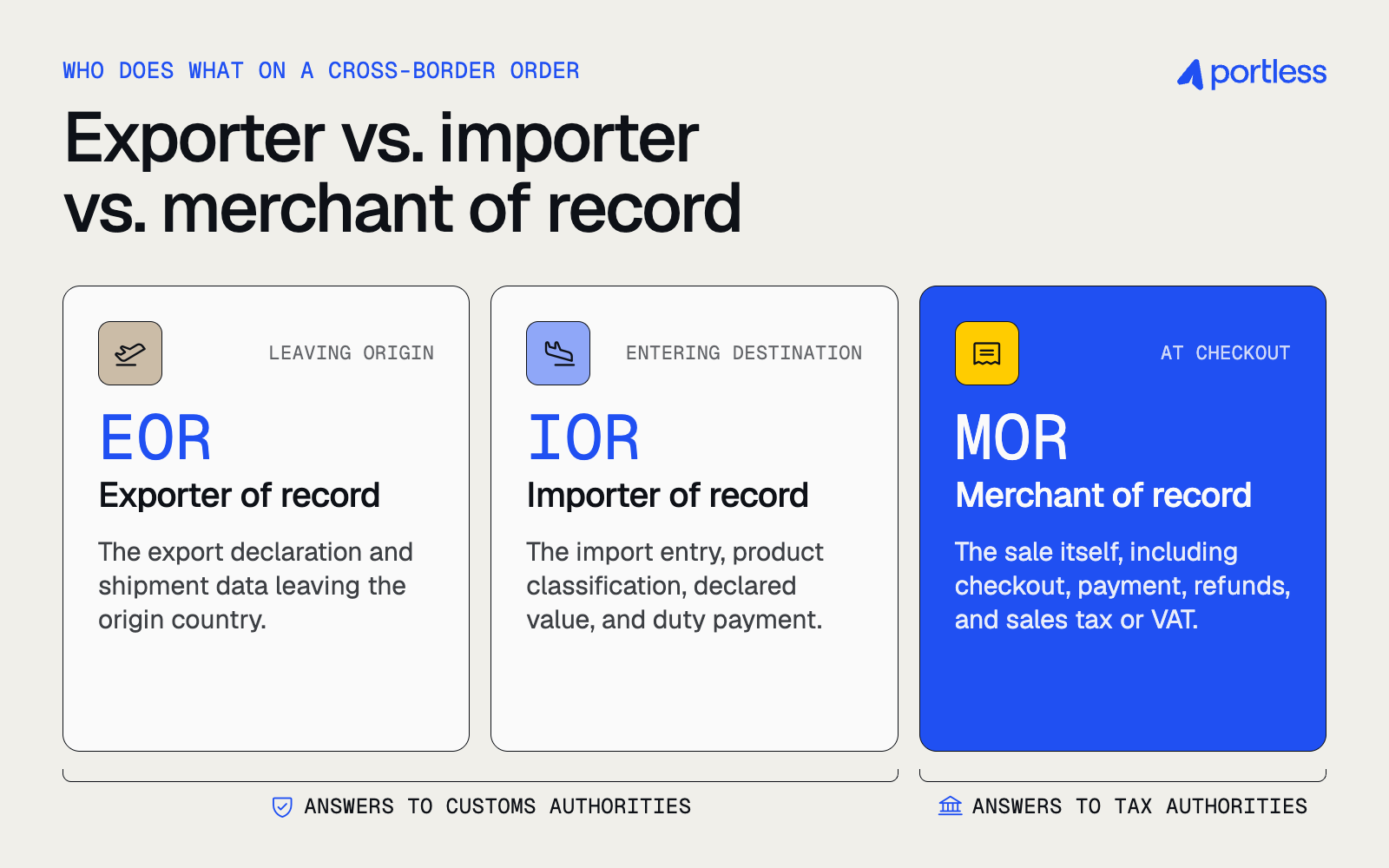
The exporter of record (EOR) is responsible for goods leaving the origin country. The importer of record (IOR) is responsible for goods entering the destination country and pays the duties. The merchant of record (MOR) is the legal seller to your customer and owes the sales tax or VAT on the sale.
::table
Role;What it owns;Who usually fills it on a DTC order from China;What goes wrong if it's wrong
Exporter of record (EOR);The export declaration and shipment data leaving the origin country;The shipper or carrier moving the parcel;The parcel gets held before it leaves
Importer of record (IOR);The import entry, product classification, declared value, and duty payment;A licensed customs broker, or your own entity in that country;Penalties, reassessed duties, and seized goods
Merchant of record (MOR);The sale itself, including checkout, payment, refunds, and sales tax or VAT;Your brand, or a compliance partner acting for you;Unpaid VAT and a tax bill in a country where you have no entity
:table
Customs authorities deal with the exporter and the importer. Tax authorities deal with the merchant. Most of the confusion comes from mixing up those two systems.
What is an exporter of record?
The exporter of record vouches for a shipment as it leaves the origin country. It declares what's in the parcel, what it's worth, and that it's allowed to leave. Once the goods clear that border, its job is done.
For DTC orders shipped from China, the shipper or carrier usually acts as exporter, so it's rarely a role your brand fills. US export rules don't use the word at all. The Foreign Trade Regulations call this party the US Principal Party in Interest (USPPI).
What is an importer of record?
The importer of record is legally responsible for goods entering the destination country. It files the customs entry, makes sure the product classification and declared value are correct, pays the duties, and answers to customs when something's wrong.
US law limits who can hold the role. Under 19 U.S.C. § 1484, the IOR must be the owner or purchaser of the goods, or a licensed customs broker they designate. Formal entries are backed by a customs bond, which customs can claim against if the IOR doesn't pay. The IOR also stays liable for a bad declaration even when a supplier or broker supplied the bad data.
Why a broker usually acts as IOR for DTC parcels
A brand shipping one container to its own warehouse can act as its own IOR. It's one shipment, one entry, and the brand receives the goods. Shipping thousands of individual parcels to customers turns every order into its own import. That's why cross-border DTC shipping usually runs through a licensed customs broker that acts as IOR at scale, under a power of attorney. A power of attorney is the signed authorization that lets the broker act in your name.
If your partner's broker is the IOR, the broker carries the entry liability. That protection only holds if the IOR is a real company with real assets and a bond. If it's a shell, customs can come looking for the party that actually benefited from the import, and that's you.
Why the IOR matters more now
The US has suspended its de minimis exemption, so low-value parcels that used to clear on a manifest now need formal or informal entries with more data attached. The exemption ends permanently by statute on July 1, 2027. Every one of those entries names an IOR. We cover what to check in is your cross-border carrier compliant, and how declared value affects your duty bill in customs valuation after de minimis.
What is a merchant of record?
The merchant of record is the legal entity selling to your customer. Its name is on the receipt. It takes the payment, handles refunds and chargebacks, and collects and remits sales tax or VAT on the sale.
If you sell on your own Shopify store, you're the merchant of record by default. Your payment processor moves the money, but the sale and the tax obligation are yours.
Merchant of record comes from tax and payments, so customs doesn't use the term. That distinction matters in the EU and UK, where VAT on low-value Ecommerce orders gets collected at checkout instead of at the border. Sellers registered for the EU's Import One-Stop Shop (IOSS) charge VAT at checkout on consignments up to €150. In the UK, the seller must charge VAT at the point of sale on consignments of £135 or less.
You can stay the MOR and register for VAT yourself. Or a compliance partner like Global-e or OpenBorder can act as MOR and carry the tax registrations for you.
Darwish Gani of OpenBorder talked about expanding without local entities on The Modern Supply Chain podcast:
How the three roles work together on one order
Back to the jacket. The carrier clears the parcel out of China as exporter. A customs broker, acting as IOR, clears it into the EU and pays the duty. The MOR already collected VAT from the customer at checkout and remits it through IOSS.
The costs flow back up the chain. In a typical setup with a compliance partner, the broker bills the partner, the partner bills your brand, and your brand built those costs into what the customer paid at checkout. Power of attorney is what lets each party act for the one below it.
Why US and EU orders work differently
For US orders, the border question is customs. The IOR clears the goods and pays the duty. The US has no federal VAT, and state sales tax on your US orders works the same way it does for any domestic sale, so the MOR question rarely comes up.
EU and UK orders cross a customs line and a tax line at the same time. Duty belongs to customs, and VAT belongs to the tax authority. That's why the MOR carries far more weight once you sell outside the US.
A short set of answers per market tells you where your risk sits. Ask your partner these before you launch in a new country.
Who's the importer of record, and do they hold assets and a bond in that country?
What value gets declared to customs?
Who pays duties, and how do they get billed back to you?
Who's the merchant of record, and does your checkout collect VAT?
Do orders ship delivered duty paid (DDP) or delivered duty unpaid (DDU)? Here's how DDP and DDU compare.
How Portless handles IOR, EOR, and MOR
Portless handles the customs side of every order. We ship from our fulfillment center in China, close to the point of manufacture, and duties are paid upfront under DDP, so your customer isn't billed at the door. For US orders, your brand imports under a real US company, or our licensed US customs broker is the importer of record.
VAT and sales tax sit with the merchant of record. You either register yourself or work with a compliance partner like OpenBorder or Global-e to act as your MOR. Read how direct fulfillment from China works for the full order flow.
See how Portless works
Every country and carrier mix changes who holds which role. Talk to our team to map who's responsible for customs and tax in each market you sell into.
FAQ
Can a non-US company be the importer of record in the US?
Yes. A foreign company can act as a non-resident importer of record. It needs a customs bond, and a non-resident corporation needs a resident agent authorized to accept legal papers in the state where the goods enter.
Do I need a local entity to sell into the EU?
No. Non-EU brands can sell into the EU without a local entity by registering for IOSS through an EU intermediary, or by using a compliance partner that acts as merchant of record.
What happens if a customer refuses to pay duties on delivery?
The parcel usually comes back, and you pay for the return or lose the order. That risk comes with DDU shipping, where the customer pays duties at the door. DDP removes it by collecting duties at checkout.
Frequently asked questions
Heading
Lorem ipsum dolor sit amet, consectetur adipiscing elit. Suspendisse varius enim in eros elementum tristique. Duis cursus, mi quis viverra ornare, eros dolor interdum nulla, ut commodo diam libero vitae erat. Aenean faucibus nibh et justo cursus id rutrum lorem imperdiet. Nunc ut sem vitae risus tristique posuere.
Get operator-level supply chain insights
Thank you! Your submission has been received!
Oops! Something went wrong while submitting the form.






.jpg)


.jpg)