The biggest thing that changes about fulfillment at $1M, $5M, and $10M is what's holding the business back. At $1M, it's your time. At $5M, it's coordination, because you're now managing people, vendors, and systems. At $10M and beyond, it's capital, because the inventory you hold has become the largest use of cash in the business. As Izzy, Portless's founder and CEO, puts it, founders "usually solve for the stage they're in and then get caught by the next one."
"What catches people is that the old answer doesn't degrade gradually. It just stops working. Whatever got you to $5M has pretty much nothing to do with what gets you to $10M and beyond." — Izzy Rosenzweig, Founder & CEO at Portless
The fulfillment models you'll choose between
Fulfillment models differ in who holds the inventory and where each order ships from.
::table
Model;Who holds the inventory;Who ships the order;Best for
In-house;You, in your own warehouse or storage space;Your team;Very early brands, or large brands with steady volume that can keep a warehouse full
Third-party logistics (3PL);You, after importing it in bulk to the 3PL's domestic warehouse;The 3PL;Heavy or bulky goods, and products that need next-day domestic delivery
Direct fulfillment;You, at a fulfillment center close to the point of manufacture;That fulfillment center, direct to the customer;Lightweight products made in Asia and sold in several countries
:table
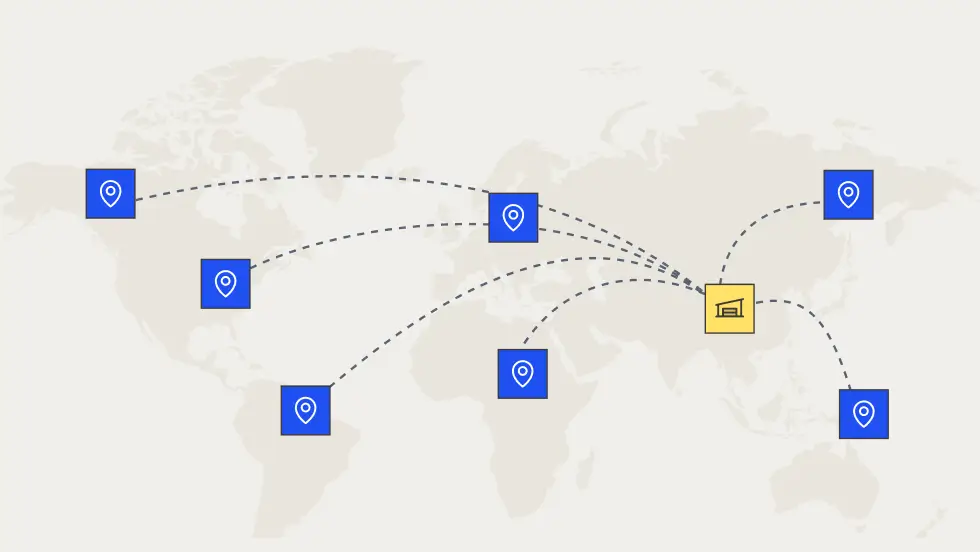
With a 3PL, you pay for inventory, ocean freight, and duty before any of it sells. With direct fulfillment, finished goods go to a fulfillment center near the factory and ship to customers as orders arrive, so there's no bulk import and no domestic warehouse in between. Inside a direct fulfillment center shows how that works day to day.
Fulfillment at $1M protects your time and cash
At $1M, the limit on the business is the founder. "You're doing most of the jobs yourself, and every hour on operations is an hour not spent finding customers," as Izzy wrote.
That makes outsourcing the obvious first step. The question is what to outsource to. Extensiv's 3PL benchmark data, cited in our breakdown of fulfillment model by revenue stage, puts typical 3PL fees at $15 to $40 per pallet per month for storage and $2 to $5 per order for pick and pack. That's affordable at low volume, but it assumes you've already imported the stock and paid for it. Your own warehouse is harder to justify. It usually costs $18,000 a month or more in fixed costs, and in-house logistics rarely pays off below $15M in revenue.
Cash is the other early constraint. In the Federal Reserve's 2024 Small Business Credit Survey, 51% of employer firms said uneven cash flows were a challenge. A brand at $1M that orders a full container to get a better unit price can tie up its cash in stock that takes months to sell.
This is also the stage where direct fulfillment starts to pay off. The same breakdown puts the strongest cash flow case between $1M and $5M in revenue. It estimates that a $3M brand holding 90 days of inventory can unlock more than $600,000 by cutting that to 10 days.
Fulfillment at $5M becomes a coordination problem
At $5M, you've hired people and signed with vendors, and the constraint becomes coordination. "You're managing relationships and systems you didn't pick, and you find out about problems late," as Izzy wrote.
Fulfillment is where a lot of those late surprises come from. In a legacy setup, stock passes from the factory to a freight forwarder, a customs broker, a 3PL, and a carrier before it reaches the customer. Each handoff is another place a delay can sit unnoticed until a best seller runs out. Direct fulfillment shortens that chain, because stock goes from the factory to one fulfillment center and ships to customers from there.
Selling in more countries adds partners too. NATPAT's global expansion shows the alternative. The brand had been finding new fulfillment partners in each country it sold to, and moved to shipping to more than 50 countries from one shared inventory pool.
This is also the stage where one model stops fitting the whole catalog. For brands between $5M and $15M, the revenue-stage breakdown recommends a hybrid setup. Lightweight, high-margin products made in Asia go through direct fulfillment, and heavy or time-sensitive products stay with a domestic 3PL. The split is by SKU weight, return rate, and delivery urgency.
Fulfillment at $10M and beyond becomes a finance decision
By $10M, the constraint is capital. In Izzy's words, "What you buy and where you hold it stops being an operations decision and becomes a finance one." He calls the stretch from $5M to $10M "the hard one because it's where cash breaks."
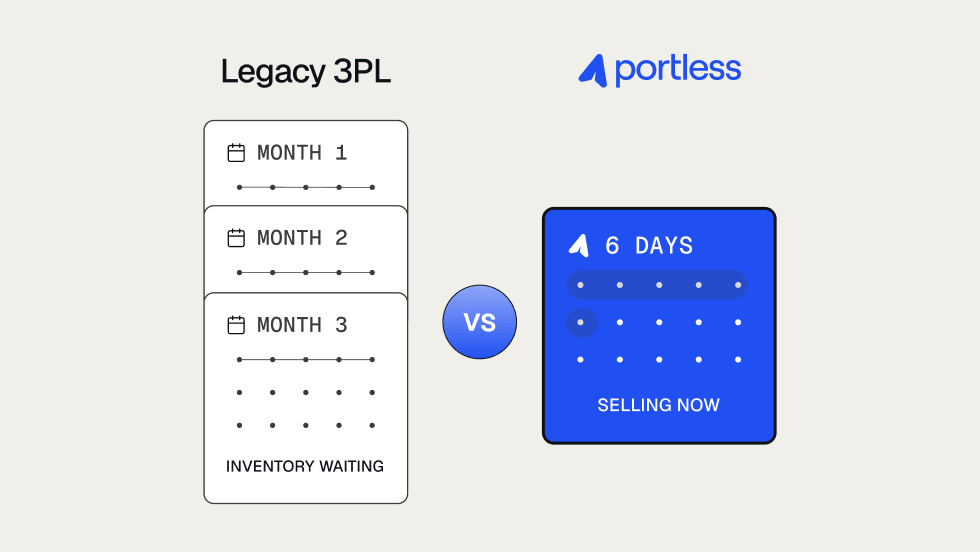
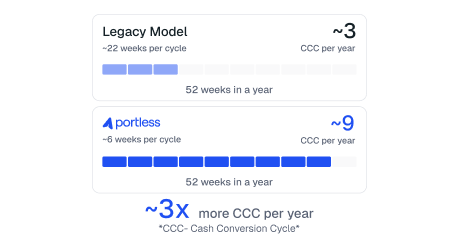
This is where the legacy model costs the most. The longer stock takes to travel from the factory to the customer, the longer your cash conversion cycle runs and the more working capital sits in inventory. Craft Club's 3x growth came after it moved to direct fulfillment and cut its cash conversion cycle from more than 22 weeks to six. Consolidating six warehouses into one is how memobottle cut a 120-day cash cycle by more than 100 days.
Adding a market doesn't have to mean adding a warehouse. Committing stock to a regional warehouse can lock you in for six to 18 months, so our guide to hard-to-reverse fulfillment decisions suggests keeping inventory upstream while a new market runs at 300 to 500 orders a month. A local 3PL starts to make sense once that market reaches 2,000 to 3,000 stable orders a month.
If your brand has hit a growth ceiling around this size, check how much of your cash is sitting in inventory.
When should an Ecommerce brand switch fulfillment?
Switch when your current model starts costing you more in cash than it saves you in convenience. That usually shows up in your inventory and margins before it shows up in order count. The revenue-stage breakdown lists these signs that it's time to leave a legacy 3PL.
- Fulfillment costs exceed 15% of revenue
- Inventory sits 60 to 120 days before it sells
- Peak surcharges eat into your margin. During Q4, 3PL surcharges can rise 15% to 30%
- You manufacture in Asia and need delivery in under 10 days
- Returns processing fees keep climbing
Changes to customs rules are another reason to review your setup. The US has suspended its $800 de minimis exemption indefinitely, and the EU has replaced its €150 exemption with duty on low-value parcels, starting with a flat €3 per item category. Orders that used to fall under the de minimis threshold now pay duty, so duty belongs in the landed cost of every SKU in every market you sell to. Both fulfillment models pay it. With direct fulfillment, you pay it per parcel on items a customer has already bought, rather than on a whole shipment before any of it sells.
To check whether your brand is at that point, run your volumes through the direct fulfillment ROI calculator.
See how Portless works
Portless fulfills orders direct from the point of manufacture to customers in 85+ countries in five to eight days, so you can hold less stock and keep more cash as you grow. Book a demo to see where it fits in your setup today.
FAQ
How long does it take to switch fulfillment providers?
It depends on how much stock you're moving and where it sits. &Collar went from its first call with Portless to its first scheduled inbound truck in under 30 days, and rerouted 40,000 units ahead of Father's Day.
Does direct fulfillment work with Shopify?
Yes. Portless picks up orders from Shopify, WooCommerce, and other major platforms in real time, so there's no manual handoff between your store and the fulfillment center.






.jpg)

.jpg)
.jpg)
.jpg)