“We generated $70K in package protection revenue in a single quarter by adding a simple $4 protection option at checkout — plus an additional $12K from cashbacks. Customers get peace of mind, and we're making a profit on every protected order with zero effort."
“We generated $70K in package protection revenue in a single quarter by adding a simple $4 protection option at checkout — plus an additional $12K from cashbacks. Customers get peace of mind, and we're making a profit on every protected order with zero effort."
Replenishment lead time decides how much stock you have to buy ahead and how much cash sits in it. For direct-to-consumer (DTC) brands that manufacture in China and import in bulk, it's usually measured in months. That means large orders, large safety stock, and stockouts whenever a forecast misses. Shortening it is one of the most direct ways to free up cash.
The Association for Supply Chain Management (ASCM) calls the full cycle the performance cycle. It covers the time to decide what to order, send the order to the supplier, manufacture the goods, deliver them, and put them into inventory.
Replenishment lead time = time to decide and place the order + production time + transit time + receiving time
The simplest way to measure it is to track, for each stock-keeping unit (SKU), the days from the moment you decide to reorder to the moment new stock can ship to customers.
Replenishment lead time sets your reorder point and your safety stock. Your reorder point is the demand you expect during the lead time plus your safety stock. Take a SKU that sells 25 units a day. On a 100-day replenishment lead time, you need 2,500 units on hand or on order before you count any buffer. At 20 days, you need 500.
What causes long replenishment lead times?
Long replenishment lead times usually come from several delays stacked on top of each other.
Production time. Your supplier's production schedule, and how much it varies from order to order, sets the baseline.
Ocean freight. Shipping from China to the US by ocean freight takes around 30 to 40 days, according to our inventory lead time guide. Receiving and putting stock away in a domestic warehouse adds more.
Minimum order quantities. A high minimum order quantity pushes you into large, infrequent orders, so each one has to cover a longer stretch of demand.
Factory shutdowns. Most Chinese factories close for two to four weeks around Chinese New Year, so brands plan for a three- to four-week production gap. Our guide to Chinese New Year shutdowns covers how to plan around it.
Slow decisions. Waiting on approvals, a final forecast, or a reply from a supplier in another time zone all add days before the order is placed.
How much lead time varies matters as much as how long it is. If a shipment takes 30 days one time and 50 the next, you have to hold safety stock for the 50-day case.
Why long lead times drain cash
Longer lead times mean bigger orders and more safety stock, and all of it ties up cash until customers buy it. That stretches your cash conversion cycle, the number of days between paying your supplier and getting paid by your customer.
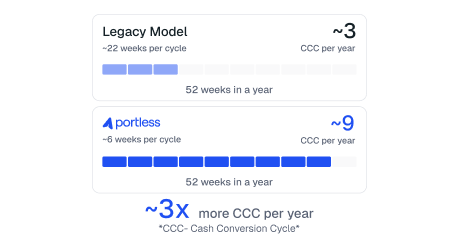
A typical bulk import cycle runs 79 days from paying the supplier to collecting cash. Direct fulfillment brings that down to about 26 days, according to our analysis of rethinking your 3PL location. On $200,000 of working capital, that's the difference between four inventory turns a year and 14.
Brands shorten replenishment lead time by cutting the time stock spends in transit and storage, ordering smaller batches more often, working with suppliers on production time, and forecasting closer to the sale. The biggest change is shipping direct from the point of manufacture, which removes the ocean freight and domestic warehouse legs entirely.
Ship direct from the point of manufacture
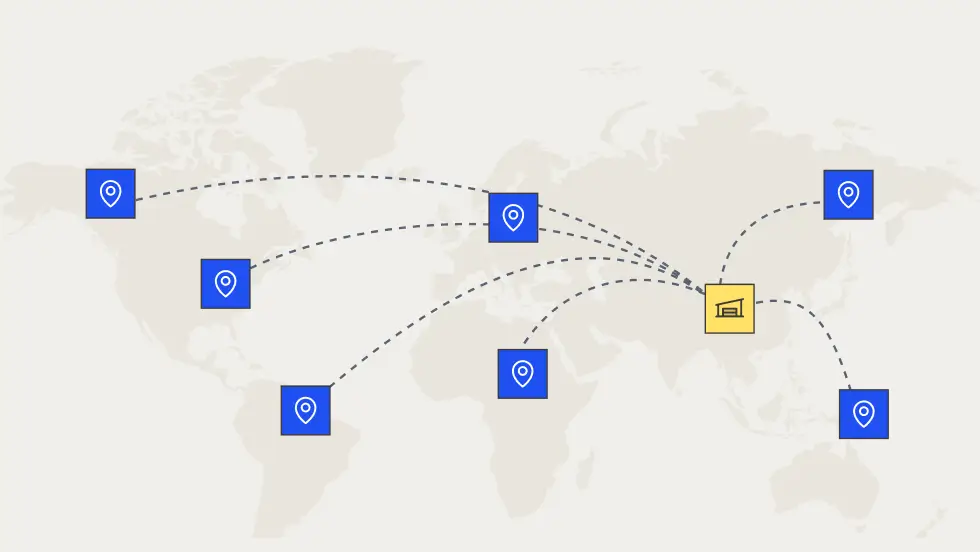
Direct fulfillment moves your inventory next to the factory. Finished goods are received at a fulfillment center close to the point of manufacture, and each order ships from there to the customer. Nothing waits for a container or sits in a domestic warehouse.
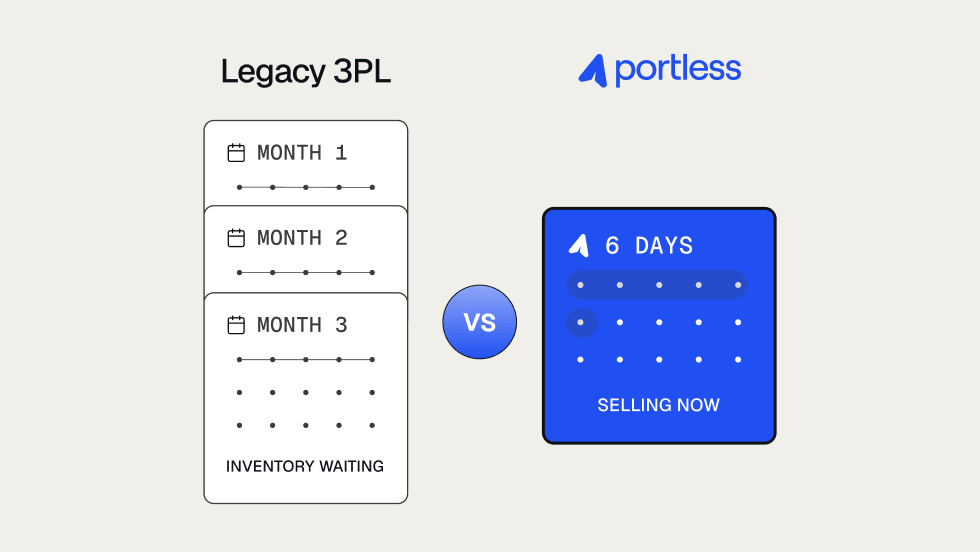
Most brands run on three- to four-month cycles from production to customer. Direct fulfillment compresses that to roughly 15 to 20 days end to end, with products ready to sell in as little as five days after production. Moana Bikini cut lead time from months to weeks, with product moving from its manufacturer to the fulfillment center in under a day.
Order smaller batches, more often
Smaller, more frequent orders mean each one covers less demand, so less cash sits in stock waiting to sell. Ask your supplier whether a lower minimum is possible at a slightly higher unit price. The same inventory lead time guide puts carrying costs at 20% to 30% of inventory value a year, so a small increase in unit price can cost less than holding months of extra stock.
Smaller batches work best when each restock arrives quickly. With direct fulfillment, restock lead times can drop from 45 to 60 days to seven to 15.
Work with suppliers on production time
Share rolling forecasts with your suppliers so they can plan capacity before your order arrives. Book production early ahead of peak season and Chinese New Year, and line up a second supplier for your best sellers so one delay doesn't stop sales.
Forecast closer to the sale
The shorter your replenishment lead time, the less far ahead you have to forecast, and short-range demand forecasting is more accurate than long-range. Our post on why long-range forecasting fails covers how shorter cycles let you decide what to reorder closer to when it sells.
Recalculate safety stock and reorder points
Once your lead time is shorter and steadier, recalculate your safety stock and reorder points. It's easy to keep old buffers long after the lead time that justified them has changed. In the example above, cutting replenishment lead time from 100 days to 20 means 2,000 fewer units to pay for in advance.
Direct fulfillment vs the legacy model
::table
Model;Who holds the inventory;Where the order ships from;Replenishment lead time;Best for
Legacy bulk import and domestic 3PL;You, bought in bulk and stored in a domestic warehouse;The domestic warehouse, after ocean freight;Weeks to months;Heavy or bulky goods, stable demand, and next-day domestic delivery
Direct fulfillment;You, stored near the factory until each order ships;A fulfillment center close to the point of manufacture, direct to the customer;Days after production;Lightweight goods made in Asia with variable demand, sold in several countries
:table
Duty follows the same timeline. Under the legacy model, you pay duty on a whole shipment when it lands, before any of it sells. With direct fulfillment and Delivered Duty Paid (DDP) shipping, duty is collected at checkout and paid per parcel, so it matches revenue you've already earned. The US has suspended its $800 de minimis exemption, so low-value parcels that used to fall under the de minimis threshold now pay duty as well, which makes the timing of that payment matter more.
Privacy Clo, for example, used to wait 90 days for sea freight from its factories. Now its inventory is sellable within 24 hours of arriving at the Portless facility, and the brand has opened 17 new markets.
Some brands use both models, with each SKU in the one that suits it. The direct fulfillment ROI calculator models the cash difference using your own volumes.
See how Portless works
Portless fulfills orders direct from the point of manufacture to customers in 85+ countries in five to eight days, with stock ready to sell within days of production. Book a demo to see what that would do to your lead times and your cash.
FAQ
Is replenishment lead time the same as delivery time?
No. Replenishment lead time is how long it takes to restock your own inventory. Delivery time is how long a customer waits between placing an order and receiving it. A brand can have fast delivery and a long replenishment lead time, and the long one is usually what causes stockouts.
Frequently asked questions
Heading
Lorem ipsum dolor sit amet, consectetur adipiscing elit. Suspendisse varius enim in eros elementum tristique. Duis cursus, mi quis viverra ornare, eros dolor interdum nulla, ut commodo diam libero vitae erat. Aenean faucibus nibh et justo cursus id rutrum lorem imperdiet. Nunc ut sem vitae risus tristique posuere.
Get operator-level supply chain insights
Thank you! Your submission has been received!
Oops! Something went wrong while submitting the form.






.jpg)
.png)

.jpg)
.jpg)
%20(1).jpg)