“We generated $70K in package protection revenue in a single quarter by adding a simple $4 protection option at checkout — plus an additional $12K from cashbacks. Customers get peace of mind, and we're making a profit on every protected order with zero effort."
“We generated $70K in package protection revenue in a single quarter by adding a simple $4 protection option at checkout — plus an additional $12K from cashbacks. Customers get peace of mind, and we're making a profit on every protected order with zero effort."
Your legacy 3PL fulfillment model can work exactly as intended and still hold your growth back. Your sales might be increasing, and you might be ramping up production. Yet every step forward seems to make your cash flow tighter.
This isn't because you're doing anything wrong. The issue is structural. You're paying for manufacturing, freight, duties, and storage months before a customer order ever provides a return. And the bigger you grow, the more cash gets locked away in inventory that's held up in a factory, stuck with your carrier, or sitting idle on warehouse shelves.
That money hasn't disappeared, but you still can't use it. And with 78.9% of US Ecommerce brands reporting that tariffs are shrinking their margins, that lack of flexibility is getting harder to absorb. Let's take a look at the challenge so you can start planning what to do about it.
The gap between forecasting demand and fulfilling it
With a traditional third-party logistics (3PL) model, brands forecast demand, manufacture in bulk, and then ship the entire inventory overseas to a domestic 3PL warehouse. The partner then handles order processing and shipping locally.
The challenge is that shipping overseas takes time. According to Flexport's Ocean Timeliness Indicator, freight transit time from China takes an average of 37.4 days to the US West Coast and 55.4 days to the East Coast. And that estimate doesn't include the production run or time spent transporting the goods from the port to the domestic 3PL warehouse.
By the time the inventory is ready to sell, the initial forecast that led to the order can already be several months old. Brands therefore need to decide what and how much to produce before customers reveal whether they'll actually buy.
That model worked well when businesses needed dependable buffer stock to supply retailers wholesale. But for DTC brands that need to respond to live demand? Committing cash in bulk up front is gambling that customers will still care once the stock arrives.
The four pressures that follow fulfillment delays
The gap between forecasting and order fulfillment may be the root cause of common 3PL problems, but the impact goes beyond logistics bottlenecks alone. The delay has a ripple effect on your cash flow, inventory, ability to meet demand, and margins.
::table
Common 3PL problems;What causes it;The impact
Tighter cash flow;Manufacturing, freight, duties, and storage costs get funded long before customer sales recover the investment;Growth puts more pressure on working capital, leaving less cash for reorders, marketing, or product development
Inventory risk;Stock volumes and allocations need to be planned before actual customer demand becomes clear;Bestsellers sell out, while slower products sit unsold or get stranded in markets where demand is weaker; inventory control gets harder
Slow responses;Replenishment needs to move through production, customs, and warehouse intake before it can reach customers;Trends, successful campaigns, and unexpected demand surges can fade before you're able to capitalize
Hidden fulfillment costs;The cost of each order gets diluted across freight, duties, storage, handling, delivery, and returns;Margins are difficult to calculate, making products harder to price and costs harder to control
:table
Why growth drains your working capital
Your revenue is growing, but you're left with less working capital than before, not more. Growth is supposed to feel like breathing room, and instead it feels like a squeeze.
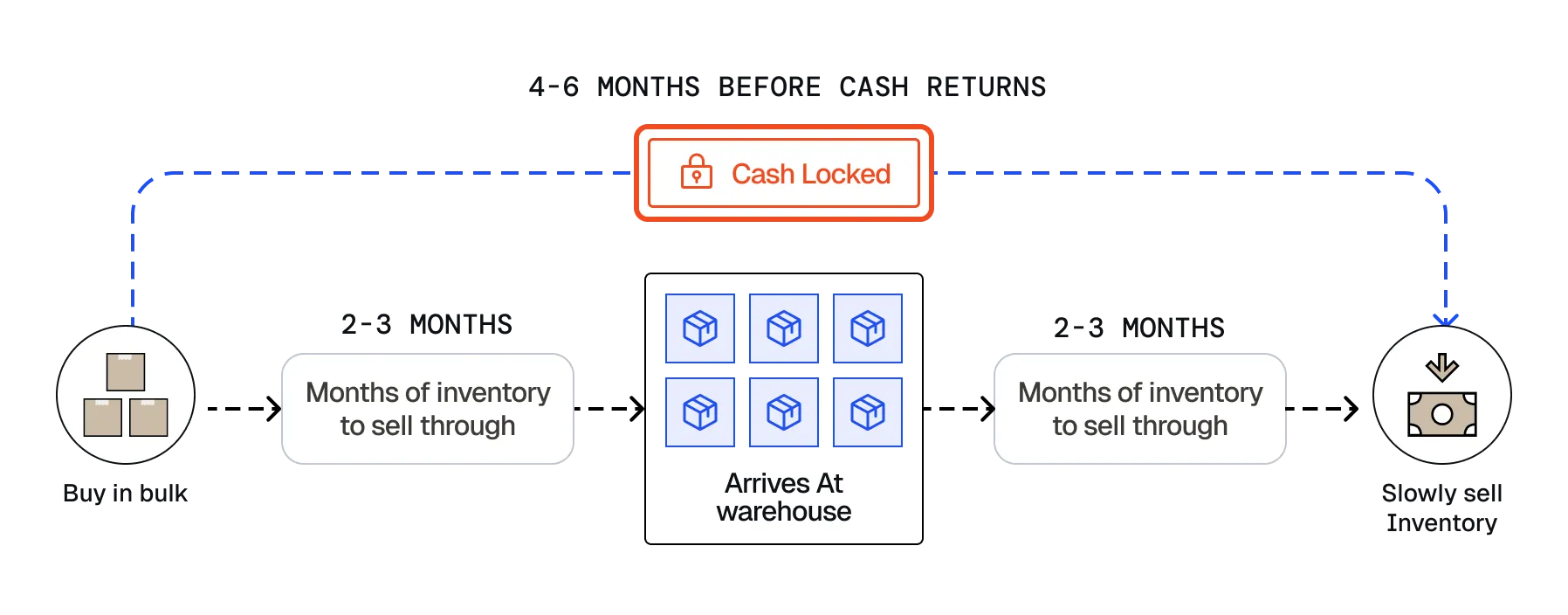
The problem? A stronger sales run triggers a larger inventory commitment. Factories want deposits, and freight needs to be booked in advance. And you'll still need to pay the rest of the bill while your current batch is still on the market. That means you end up juggling:
One batch that's currently generating revenue
Another that's crossing the ocean to your domestic 3PL
A third that's already in production because you can't afford stockout risks
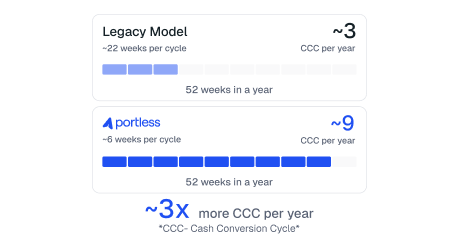
Each batch is at a different point in the same journey. Money leaves in large bulk payments, then trickles back in gradually through individual orders. In turn, your cash conversion cycle stretches, and your revenue gets locked up in inventory that hasn't paid you a dollar in return.
Building a safety buffer comes at a cost
One of the other problems with long lead times is that stockouts become a constant threat.
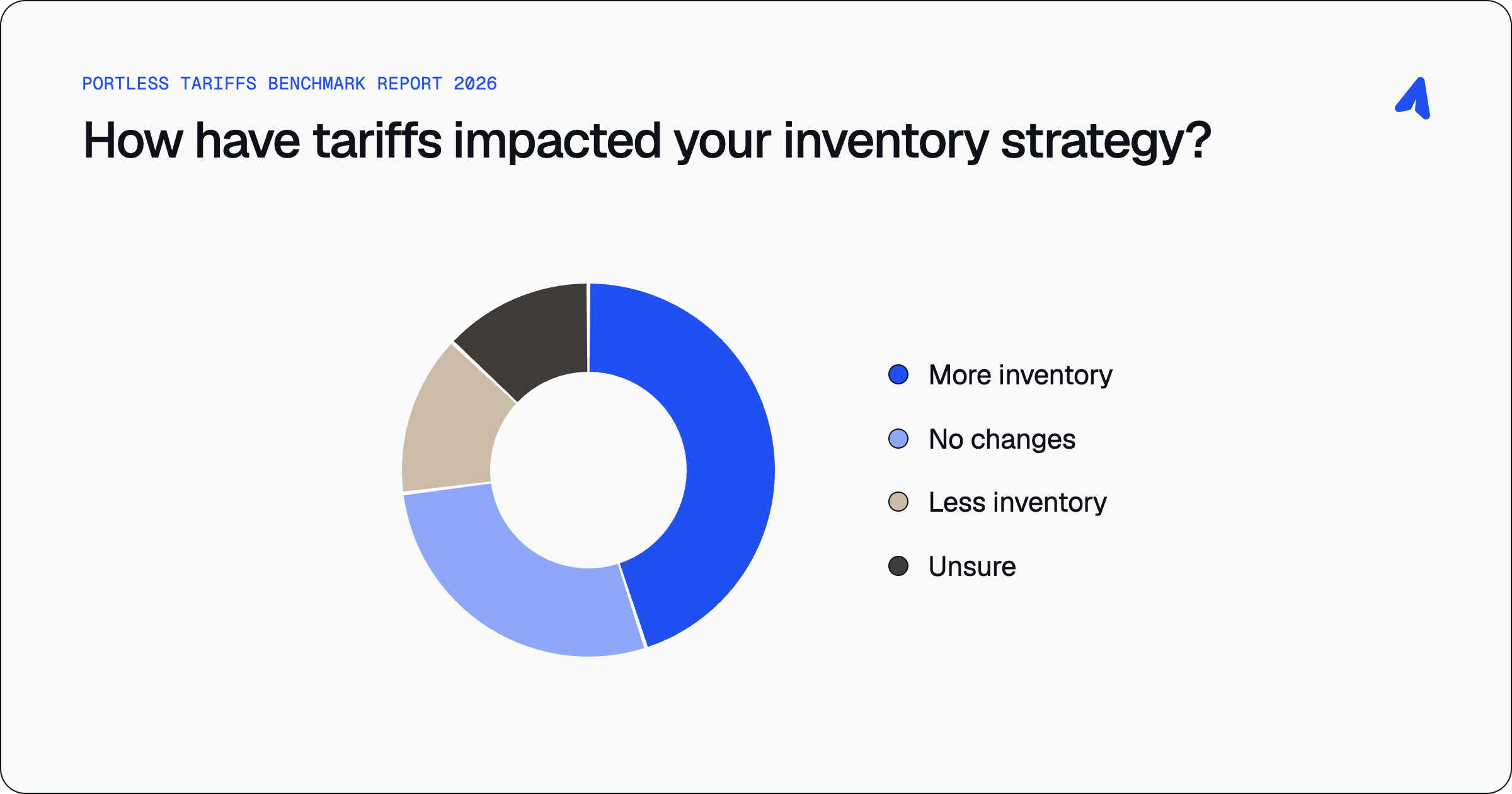
Ecommerce brands often protect themselves by ordering more than the forecast calls for so subsequent shipments have time to arrive before the shelves run empty. That has had a major impact, as 60% of Ecommerce brands now say they're carrying more inventory than before.
Buffer stock can reduce the frustration of late shipments, especially with tariff volatility adding an extra incentive to lock in stock. But it also aggravates the problem because those units need to be bought up front. Uncertainty leads to overcommitment, which leads to trapped cash.
Your growth budget gets trapped in a warehouse
Opportunity cost adds an extra sting. You might be thriving on paper, but lack the cash flow to actually capitalize on what's working well. Any capital that could be used to fund a larger campaign or expand into a new market is already sitting in your stock.
Of course, credit and longer supplier terms can help you bridge the gap in the short run. But that's still another obligation to bear. Until you can shrink the gap between paying for stock and getting returns, every new growth stage adds another investment round to the pile.
Learn more with our article on the DTC cash flow trap. We'll explore this cycle in more detail and explain how brands can release more working capital without damaging their growth.
Inventory risk makes every forecast an upfront bet
Every production order is a forecast about the future: which products will sell, how many units customers will buy, and where demand will be strongest. The longer the lead time, the less certain those assumptions become. But that's only half the risk.
Fulfillment latency also makes each forecast expensive to reverse. Once you're shipping products overseas to a predetermined market, changing course usually means discounting it, transferring it, or waiting for demand to catch up. You can adjust a marketing campaign overnight; you can't easily turn 5,000 unwanted units into a profit.
What happens when your forecast misses
When your forecast doesn't land, you'll usually see one of two problems occur:
You overstock your shelves: SKUs that are slow to sell take up shelf space and rack up inventory holding costs.
You have a stockout: popular products disappear, and you're left waiting months to get back on top of the inventory shrinkage.
Your forecast might have been perfectly accurate at the time. Predicting demand months in advance is hard, and getting it slightly wrong is expensive.
When an influencer mentions one of your products or a campaign goes viral overnight, you know exactly what to do. Reorder stock, double down, then get rewarded for it.
But the inventory you need to capitalize on that trend is still at sea. By the time it arrives, the moment has passed, and your audience has moved on.
Why you can't act on demand signals in time
Demand rarely waits for the supply chain to catch up. Google still sees completely new terms in 15% of searches each day, providing fresh signals about what customers want in real time. Your business is primed to benefit from those insights, but if you can't move with agility, you can't capitalize on the opportunity.
Those data discrepancies create decision latency. You know exactly what you need to do, but you can't take action until it's too late. Aside from being frustrating, this is what leads to:
Campaigns that do surprisingly well but run out of steam by the time stock arrives
A seasonal trend that's already moved on by the time you've crossed the ocean
A product launch that does better than expected, then goes out of stock for months
One of the biggest problems happens when you want to enter a new market. A country could show massive amounts of interest through campaign data. But then you have to buy in bulk and ship stock around the world just to learn whether that demand is real. Learn more about how decision latency impacts your margins and holds you back.
The fulfillment costs your quote doesn't show
A 3PL quote can feel fairly easy to break down. Storage costs this much, pick and pack that much, and shipping depends on the destination. However, those landed costs and hidden logistics fees rarely arrive in a neat bundle:
Before the warehouse, you're paying separately for international freight, customs duties, insurance, port fees, and inbound shipping to the 3PL facility.
Inside the warehouse, you need to pay for your partner to receive, store, manage, pick-and-pack, and distribute your orders.
En route to the customer, parcel rates can skyrocket based on fuel surcharges and package weight, even more so if you're paying peak season fees.
If an order comes back, you'll also need to handle return shipping and pay for someone to inspect, then repack, restock, or dispose of the product.
Each charge is fairly manageable on its own. But working out actual costs isn't easy when you're piecing together 20 invoices for a single production run.
Returns are particularly easy to underestimate because the cost carries on long after your order leaves the warehouse. Our guide to outsourcing customer returns explores how brands can reduce that burden and get products back into sellable inventory sooner.
At a certain point, margins start to blur. A product may look profitable at first, but once freight, storage, delivery, and returns are accounted for, the margin can shrink fast.
Your customers only see one delivery fee
Your customers don't see the amount of money you put into freight transport and storage.
All that matters to them is the delivery fee at checkout. If it's too high, they'll drop off. According to McKinsey, over 90% of US consumers are likely to abandon a cart when shipping is expensive. This leaves Ecommerce businesses balancing three difficult choices:
Pass the full cost on to the customer and risk losing the sale
Absorb the cost and let fulfillment eat into margins
Offer free shipping without knowing what each order costs
The good news is 90% of consumers are also willing to wait two or three days if it helps them avoid those charges. This gives you breathing room to rethink free-shipping thresholds and the fulfillment model underneath them instead of absorbing the costs yourself.
The obvious first move when you outgrow your current model is to shop around and find a better deal. A new 3PL will often promise sharper rates, faster receiving times, and, with any luck, fewer mysterious fees.
However, changing 3PLs doesn't change the journey your stock takes to get there. While the new partner may handle inventory better once it arrives, you still need to cope with forecasting, production, shipping, and allocation upstream.
If you're still manufacturing stock in bulk and sending it to a domestic warehouse before you make a sale, a new provider won't address the root cause. More often than not, 3PL problems are a symptom of the model rather than the vendor.
So, what should you actually be looking for?
For a proper 3PL comparison, look beyond storage rates and picking and packing fees. What you actually want to know is how the operator will handle latency:
How long does finished stock take to become sellable?
Does stock need to be split between markets in advance?
What happens when one region suddenly outperforms another?
If demand changes, how quickly can you adapt?
The reality? You'll often find that the barrier to your productivity will be the journey, not the provider. Of course, how your partner handles daily operations matters, but those efficiencies will be overshadowed if your inventory will be at sea for months to reach them.
Our 3PL evaluation checklist explores the questions worth asking before you sign another contract.
A new warehouse can't outpace an old model
What's the takeaway from the evaluation questions above? Fulfillment operational inefficiencies stem from the model, not the warehouse. The solution starts with removing the step that forces your inventory to be pre-positioned before you have a handle on customer demand.
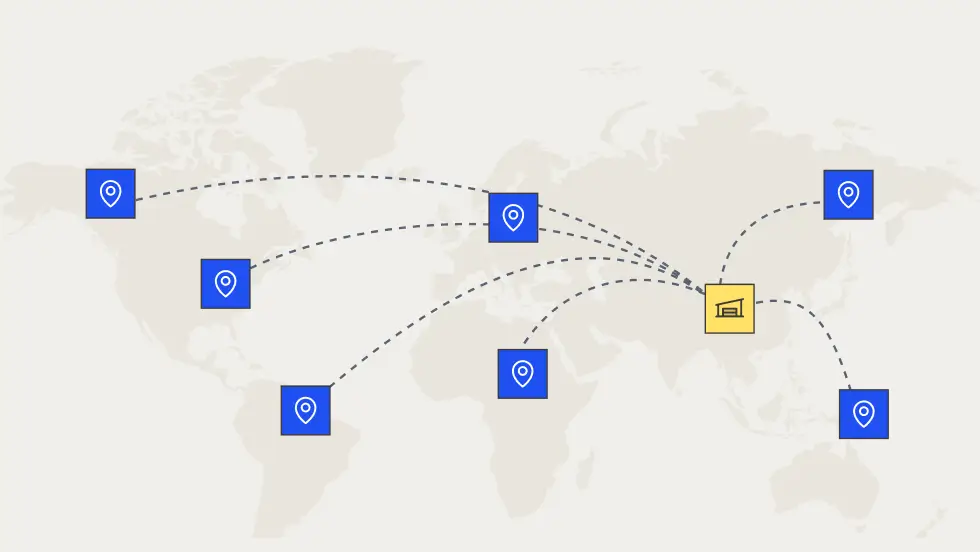
This is the idea behind direct fulfillment. Rather than being shipped overseas to domestic partners, your inventory stays centralized in a warehouse near your production facility. Once an order comes in, the product is shipped directly to the customer by air freight, with a local carrier completing the final delivery.
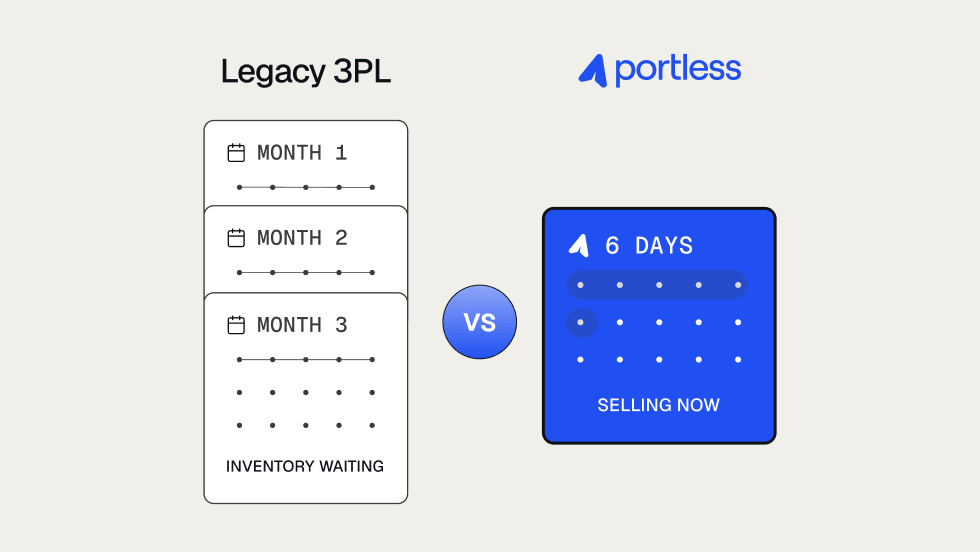
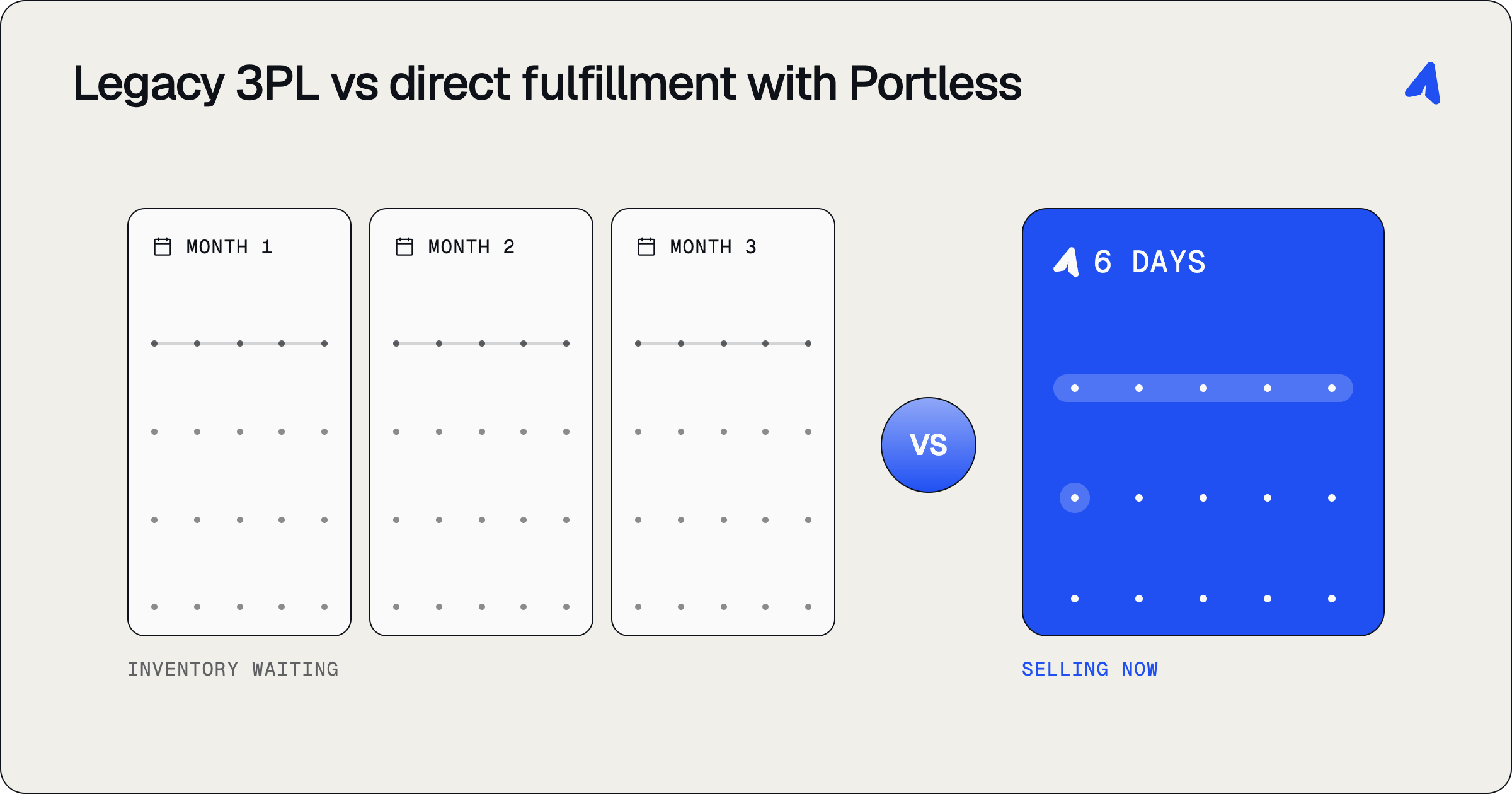
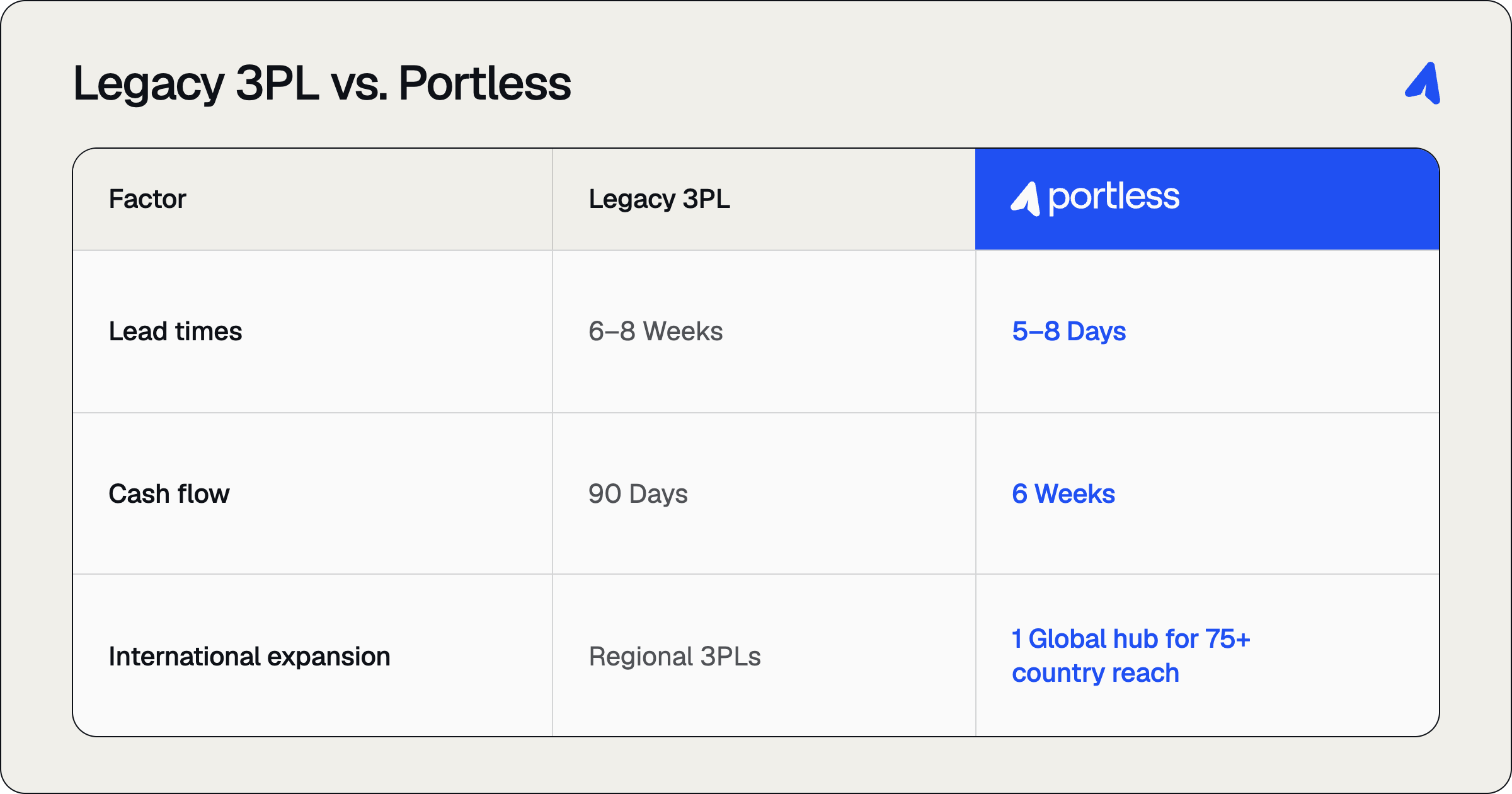
How the traditional and direct fulfillment models compare
From forecasting demand to fulfilling it
The result is a better way to meet demand.
Skipping the domestic warehouse transit means there's a much shorter delay between production and sale and less capital lost at sea. That means you can:
Maintain full inventory visibility because everything is stored in one place
Make that inventory available straight after production
Fulfill multiple markets from the same pool of stock
Respond to demand in real time without predicting stock six months in advance
Pull back from a new experiment without leaving stock stranded overseas
Forecasting still matters, of course. Brands still need to invest in marketing and deliver a strong customer experience. However, when you don't have to tie your capital in ocean freight, you have more flexibility to make those goals a priority.
How memobottle consolidated six warehouses into one and shortened its cash cycle
memobottle had already built the global setup that many brands aspire to. It operated six regional 3PL warehouses to keep inventory close to customers across multiple markets.
Yet its products would routinely spend 45–80 days at sea before they could be sold. Its cash conversion cycle stretched beyond 120 days, while storage costs during peak periods could easily hit $25,000–$30,000 USD each month. In the meantime, one region would regularly sell out of a bestseller, while the next sat on excess inventory that couldn't easily be recovered.
memobottle wasn't struggling for scale, and the team certainly wasn't lacking in effort. But every additional "just in case" warehouse meant taking another gamble on demand and setting aside enough inventory in each location in case the forecast proved correct.
To solve the problem, memobottle switched to a direct fulfillment model with Portless, consolidating its six regional warehouses into one centralized fulfillment center. Now, the brand's finished stock becomes available for sale in less than 24 hours rather than spending up to 80 days at sea.
As a result, memobottle expects to see a 5x reduction in its inventory holding, shorten its cash conversion cycle by more than 100 days, and remove most of its peak storage spend. More importantly, the company doesn't have to guess where demand is going to appear anymore. It can stay in one place until a customer order provides the answer.
The signs you've outgrown your fulfillment model
A different warehouse might sound appealing, but at what point is it time for an overhaul?
For most Ecommerce brands, the clearest warning is when growth stops feeling like a win. If you answer yes to the following questions, it's probably time for a change:
Does your cash conversion cycle get longer as sales rise?
Are you regularly discounting, transferring, or writing off misplaced stock?
Does testing a new market require a major inventory commitment?
Are fulfillment costs rising faster than your order volumes?
Do returns take too long to become sellable again?
Can you spot demand shifts but still not respond in time?
Is warehouse management starting to drag down your time for high-value tasks?
Has switching 3PLs improved day-to-day service without easing inventory pressure?
One warning sign is a curable headache; multiple signs appearing at once suggest your team is spending more time working around the model than benefiting from it.
At that point, another small optimization is probably just going to buy temporary breathing room. Rebuilding your structure from the ground up will help you address the problem at the root cause and start growing without every new milestone requiring another gamble.
Reduce the cash tied up in your supply chain
Growth is meant to be the fun part for scaling Ecommerce brands. But when every increase in sales forces more cash into ocean freight, regional warehouse operations, and buffer stock, it can start to feel like you're being punished for your success.
Direct fulfillment adds flexibility. Keeping inventory closer to the point of production lets you ship based on live customer orders. That means you can respond faster to demand when it shifts and test new markets without putting your cash flow at risk.
Are you manufacturing in Asia and want a better way to power your growth? Portless can help. We support Ecommerce brands with direct fulfillment into 85+ countries. Request a demo to see how we can help your business take back control of its cash flow.
FAQ
What are the most common 3PL problems?
The most damaging common 3PL problems often extend beyond picking errors, shipping errors, tracking errors, or inefficient warehouse operations. Growing brands may also face tighter cash flow, inventory stranded in the wrong markets, slow responses to demand, and fulfillment costs that are difficult to trace back to each order.
How can brands reduce inventory lead times?
For most businesses, lead time reduction in inventory management starts with reducing unnecessary waits between production and sale. Better inventory tracking, regular cycle counting, and tighter coordination between suppliers and fulfillment centers can help.
Direct fulfillment offers a long-term solution by removing the domestic warehouse stage altogether. This shortens the path from production to sale, makes stock available sooner, and reduces the amount of capital tied up while inventory waits to reach the market.
How can brands respond faster when customer demand changes?
Brands respond faster when inventory remains flexible until customers reveal where demand is strongest. A good place to start is with a centralized stock pool. This means you can supply several markets, replenish successful products, and support new launches without transferring inventory between regional warehouses. It also gives the business more room to adapt when peak season delays or a wider supply chain disruption make the original forecast obsolete.
Frequently asked questions
Heading
Lorem ipsum dolor sit amet, consectetur adipiscing elit. Suspendisse varius enim in eros elementum tristique. Duis cursus, mi quis viverra ornare, eros dolor interdum nulla, ut commodo diam libero vitae erat. Aenean faucibus nibh et justo cursus id rutrum lorem imperdiet. Nunc ut sem vitae risus tristique posuere.
Get operator-level supply chain insights
Thank you! Your submission has been received!
Oops! Something went wrong while submitting the form.








.jpg)
%20(1).jpg)
%20(1)%20(1).avif)