“We generated $70K in package protection revenue in a single quarter by adding a simple $4 protection option at checkout — plus an additional $12K from cashbacks. Customers get peace of mind, and we're making a profit on every protected order with zero effort."
“We generated $70K in package protection revenue in a single quarter by adding a simple $4 protection option at checkout — plus an additional $12K from cashbacks. Customers get peace of mind, and we're making a profit on every protected order with zero effort."
You paid the factory in full. The order spent five weeks on a boat, another week or two getting received at a US warehouse, and landed after demand had moved on. Now half of it sits on a shelf and costs you storage every month. Meanwhile, your best seller sold out in week two.
More brands are stuck in that spot. In Netstock's 2026 Supply Chain Planning Benchmark Report, 24% of businesses surveyed said more than 10% of their inventory was dead stock, up from 12% in 2024. Ocean freight is adding to the pressure. In 2026, the spot rate for a 40-foot container from Shanghai to New York more than doubled in about four months, which pushes brands toward even bigger, earlier orders.
Rising ocean freight pushes you into bigger orders
Whether you book a full container or share one, those rates set the price of every freight quote for US-bound goods. When freight costs more, the pressure is to ship fewer, bigger orders to spread the cost, and every extra unit is another bet on your forecast.
Long lead times turn those orders into dead stock
Long lead times force you to order big and order early, and every order placed months ahead is a bet on demand. Netstock's research on small and medium-sized businesses shows how common this is.
Nearly three quarters call lead time variability a planning challenge.
63% point to long lead times.
60% identify minimum order quantities (MOQs) as ongoing obstacles.
Here's how that turns into dead stock. You forecast three or four months out. The factory's MOQ pushes your order above that forecast. Demand shifts before the container lands, and the extra units have nowhere to go.
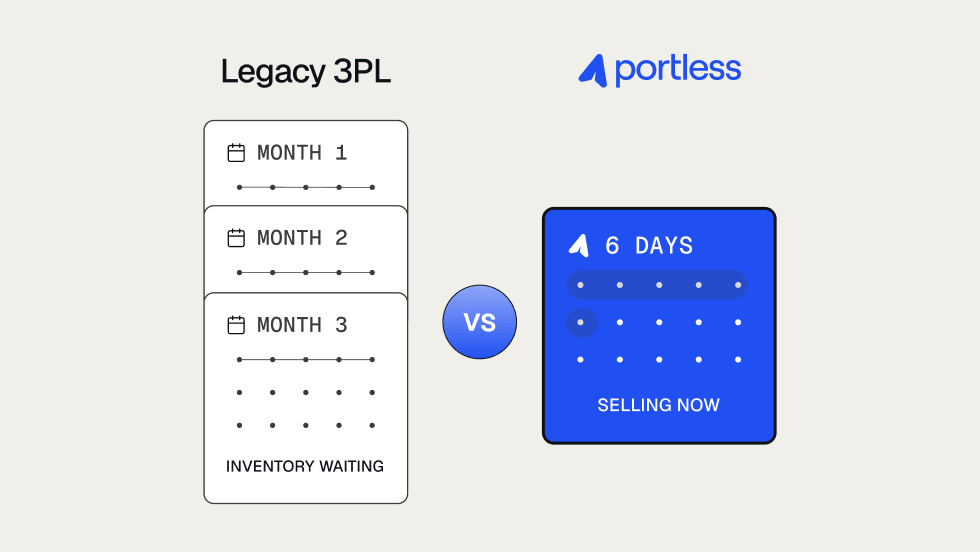
The legacy model locks cash into stock you can't sell yet
It takes two or three weeks for a manufacturer to produce the product and then it takes another five weeks on a boat to get here. So effectively, you've got capital tied up on a boat doing nothing. — Nikos Maniaty, Co-founder at Craft Club
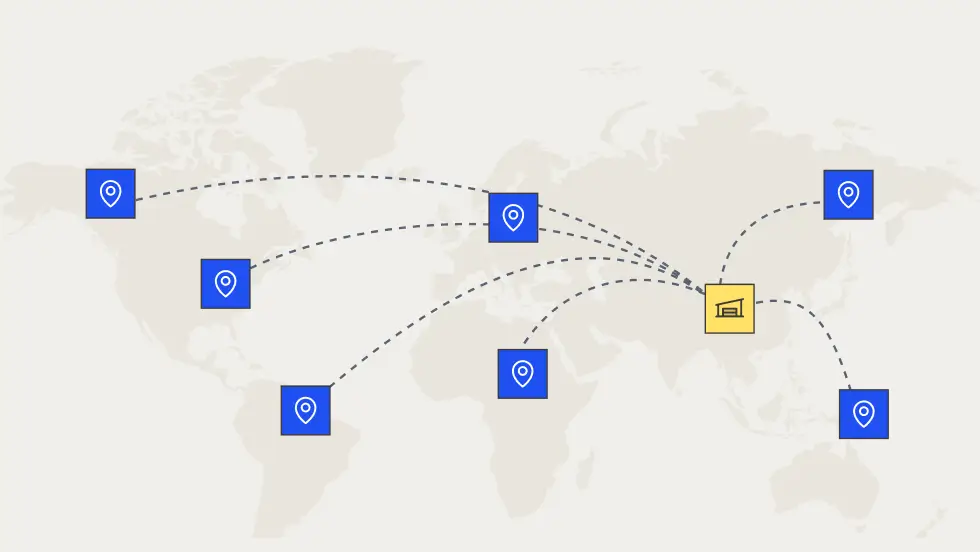
Orders ship by air from the fulfillment center to your customer's country, where a local carrier delivers the final mile through direct injection. You never need to fill a container, so a spike in ocean rates doesn't push you into a bigger order.
Air freight costs more per kilogram than sea freight. The gap narrows once you count what ocean freight adds, like weeks of carrying costs, duty paid upfront on the whole shipment, and stockouts while the next container is at sea. Our comparison of air freight vs sea freight runs the numbers. memobottle's figures show the trade-off. When it moved to Portless, it budgeted for a 10–20% increase in shipping costs to customers, and the increase during its test came in closer to 10%. It also expects to cut most of the $25–30K a month it spent on storage during peak periods.
Your reorders follow real sales
With a legacy 3PL, you commit stock 90 days out for each region. With Portless, you reorder against live sales data. Smaller, more frequent orders track demand closely, so less stock is left over when a product slows down.
Fast reorders also keep best sellers in stock. Ahead of Father's Day, menswear brand &Collar rerouted about 40,000 units through Portless within 30 days. Co-founder Mark Brown said that without it, &Collar would have been only 5% in stock on its hero SKUs. Its Father's Day sale revenue grew 35% year over year.
Craft Club saw the same thing. Co-founder Nikos Maniaty put the change this way:
We used to be out of stock all the time. Now, we're never out of stock because the speed at which we can order, the speed at which we can sell, the speed at which we can scale, it's all just so much greater. — Nikos Maniaty, Co-founder at Craft Club
One inventory pool serves every market
Portless serves 85+ countries from one inventory pool. You don't split stock across regional warehouses, so one region can't sell out while another sits on extra units.
New markets run from the same pool, so a product that slows in the US can sell in the UK or Australia. In practice, one pool means fewer warehouses and faster launches in new markets. memobottle is consolidating six regional 3PLs into one Portless hub, and it projects the move will cut its inventory holding by roughly 5x. Privacy Clo started selling in 17 new countries within months, with Portless handling compliance, duties, and documentation for each market.
You pay duty as orders ship
With direct fulfillment, the duty event happens at the point of sale, after the customer has already paid you. You don't pay duty on a full container of stock that may never sell.
Your cash turns over faster
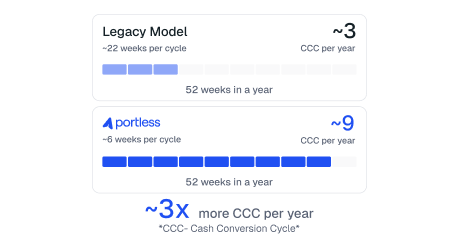
Craft Club's cash conversion cycle ran past 22 weeks under the legacy model, so its cash turned over about twice a year. With Portless, the cycle dropped to six weeks, which turns cash over more than eight times a year, and revenue grew 3x. Every dollar that isn't sitting in dead stock goes back into products that sell.
See how Portless works
Every order you place months ahead is a bet on demand. Talk to our team to see what your cash cycle would look like with Portless.
FAQ
What is dead stock?
Dead stock is inventory that hasn't sold and isn't expected to sell at full price. It ties up cash, takes up paid warehouse space, and usually ends up discounted or written off.
How do brands clear dead stock they already have?
Most brands discount it. In Netstock's survey, 77% used promotions or sales to move excess inventory, 39% used liquidation, and 34% moved stock to another location. Each of these trades margin for cash.
Does direct fulfillment change factory MOQs?
No, your factory sets its own MOQs. Direct fulfillment changes what happens after you meet them. Your stock is inbounded within a business day, you can sell it in 85+ countries, and you reorder against live sales, so an MOQ is less likely to leave you with units you can't move.
Frequently asked questions
Heading
Lorem ipsum dolor sit amet, consectetur adipiscing elit. Suspendisse varius enim in eros elementum tristique. Duis cursus, mi quis viverra ornare, eros dolor interdum nulla, ut commodo diam libero vitae erat. Aenean faucibus nibh et justo cursus id rutrum lorem imperdiet. Nunc ut sem vitae risus tristique posuere.
Get operator-level supply chain insights
Thank you! Your submission has been received!
Oops! Something went wrong while submitting the form.






.jpg)

.avif)