“We generated $70K in package protection revenue in a single quarter by adding a simple $4 protection option at checkout — plus an additional $12K from cashbacks. Customers get peace of mind, and we're making a profit on every protected order with zero effort."
“We generated $70K in package protection revenue in a single quarter by adding a simple $4 protection option at checkout — plus an additional $12K from cashbacks. Customers get peace of mind, and we're making a profit on every protected order with zero effort."
The cheapest way to ship from China is almost never the method with the lowest quote. If you manufacture in China and sell DTC products into the US or worldwide, the freight rate is one line on a bill that also carries duty and storage. It says nothing about the weeks your cash spends in transit. Here's what each method costs, and what decides the number you actually pay.
What's the cheapest way to ship from China?
It depends on weight and how fast you sell through. Sea freight almost always wins on the freight rate itself. For lightweight goods with variable demand, air freight usually wins once everything else is counted. Heavy or bulky goods with steady demand still price best on the water.
Sea freight prices per container and takes 30 to 45 days on the water, plus customs and receiving, before anything is sellable.
Air freight prices per kilogram and moves in days. It suits lightweight goods like apparel, beauty, and small electronics.
Sea or air sets your freight rate and your lead time. It doesn't set when you pay duty. That comes down to whether you import in bulk or ship against confirmed orders, and it moves more money than the rate does.
Sea freight: lowest cost per unit, longest cash cycle
Sea freight prices per container and wins on cost per kilogram. It also commits you to a transit time of 30 to 45 days, plus customs and receiving at the other end, before a single unit is sellable.
You can book a full container load (FCL) or less than container load (LCL). A full container is yours alone and prices per container. LCL shares space, prices per cubic meter, and adds consolidation at origin and deconsolidation at destination. Small volumes absorb a lot of that fixed handling, which narrows the gap against air on a first production run.
Reliability doesn't improve when prices rise. Xeneta measured global on-time performance at 29.4% in August 2026. Peter Sand, Xeneta's chief analyst, called it "a strange contradiction witnessed during every major market shock." In his words, "the more a shipper must pay, the poorer the service."
Air freight: the method that fits lightweight DTC orders
The economics turn on weight. Air usually wins under about 3.5 pounds (1.6 kg), which covers many DTC catalogs. Heavier than that, the per-kilogram gap against sea widens faster than the cash benefit closes it. By our own estimate in our comparison of air and sea freight, sea costs roughly a twelfth to a sixteenth of air per kilogram. It still loses on total cost once duty, storage, carrying cost, and stockouts are counted. Express couriers fly the same lanes at a premium, priced per parcel rather than per kilogram.
That math only pays off if a single parcel can leave a Chinese factory and arrive looking like a domestic delivery. Direct injection is how. Parcels fly from the origin country, clear customs on arrival, and hand off to a domestic carrier for the last mile.
Portless runs on direct injection, shipping from a fulfillment center close to the point of manufacture. Parcels go straight into the local carrier network instead of routing through a consolidator, so fewer carriers touch each one between the factory and the door. Your customer gets a USPS or Royal Mail tracking number and a domestic delivery window, and orders reach more than 75 countries in five to eight days.
What sea and air actually cost you
::table
;Sea freight;Air freight
Priced by;The container, or cubic meter for LCL;The kilogram
Transit;30 to 45 days, plus customs and receiving;Days
Smallest practical shipment;A container, or a consolidated LCL load;A single parcel
Best fit;Heavy or bulky goods with steady demand;Lightweight goods, under about 3.5 pounds
Where it breaks down;Forecast risk, and cash locked in transit;Per-kilogram cost rises fast with weight
:table
You pay duty on every parcel now, so timing is the lever you control
Low-value parcels used to enter the US free of duty under the $800 de minimis threshold, through a rule called Section 321. That exemption is suspended indefinitely, so those parcels clear customs and pay duty like any other import. Our guide to where US import rules stand covers the current position, and our de minimis tracker shows where thresholds sit country by country.
The suspension is what ended the postal route. China Post and ePacket were cheap because of the exemption, not because of the postage. Without it, what's left is the slowest parcel service on the board, paying duty like everything else.
Governments set the rate. You set the timing. As duty timing versus duty rates lays out, a $100,000 shipment at a 25% duty rate means wiring $25,000 months before any of it sells. Import in bulk and you pay on every unit in the container, including the ones that never sell. Ship against confirmed orders and duty lands per parcel, after your customer has already paid you.
Moana Bikini moved off bulk importing for that reason. Operations manager Ryan Jones described the change as "being able to not have to pay a bulk tariff on entry into a North American 3PL, and be able to pay as you go." For a small business, he said, the cash flow difference is hard to overstate.
What actually drives the number on your invoice
Dimensional weight. Carriers bill the higher of actual or dimensional weight, using a divisor of 139. A 12 by 12 by 12 inch box holding a two-pound product bills as 13 pounds. Check billed weight per SKU before you pick a carrier.
Zones. Distance costs you most on the domestic leg. At published commercial rates, a two-pound USPS Priority Mail package runs $9.35 in Zone 2 and $14.25 in Zone 8, a 52% premium for the same parcel. Zone skipping recovers part of it.
Storage and handling. A domestic warehouse charges $15 to $40 per pallet per month for every month the stock sits there, plus $2 to $5 per order for pick and pack.
The lowest freight rate is rarely the lowest total cost
Landed cost and cash conversion cycle decide whether a shipping decision makes you money. Landed cost is the full price of a unit once freight, duty, and fees are in. Your cash conversion cycle is the days between paying your supplier and collecting from your customer. Bulk importing stretches both.
Memobottle shipped by sea into six regional warehouses. Supplier deposits came first, then production, then 45 to 80 days on the water across those six destinations. "We actually weren't recouping any cash from sales for 120 days, if not more," said Jonathan, one of the brand's co-founders. Consolidating six warehouses into one fulfillment center close to the point of manufacture cut that cycle to a few days. It also removed $25,000 to $30,000 a month in storage and brought product launches forward by more than 100 days.
The freight rate barely moved. The savings came from skipping the warehouse, deferring the duty, and taking weeks out of the cycle.
Direct fulfillment changes which number you're optimizing
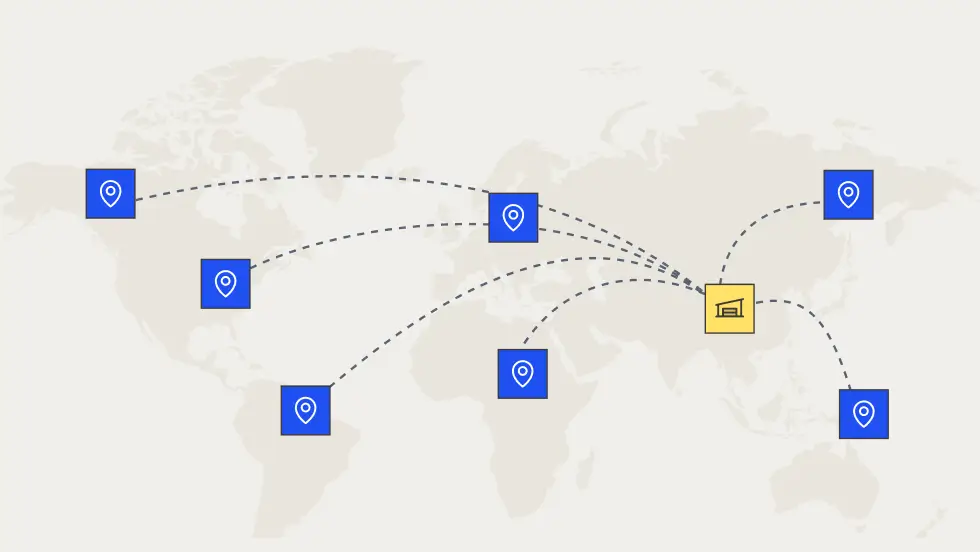
Direct fulfillment ships confirmed orders by air from a fulfillment center essentially right next to your factory in China, straight to the customer. No domestic warehouse sits in the middle, so there's no container of unsold stock to finance and no duty paid months before revenue.
The last mile looks the same either way. Both models hand your parcel to USPS, Royal Mail, or Australia Post for the final stretch. What changes is where the parcel starts and when you paid duty on it.
Shein and Temu proved the model at scale, compressing the supply chain cycle from 60 to 90 days down to five to 10. The same model is now available to brands without their volume.
::table
Factor;Legacy bulk import;Direct fulfillment
Who holds stock, and where;You, in a domestic warehouse or 3PL;A fulfillment center close next to your manufacturer
Cash tied up in inventory;Months of stock, plus freight, duty, and storage, all paid before the first sale;Much, much less, because short lead times let you buy in smaller, more frequent runs
What sets your lead time;Sea transit, then customs, then receiving;Production, then the next available flight
When duty is paid;Upfront, on the whole shipment;Per parcel, after the sale
Inventory exposure;You commit to a forecast months out;You replenish against real demand
Best fit;Heavy or bulky goods with steady demand;Lightweight goods with variable demand
:table
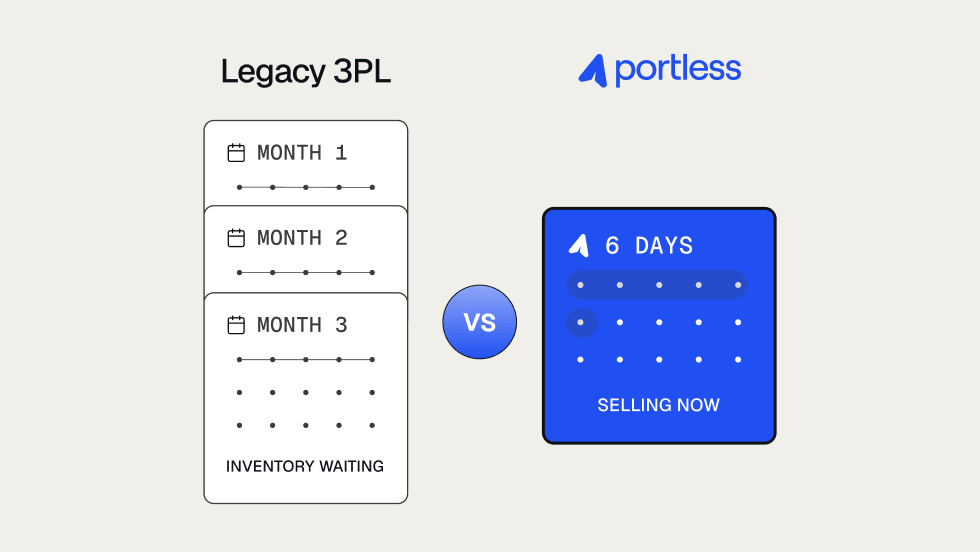
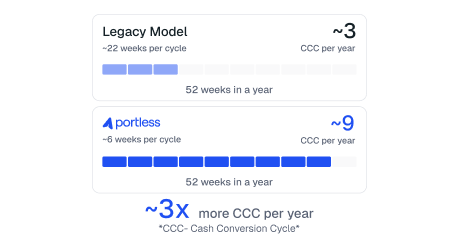
The results show up in stock position and working capital. For example, &Collar took its hero SKUs from 5% in stock to 100%, a 20x improvement, after rerouting 40,000 units in under 30 days. Revenue grew 35% year over year through its Father's Day peak. Craft Club, another example, cut its cash conversion cycle from more than 22 weeks to six, and tripled revenue as it did.
Most brands are under the same pressure. Our Ecommerce Tariffs Benchmark Report surveyed 133 US brands: 92% raised prices, and 79% still saw margins compress.
Direct fulfillment doesn't suit everything. Heavy or bulky goods with steady demand still price best on the water. For lightweight goods with variable demand, the freight rate stops being the number that decides your margin.
How to pick the right method for your product
Start with weight. It settles most of the question before you price anything.
Price the model, not the rate. For recurring inventory, compare landed cost and cash conversion across models before you compare quotes. Our rundown of the best Ecommerce fulfillment services covers what each model costs to run.
Use express where it earns its price. Samples, urgent restocks, and the batch you can't wait on. Not a month of stock.
Consolidate small factory shipments. If you buy from several suppliers, combining the inbound leg through a freight forwarder cuts handling and customs overhead.
Collect duty at checkout. DDP keeps customs fees off your customer's doorstep, so fewer parcels get refused on delivery.
Reprice every quarter. The Shanghai to Los Angeles rate nearly tripled in 12 months. A method that won last year may not win this one.
Add freight, duty, storage, and pick and pack for each option. Then look at how much cash each one locks up, and for how long. Our ROI calculator runs that comparison with your own volumes.
See how Portless works
Freight rates, duty rates, and import rules all move, and every one of them changes the cost of the same parcel. Portless fulfills orders direct from the point of manufacture to customers in more than 75 countries, with duty paid per parcel and delivery in five to eight days. See how it works, or book a demo to see the math on your own catalog.
Frequently asked questions
Heading
Lorem ipsum dolor sit amet, consectetur adipiscing elit. Suspendisse varius enim in eros elementum tristique. Duis cursus, mi quis viverra ornare, eros dolor interdum nulla, ut commodo diam libero vitae erat. Aenean faucibus nibh et justo cursus id rutrum lorem imperdiet. Nunc ut sem vitae risus tristique posuere.
Get operator-level supply chain insights
Thank you! Your submission has been received!
Oops! Something went wrong while submitting the form.






%20(1).avif)

.jpg)
.jpg)
.jpg)