Somewhere between your product page and your confirmation email, you make a delivery promise. It might be a date at checkout or just a shipping method name. Either way, the window you can hold was set months earlier, when you decided where to put your inventory.
For most direct-to-consumer (DTC) brands, that inventory decision is where the money goes. You buy stock, ship it across the ocean, and clear it through customs so it’s sitting near your customers before they order. Your shipping rates are a small line item next to it.
The window you actually have to hit
A date you can keep is worth more than the fastest date you can quote. Asked directly, shoppers name a fast number, and the AlixPartners 2026 home delivery survey puts free-delivery expectations at an average of 2.7 days. What they actually do ranks differently. 35% permanently abandon a retailer after one late delivery, per the Bringg 2026 Delivery Experience Study.
Speed still has a floor. Baymard Institute’s cart abandonment research shows 20% of shoppers abandon because delivery is too slow, with 40% abandoning over extra costs like shipping and fees. Clear the floor and consistency carries the rest, which we work through in why reliable delivery beats faster delivery.
So the target isn’t two days. It’s a date you can name at checkout and hit consistently. That target costs far less to reach, and the rest of this post is about what it takes.
Where the speed expectation came from
Shoppers didn’t always expect two-day delivery. A handful of large players trained that expectation over the past decade, and now every brand inherits it.
Amazon set the pace. Amazon Prime delivery data shows the company delivered more than 13 billion items same-day or next-day in 2025. That volume set the reference point, and a five-person brand gets measured against it.
The share of retail moving online keeps that pressure climbing. US Census Ecommerce data shows Ecommerce reached 17.1% of total US retail sales in Q2 2026.
Speed usually costs cash and margin
Most advice tells you to just go faster. Add premium carriers, or spread inventory across more regional warehouses.
That raises your operating costs, and it does more damage to your cash.
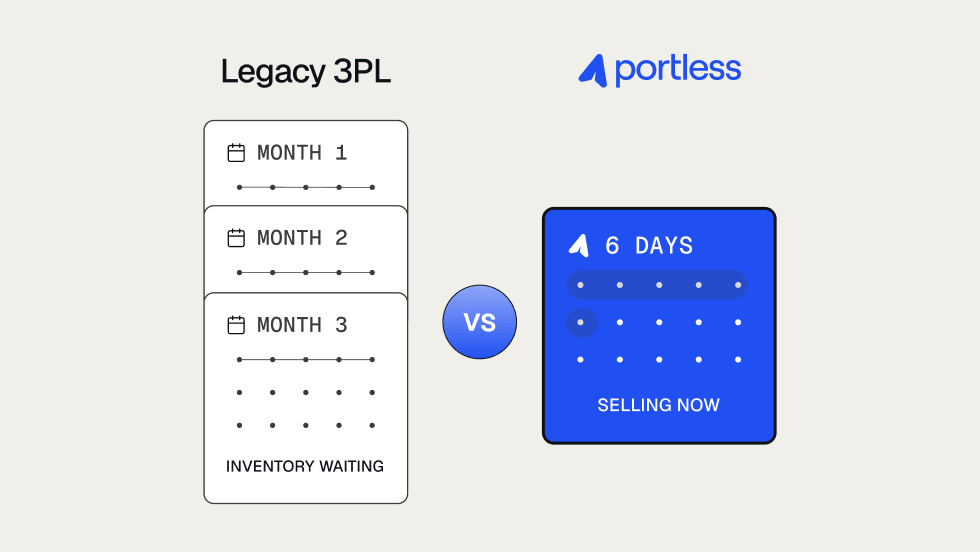
The legacy way to hit the window works like this. You ship bulk stock across the ocean, then store it in warehouses near your customers. You also pay duties upfront on goods you haven’t sold.
That path leans on ocean freight, the slow bulk sea route that moves goods in containers. It also leans on a third-party logistics (3PL) provider that stores and ships your inventory.
You bet your cash on a forecast months before you know real demand, which is what drives the DTC cash flow trap.
What each fulfillment model costs you to hit a window
Three fulfillment models can put a reliable date at checkout. They differ mostly in how much cash you tie up to get there, and how long that cash stays tied up.
Each model shapes how transit time works. That’s the number of days a parcel spends moving from dispatch to the customer.
Self-fulfillment
You hold the stock and pack every order yourself. This works at low volume, and it keeps you close to your product.
Speed and reach cap out fast, though. You might manage same-day shipping locally. Distant orders still lag behind.
Legacy 3PL with distributed warehouses
You pre-ship bulk inventory by sea, then store it across regional warehouses. Orders ship from the warehouse nearest each customer, which makes two-day shipping possible in-region.
Your cash sits in stock you haven’t sold yet, though. Far-zone deliveries also cost more. Rethinking your 3PL location shows a two-pound package costs 52% more to the farthest US zone than the nearest.
Direct fulfillment from the point of manufacture
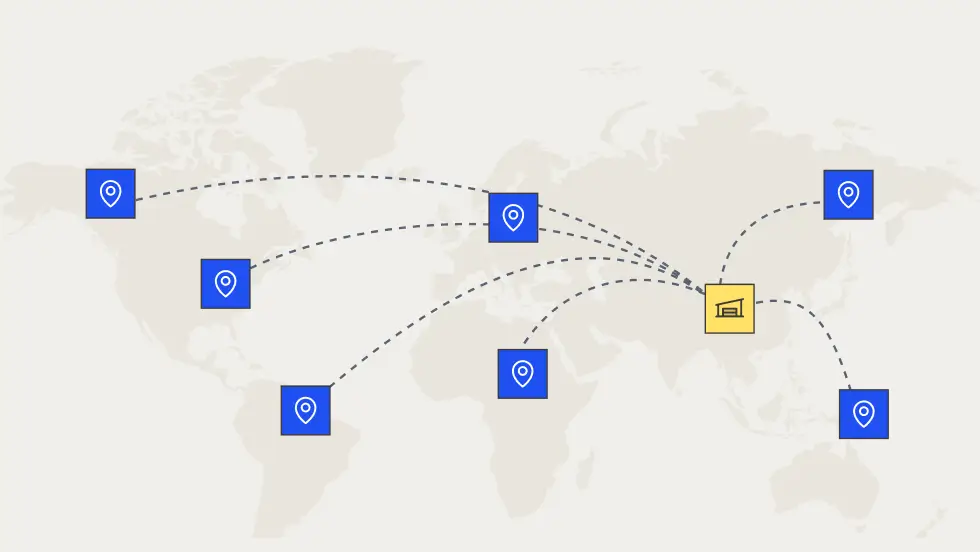
The direct fulfillment model ships each order straight from a hub at the point of manufacture to your customer. You skip bulk freight and domestic warehousing entirely.
Products are ready to sell days after production, and each order leaves on the next available flight. That cuts days out of transit.
It can also cost less, because you drop warehouse fees. How direct fulfillment works covers the mechanics.
::table
Model;Cash tied up before the first sale;What sets your lead time;Duties paid
Self-fulfillment;Full inventory buy, held by you;Your own pick-and-pack capacity;Upfront, on the whole shipment
Legacy 3PL;Full inventory buy, plus freight and storage;Ocean transit, then warehouse receiving;Upfront, on the whole shipment
Direct fulfillment;Production only, no pre-imported stock;Production, then next available flight;Per parcel, after the sale
:table
What direct fulfillment frees up
Inside direct-from-China operations shows orders packed before cutoff make same-day flights out of Shenzhen and Hong Kong, moving across 20+ last-mile carriers. That’s how Portless delivers in five to eight days to 75+ countries, on the same window every time rather than a range that moves with the ocean.
A delivered duty paid (DDP) model handles duties. Duty is calculated and paid before the parcel ships rather than collected on arrival.
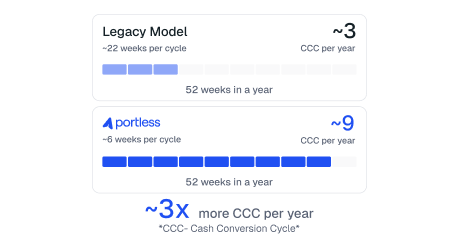
Shipping direct also compresses your cash conversion cycle, the time between paying for inventory and collecting from customers.
Real success stories from real DTC brands
- Craft Club hit 3x growth as its cash conversion cycle dropped 3x, with orders averaging seven days from order to delivery.
- &Collar rerouted 40,000 units straight from the factory in under 30 days, met every service level, and drove a 35% year-over-year revenue increase.
- Cosara pulled delivery from 15+ days to six to eight days, and weekly revenue grew 10x.
How to tell if your brand can compete on speed
Chasing speed past the point customers notice has a cost of its own. Use this checklist to gauge your fit for a speed-first model:
- Lightweight products. Your items weigh under 3.5 lbs, so air shipping stays affordable.
- Healthy margins. Your margins can absorb fast shipping without erasing profit.
- Worldwide customers. You sell across borders, not just one region.
- Hard-to-forecast demand. Your sales are tough to predict months ahead.
- Cash to protect. You prefer not to sink capital into pre-imported stock.
If most or all of these describe your brand, a speed-first model is worth getting quotes on. Fewer than that and the economics probably won’t work yet.
See how Portless works
A delivery date you keep is worth more than one you beat. The harder part is holding that date without parking six figures of inventory in a warehouse first.
Direct fulfillment lets you hold a consistent window and keep capital free for growth. Book a demo to see whether it fits your product mix and markets.
FAQ
What’s a realistic delivery window if you manufacture overseas?
Five to eight days is achievable shipping direct from the point of manufacture, without pre-positioning stock in the destination market. Bulk importing can beat that once goods land, but only after four to eight weeks of freight and receiving, and the window moves with the ocean. A window you hold consistently is worth more than a faster one you miss.
Can direct fulfillment speed up Ecommerce shipping?
Yes. Shipping each order from the point of manufacture makes products sellable days after production instead of weeks after a sailing, and each order leaves on the next available flight.
Should you promise a delivery date or a delivery window?
A window, in most cases. A single date sets an expectation you either meet exactly or miss visibly, while a two-day window absorbs the normal variation in carrier handoffs. Either way, the number has to be one you hit consistently.






.jpg)

.jpg)
%20(1).jpg)