“We generated $70K in package protection revenue in a single quarter by adding a simple $4 protection option at checkout — plus an additional $12K from cashbacks. Customers get peace of mind, and we're making a profit on every protected order with zero effort."
“We generated $70K in package protection revenue in a single quarter by adding a simple $4 protection option at checkout — plus an additional $12K from cashbacks. Customers get peace of mind, and we're making a profit on every protected order with zero effort."
A soft month shows up, your paid media agency looks like the reason, and your brand starts shopping for a replacement. Two quarters later the same dip arrives with a different agency's name on it. The cause usually sits months upstream of the campaign, in the gap between a marketing calendar that moves weekly and a supply chain calendar that commits in quarters.
Sean Christman spent close to a decade on the brand side before co-founding Proper Growth, a back-office firm that runs finance, accounting, and supply chain for DTC brands in the $5M to $50M range. He was part of the founding crew at Cuts Clothing in 2016. On a recent Portless partner session, he laid out why the two calendars fall out of sync, and what happens to brands when the supply chain side gets shorter.
Your brand runs on two clocks
Marketing operates week to week and can be adjusted continuously. Supply chain forces binding decisions months before you see the result.
"There are two competing calendars within a lot of these brands. There's the day-to-day, week-to-week, month-to-month marketing calendar. And then there's the supply chain, which is longer, a little more cumbersome, and it forces you, when you're making a physical good, to make concrete decisions months in front of when you're actually going to see the execution happen." — Sean Christman, co-founder, Proper Growth
A purchase order you commit to in March is a forecast of what your marketing team can sell in July. You place it before July's creative exists, before the channel mix is set, and before you know what your competitors will be discounting. That distance is where inventory mistakes start.
Why the gap gets blamed on marketing
The symptoms surface in marketing first, which is how the agency ends up answering for a decision made a quarter earlier. Sean watched it happen from the inside at Cuts.
"Early days at Cuts, we churned through paid media agencies like we churned through product launches. Any little downturn in performance and it was, ‘all right, they're not cutting it, time for a new one.’"
But when he looked harder, much of the responsibility sat with the brand.
"Stockouts, overstocks, and limited cash supply can oftentimes be pointed back to efficiency targets in marketing being too high or too low."
Supplier variance, QC holds, and demand shocks all cause the same symptoms, so this is one contributor among several. It's the one brands are least likely to look at, because the evidence for it shows up in a dashboard owned by a different team. Set the efficiency target too aggressively and you sell through inventory you can't replace for four months. Set it too conservatively and you hold stock that costs you money every day it sits.
Cash behaves the same way. Capital sitting in unsold inventory is capital you can't spend acquiring customers, which is how your supply chain ends up capping your ad budget no matter how well your campaigns perform.
Free diagnosticHow much cash is your supply chain trapping?Answer 10 quick questions about how you move inventory and capital. You'll get a grade from Legacy to Modern, see how much cash your current setup has tied up, how you compare with similar brands, and the three moves that matter most for where you landed.Start the diagnostic →
Better forecasts can't close a four-month gap
Forecast accuracy runs into a ceiling on a long horizon, because you're predicting demand for a season that hasn't started. Compress the horizon and the ceiling rises on its own, because you commit later with more information in hand.
"The only thing that we know about a plan is that the plan is going to be wrong. What our job is, is to get it more right."
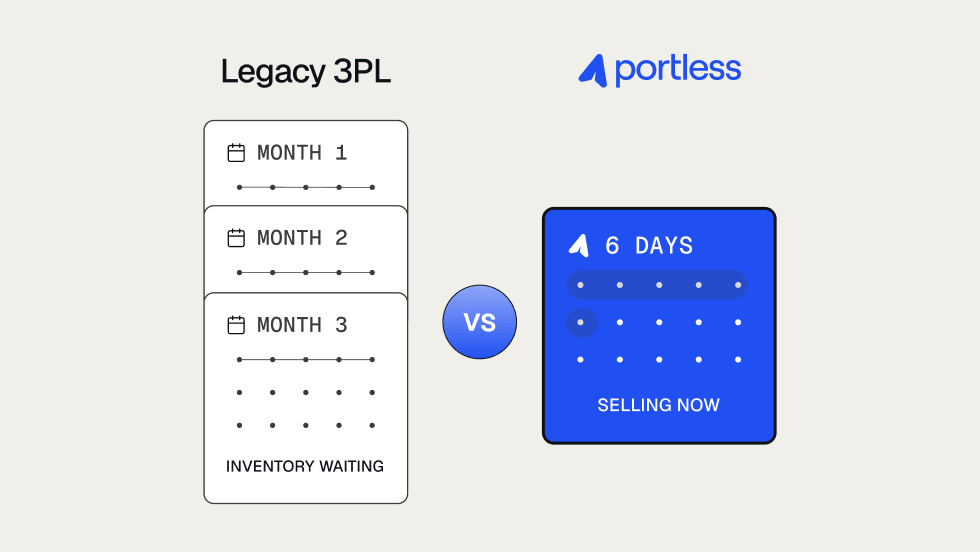
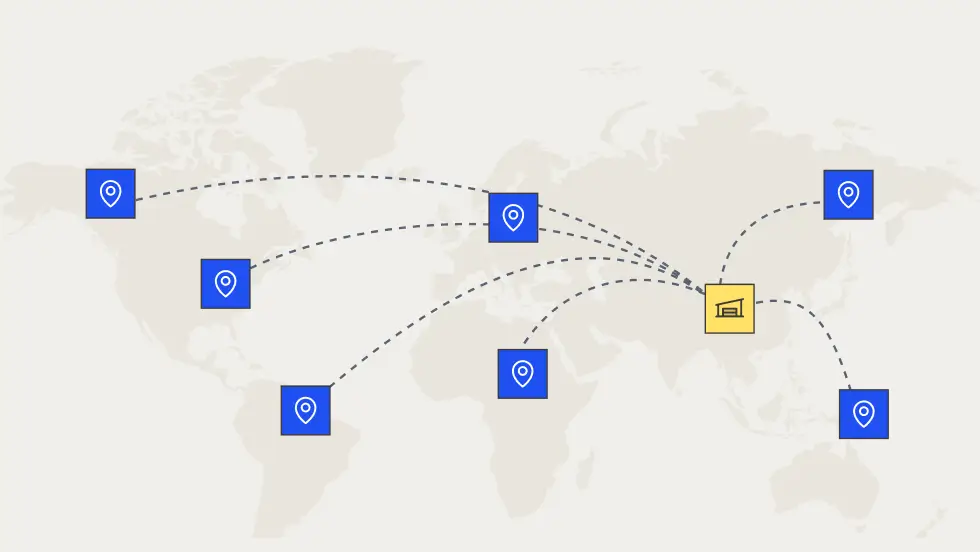
That's the mechanical case for direct fulfillment. The conventional path runs production, consolidation, ocean transit, customs, and domestic trucking before a single unit can be sold. Direct fulfillment moves inventory from the factory to a fulfillment center nearby, where it's ready for sale in one to two days. Orders ship to the customer from there, arriving in roughly five to eight days across 75+ countries.
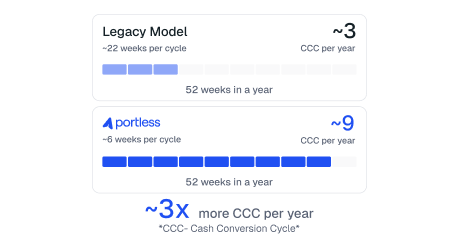
Craft Club's founder described the old calendar exactly: "It takes two or three weeks for a manufacturer to produce the product and then it takes another five weeks on a boat to get here." After switching, their cash conversion cycle went from 22+ weeks to six, and revenue tripled.
What changes when the calendar compresses
Compressing the calendar doesn't hand you an easier planning job. Sean walked a client through the transition and the questions that came up weren't about logistics.
"That was a lot of the conversation. Aren't costs higher? What if a product gets lost? I used to have two and a half, three weeks, a month to be able to know and plan for, ‘my product is ready, it's on the water and it's coming. I'm going to lose that month of preparation.’"
A brand that spent years planning around a fixed transit window built habits around it. Those habits assume a month of lead time that no longer exists, and without something in their place the change lands as pressure. Sean's answer is cadence.
"It's a positioning conversation, an expectation conversation, and an operating rhythm conversation, to be able to utilize this as an asset rather than something that is going to pile more work on or shorten the decision-making window."
Proper Growth runs two standing reviews with every client, every week:
::table
Review;Questions it answers
Inventory position;What's in the factory right now? What's already in motion? What do we need to buy this week? What did the last seven days of demand change about that?
Cash position;How much cash do we have today? How much is already allocated? How much is coming in? How fast is it turning?
:table
A monthly version of these reviews can't keep pace with a supply chain that responds in days, and the speed you paid for goes unused. Running them weekly is also the fastest way to shorten your cash conversion cycle, because you catch allocation decisions while you can still change them.
Where to start
Measure the distance between your two calendars before you change anything:
Take your last four purchase orders and write down two dates for each: the day you committed the money, and the day the first unit was sellable.
Work out how far ahead your marketing plan is actually firm. The difference is the number of weeks you're making inventory decisions on information you don't have yet.
As a rough guide, a gap under six weeks means you're buying against a plan you can still see. Past twelve, a meaningful share of your inventory decisions are being made blind, and the variance between those four purchase orders matters as much as the average.
If the gap runs to months, you have two levers. Shorten the production-to-sellable timeline where your fulfillment model allows it, and put the weekly inventory and cash reviews in place so the time you recover turns into faster decisions. The second lever works whether or not you change anything about how you ship, and most brands can start it immediately.
For the first lever, book a walkthrough with our team and we'll map your current production-to-sellable timeline against a direct fulfillment one, using your SKUs, your lead times, and your order volumes.
FAQ
Can you shorten your supply chain calendar without changing fulfillment models?
Yes, though the gains are smaller. Airfreighting part of each production run, negotiating shorter factory lead times, and placing smaller and more frequent purchase orders all pull the commitment date closer to the selling date. Each adds cost per unit, so brands tend to apply them to their fastest-moving SKUs rather than the full catalog.
What happens to safety stock when lead times get shorter?
Safety stock requirements fall as lead times fall, because you're covering a shorter window of uncertainty. The standard planning rule is that safety stock scales with the square root of lead time, so cutting a 16-week lead time to four weeks cuts the buffer roughly in half at the same service level. For most brands, released capital is the biggest perk of compressing the calendar.
Does this apply to brands manufacturing outside of Asia?
The calendar mismatch applies anywhere production lead times exceed marketing planning horizons, which covers most manufacturing regions. What changes is the size of the gap. A brand producing domestically on four-week lead times has far less to manage than one on a four-month overseas cycle. Weekly inventory and cash reviews are worth running either way.
Frequently asked questions
Heading
Lorem ipsum dolor sit amet, consectetur adipiscing elit. Suspendisse varius enim in eros elementum tristique. Duis cursus, mi quis viverra ornare, eros dolor interdum nulla, ut commodo diam libero vitae erat. Aenean faucibus nibh et justo cursus id rutrum lorem imperdiet. Nunc ut sem vitae risus tristique posuere.
Get operator-level supply chain insights
Thank you! Your submission has been received!
Oops! Something went wrong while submitting the form.






%20(1).jpg)