“We generated $70K in package protection revenue in a single quarter by adding a simple $4 protection option at checkout — plus an additional $12K from cashbacks. Customers get peace of mind, and we're making a profit on every protected order with zero effort."
“We generated $70K in package protection revenue in a single quarter by adding a simple $4 protection option at checkout — plus an additional $12K from cashbacks. Customers get peace of mind, and we're making a profit on every protected order with zero effort."
Shein and Temu didn't become two of the fastest-growing Ecommerce companies on price alone. Behind the low costs, big product selection, and fast delivery times is a fulfillment model most brands don't use: direct to consumer shipping from China.
The model skips the ocean freight containers, skips the domestic warehouse, and ships finished goods by air directly from China to the customer's door. It's faster than most people assume — Portless merchants average six-day delivery — and it fundamentally changes the cost structure of running a DTC brand.
This post breaks down how the model works, why it gives Shein and Temu a structural advantage, what happened when US tariffs changed, and how independent DTC brands are using the same playbook.
What is China direct to consumer shipping?
China direct to consumer shipping — sometimes called direct fulfillment from China — is a model where finished goods ship from manufacturers or fulfillment centers in China directly to end customers via air freight. There's no bulk ocean shipment to a US warehouse, no domestic storage, and no separate pick-and-pack step.
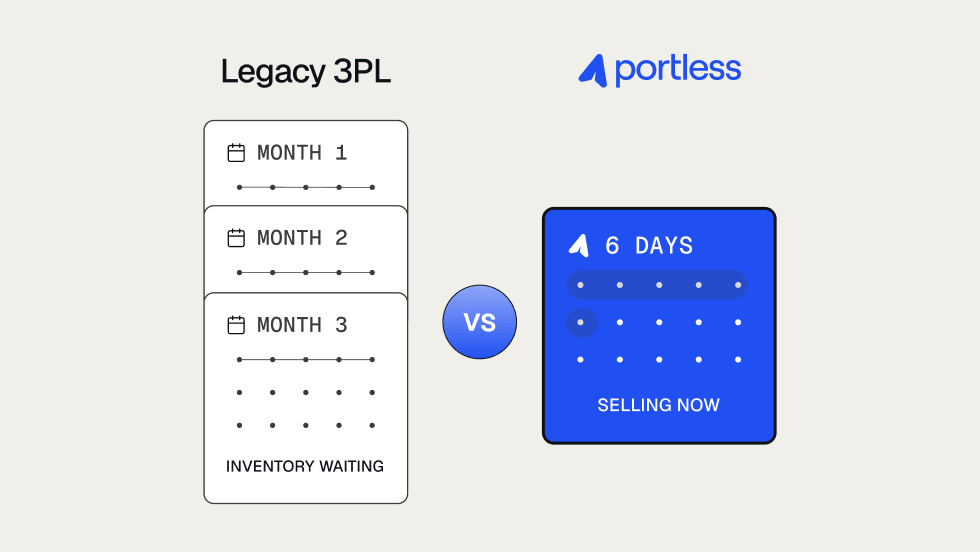
Here's how the legacy supply chain model — that Temu and Shein don’t use — works:
Brands manufacture goods in China.
Goods ship in bulk via ocean freight to a US warehouse a few times per year — with six or more weeks of lead time.
Tariffs and duties are paid on the entire container load when they enter the country
Goods are inbounded, made available for sale, and then sit in domestic storage or warehouse until an order is placed.
An order is picked, packed, and shipped domestically to the customer with a last-mile delivery provider (like USPS)
In the direct-from-China model, steps two to four disappear. The result is a faster, leaner supply chain — and a fundamentally different cost structure.
Factor
Legacy model (ocean freight + US 3PL)
Direct from China (air freight)
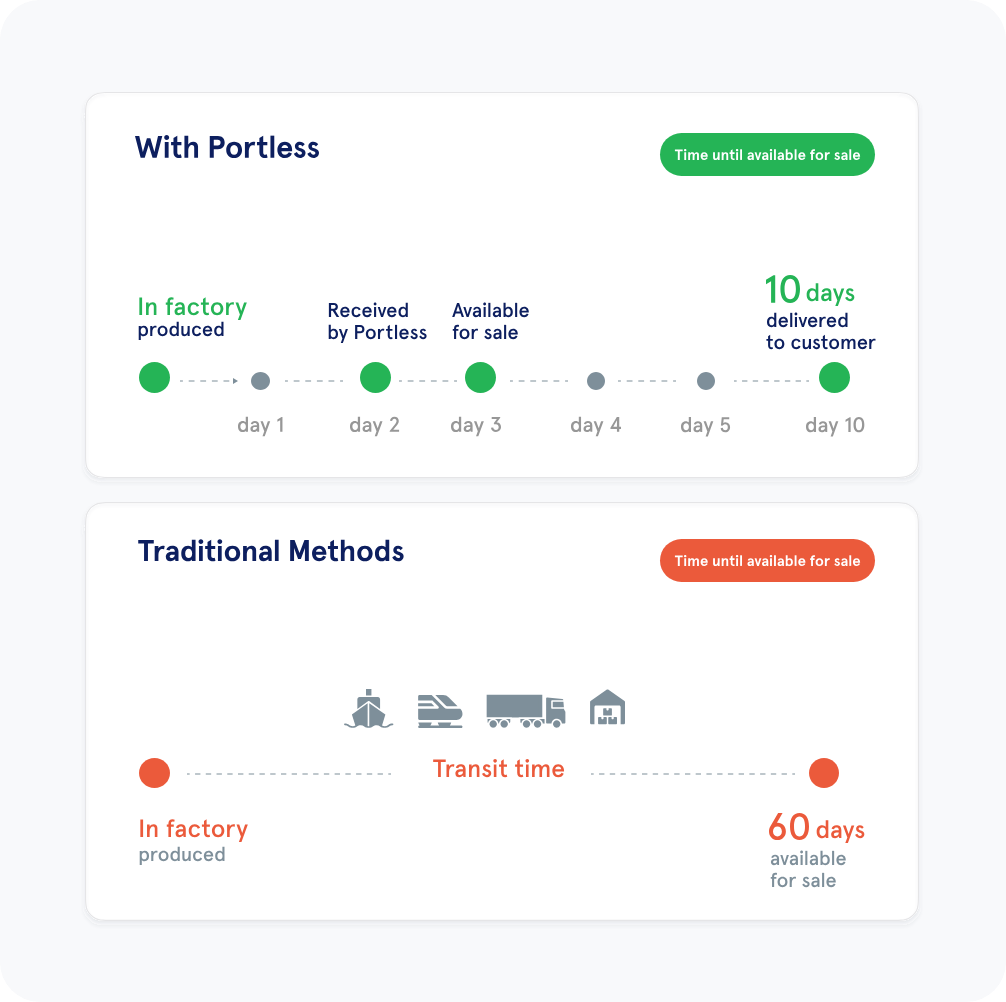
Production to first sale
60–90 days
5–10 days
Domestic warehousing
Required
None
Inventory risk
High (bulk pre-purchase)
Low (sell-then-ship or small batches)
Customer delivery (US)
2–5 days from warehouse
5–10 days from China
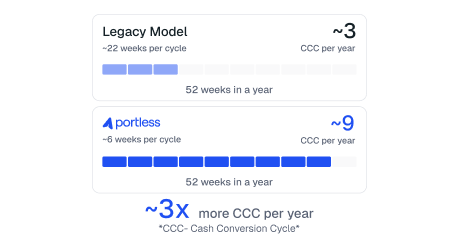
Cash conversion cycle
60–120 days
Under 30 days
Best for
Heavy/bulky goods, same-day delivery
Lightweight, higher-margin DTC products
Why air freight works for this model
The economics work because the products Shein, Temu, and similar brands sell are light relative to their sale price. Air freight on a 300g fashion item costs a few dollars. That cost is more than offset by eliminating months of warehousing, the carrying cost of pre-purchased inventory, and — for brands shipping through bonded facilities in China — a 13% VAT rebate that non-bonded routes can't access.
Bonded vs non-bonded warehouses in ChinaA bonded warehouse lets your factory treat goods as exported, unlocking a 13% VAT rebate. Non-bonded skips the rebate but offers cheaper shipping, storage, and pick-and-pack. For most low-to-mid COG DTC products, non-bonded nets out cheaper.Read the full comparison
How Shein and Temu built their advantage on this model
Both brands built their supply chains around direct-from-China fulfillment from the start. The architecture is the same one any DTC brand manufacturing in China can use — Shein and Temu just proved it works at a massive scale.
Shein
Shein holds roughly 50% of the US fast fashion market and ships to over 25 countries, all without relying on a domestic warehouse network. Its supply chain is built on real-time inventory visibility across its manufacturer base, automated order routing, and direct air freight from China to customers internationally. It adds hundreds of new SKUs daily — a pace that would be impossible with a legacy fulfillment cycle.
Temu launched in September 2022 and scaled faster than almost any Ecommerce platform before it. By May 2023 it had outpaced Shein on sales in several product categories. Its five Super Bowl ads in February 2024 — backed by $15 million in giveaways and the "shop like a billionaire" tagline — pushed it to the #1 spot on the App Store, with downloads rising 47% on game day alone according to Sensor Tower.
The model was the same: manufacture close to inventory, ship direct via air freight, route each order algorithmically to the fastest and cheapest carrier available.
Post-tariff, Temu took a different path than Shein. It shifted toward US warehouse fulfillment on its highest-volume SKUs, effectively marking direct-from-China items as out of stock for US customers. By 2026, Temu's US warehouses are projected to handle 20–25% of its US volume. The rest still routes through the direct model or semi-managed sellers.
Does Temu or Shein ship faster?
Both brands deliver significantly faster than legacy retailers fulfilling from domestic warehouses after a 60-day ocean freight inbound. But the real story is that direct-from-China fulfillment is genuinely fast in absolute terms — not just "faster than ocean freight."
The table below shows a side-by-side of Shein and Temu’s shipping models, along with what a brand using Portless or a legacy 3PL could achieve:
Brand
Typical US delivery
Model
Shein
7–14 days standard
Direct from China + some US warehouse
Temu
6–20 days standard
Shifting to US warehouse fulfillment
DTC brand via Portless
5–7 days avg
Direct fulfillment, domestic last-mile carriers
DTC brand via legacy 3PL
2–5 days (after 60+ day inbound)
Ocean freight to US warehouse
Here's what's worth noting: Shein and Temu built massive repeat customer bases with seven-to-20-day delivery windows. You don't see reviews complaining about slow shipping because customers know what to expect when they order. The delivery promise is clear, and it's met consistently. That matters more than raw speed.
Portless averages six-day delivery to US customers because it uses domestic last-mile carriers for the final leg — the customer gets a tracking experience identical to a domestic shipment.
The comparison isn't Temu vs Shein. It's direct fulfillment vs the legacy supply chain model, where your inventory sits on a container ship for a month before it's even sellable.
How a direct-from-China supply chain works
Real-time inventory visibility
Direct-from-China brands maintain a live view of manufacturing inventory across their supplier network. When demand spikes on a product, they pull from whichever factory or consolidation hub can fulfill fastest. This lets them respond to demand signals in days instead of weeks.
Automated order routing
Orders match to inventory location and carrier automatically. There's no manual pick, sort, or cross-dock step. Once placed, an order routes directly from the optimal fulfillment point to the customer's address. This removes the domestic warehouse layer entirely.
Multi-carrier optimization
Both Shein and Temu work with multiple carriers — postal services, private couriers, airline consolidators — and route each shipment algorithmically. A $12 order to California ships differently than a $35 order to New York. This per-order optimization adds up to significant savings at scale.
Together, these three layers cut the legacy supply chain cycle from months to days and eliminate the carrying cost of regional warehouse networks.
Duty payment on what sells, not what ships
In the legacy model, you pay duties on an entire container of inventory at the port of entry — before a single unit sells. If tariff rates change after you've paid, you're stuck filing protests to recover the difference. Direct-from-China fulfillment flips this: duties are paid per order at the shipment level, so you only pay on what's actually sold. Your duty exposure scales with demand, not with your forecast.
One inventory pool, 85+ countries
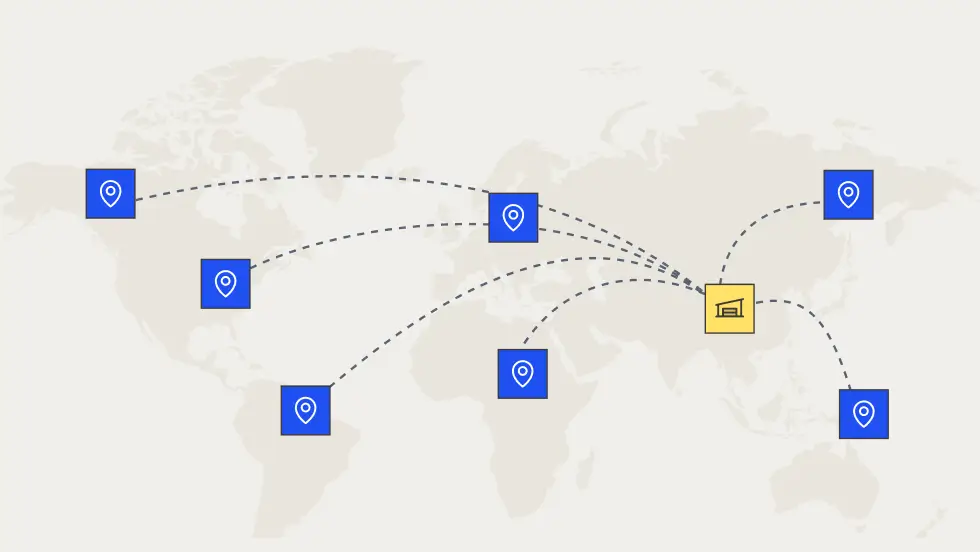
A legacy brand selling internationally needs warehouse infrastructure in every major market — or at minimum, separate inventory allocations for each region. Direct-from-China fulfillment centralizes your inventory in one location at the point of manufacture.
From that single pool, you can ship to any country via air. A customer in Germany, a customer in Australia, and a customer in Texas all pull from the same stock.
No regional pre-positioning, no splitting inventory across warehouses, no guessing which market will need units next. That's how Shein serves 25+ countries without a warehouse network — and it's the same architecture Portless offers to independent DTC brands across 85+ countries.
Both brands responded differently. Shein expanded manufacturing in Turkey, Mexico, and Brazil to diversify origin exposure while continuing to ship direct from China — absorbing tariffs on its high-margin core business. Temu, which operates as a marketplace with ultra-thin per-item margins, shifted its highest-volume US SKUs to domestic warehouse fulfillment to absorb duties in bulk rather than per-package. That's a scale play specific to Temu's marketplace model, not a signal that direct fulfillment stopped working.
The short-term hit
The tariffs landed hard at first. Bloomberg Second Measure reported that Shein and Temu US sales fell 23% and 17% respectively in the week immediately following the hikes. Temu's US daily active users dropped roughly 48% between March and May 2025. Both platforms raised prices.
The long-term adaptation
Neither company retreated to a legacy warehouse model. They adjusted pricing, diversified geographically, and kept the direct-from-origin architecture intact. According to LatePost, Shein's GMV still reached $27 billion in the first half of 2025 — growing 15–20% year-over-year. The US now accounts for less than 30% of Shein's global GMV. Temu leaned into Europe, where over 25% of the EU population made a purchase on the platform in the first half of 2025, according to eMarketer.
The takeaway for independent DTC brands: tariffs raised costs, but they didn't break the model. The structural advantages — no domestic warehouse overhead, no bulk pre-purchase, compressed cash conversion cycle — remain intact regardless of duty rates. You factor duties into your landed cost model, same as any import.
Why speed matters as much as price
Most analysis of Shein and Temu focuses on low prices. Speed is equally important — and for DTC brands evaluating this model, the cash flow effect may matter even more.
A 2023 Capgemini study found that 72% of customers satisfied with their delivery experience increase their purchase levels with the brand by 12%. Direct-from-China fulfillment doesn't just compete on delivery speed, it competes on availability. In a legacy model, a new product isn't available for sale until it clears 60–90 days of ocean freight and warehouse inbounding. Direct fulfillment makes it sellable within days of production. That means faster launches, faster restocks, and fewer out-of-stock pages that send customers to a competitor.
The bigger financial impact is on working capital. Legacy DTC requires buying inventory, shipping it to a domestic warehouse, then fulfilling to customers. You're funding weeks of stock before a single order ships. Direct fulfillment inverts it: sell first, then pull from the factory. For a brand doing $10M in annual revenue, that cycle compression can unlock $1 to $2M in working capital that was previously tied up in transit and storage.
Independent brands using the same model
Shein and Temu prove the model works at scale. But direct-from-China fulfillment isn't limited to platforms with hundreds of millions of users. Independent DTC brands are applying the same architecture to compete on speed and cost without domestic warehouse overhead.
Cosara switched to direct fulfillment from China with Portless after struggling with a slow fulfillment partner. The result: faster delivery, real-time inventory visibility, and $82K in new revenue in the first quarter.
Craft Club initially chose a cheaper direct fulfillment provider, then switched to Portless after experiencing operational issues. Since migrating, Craft Club has grown 3x — with no limiting factors on their ability to continue scaling.
Both brands proved what Shein and Temu operate at scale: when you remove the domestic warehouse from the equation, speed and margin improve at the same time.
Is China direct to consumer shipping right for your brand?
The model works best when:
You manufacture in Asia and your products are lightweight relative to their value.
You want to cut or eliminate domestic warehousing costs.
You're carrying too much inventory risk or your cash conversion cycle is too slow.
You sell products where delivery speed affects repeat purchase rate.
Add: you want to expand into new international markets without having to pay and se tup new fulfillment centers or infrastructure.
It's a harder fit for heavy or bulky goods where air freight economics don't work, or if your customers expect same-day or next-day delivery that only domestic stock can support. For most DTC brands in fashion, beauty, accessories, or consumer electronics manufacturing in Asia, the math favors going direct.
Start with the model, then scale it
Shein and Temu didn't invent direct-from-China fulfillment — they just proved it works at scale. The same architecture is available to any Ecommerce brand manufacturing in China. Portless ships directly from China to customers in 85+ countries with no domestic warehouse required, averaging 5-day delivery to the US. Talk to our team to see how the model performs for your brand.
::dropdown
FAQ
What's the minimum order volume needed to use direct-from-China fulfillment?
There's no universal minimum — it depends on the provider. At Portless, we work with brands from early-stage through high-volume. The more relevant threshold is product weight and value: the model works best for lightweight, higher-margin goods where air freight costs are a small percentage of the sale price.
How does direct-from-China fulfillment handle returns?
Returns are the main operational tradeoff. Most brands using direct-from-China fulfillment handle returns domestically — either through a US returns address or a third-party returns processor — rather than shipping items back to China. This is worth factoring into your landed cost model before switching.
What's the difference between a bonded and non-bonded warehouse for DTC shipping?
A bonded warehouse in China lets your manufacturer treat goods as exported, unlocking a 13% VAT rebate on your cost of goods. Non-bonded is cheaper to operate and ships from any mainland airport, but you don't get the VAT rebate. For most low-to-mid COG DTC products, non-bonded savings on shipping and storage outweigh the VAT difference.
How does direct fulfillment from China compare to using a domestic 3PL?
A domestic 3PL gives you faster last-mile delivery and easier returns handling, but you're paying for warehousing, carrying inventory risk, and adding four to six weeks of ocean freight lead time upfront. Direct-from-China removes those costs and compresses your cash conversion cycle. Portless merchants average 5-day US delivery, which makes the last-mile tradeoff smaller than most brands expect.
Does Temu or Shein ship faster?
Shein typically quotes 7 to 14 business days for standard US delivery. Temu's standard delivery runs 6 to 20 days depending on the item and whether it ships from China or a US warehouse. Both are faster than legacy brands running ocean freight into a domestic 3PL. Direct fulfillment providers like Portless average 5 to 7 days by using direct injection into domestic carrier networks, skipping the central sort facility and getting packages into last-mile delivery faster.
Is direct-from-China fulfillment still viable after de minimis ended?
Yes. De minimis was a tailwind, not the foundation. The model's cost advantage comes from eliminating domestic warehousing and compressing the cash conversion cycle — both of which remain intact regardless of tariff status. Brands now factor duties into their landed cost model, just as they would with any import. The structural savings from cutting two supply chain tiers still outweigh the added tariff cost for most lightweight, higher-margin DTC products.
:dropdown
Frequently asked questions
Heading
Lorem ipsum dolor sit amet, consectetur adipiscing elit. Suspendisse varius enim in eros elementum tristique. Duis cursus, mi quis viverra ornare, eros dolor interdum nulla, ut commodo diam libero vitae erat. Aenean faucibus nibh et justo cursus id rutrum lorem imperdiet. Nunc ut sem vitae risus tristique posuere.
Get operator-level supply chain insights
Thank you! Your submission has been received!
Oops! Something went wrong while submitting the form.








.jpg)
.avif)