“We generated $70K in package protection revenue in a single quarter by adding a simple $4 protection option at checkout — plus an additional $12K from cashbacks. Customers get peace of mind, and we're making a profit on every protected order with zero effort."
“We generated $70K in package protection revenue in a single quarter by adding a simple $4 protection option at checkout — plus an additional $12K from cashbacks. Customers get peace of mind, and we're making a profit on every protected order with zero effort."
If you're evaluating Ecommerce fulfillment services, you've probably already outgrown your current setup. Maybe your 3PL's costs are climbing faster than your margins. Maybe you're expanding internationally and your provider only covers the US. Or maybe you’re sick of spending time on self-fulfillment and looking to graduate to a managed service.
The fulfillment landscape has shifted. Legacy domestic-based 3PLs still dominate, but newer models like origin-based fulfillment and direct fulfillment are giving established brands more options for how they move inventory and serve global customers.
We've reviewed and scored ten Ecommerce fulfillment providers across six pillars: fulfillment model, cost efficiency, speed, global reach, flexibility, and customer experience. The goal is to help you pick the right partner for where your customers are, what you manufacture, and how much inventory risk you can carry.
Why brands switch fulfillment providers
Most brands reading this aren't choosing their first fulfillment partner. You're probably evaluating whether your current one still fits. Here are the triggers that typically push established Ecommerce brands to make a switch.
Cost ceilings. Your 3PL's fees have crept up across storage, pick and pack rates, and carrier surcharges, and your margins are getting squeezed. According to industry research from Statista, US 3PL warehousing rates have risen 8.6% year-over-year through 2024, with no sign of slowing. You're paying more for the same service.
International gaps. You want to sell in new markets, but your provider only covers domestic fulfillment. Setting up warehouses in each new country means more inventory risk, more capital committed upfront, and more complexity to manage. As Deloitte's 2026 retail outlook notes, 82% of retail executives are now prioritizing margin improvement over revenue growth, which makes capital-light international expansion a structural advantage.
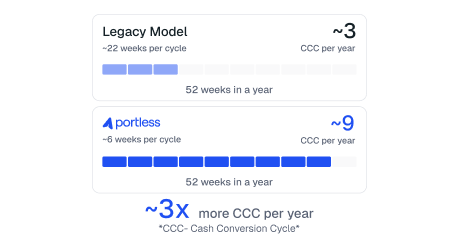
Cash flow strain. The legacy supply chain model (bulk ocean freight, domestic warehouse, months of inventory holding costs) locks up working capital that could be going into marketing, product development, or your next production run.
Reliability issues. Lost inventory, slow pick and pack, inconsistent delivery times, slow customer support. When fulfillment problems become the norm instead of the exception, it costs you customers.
An overview of the top 10 Ecommerce fulfillment platforms
The ten providers below represent a mix of fulfillment types, from legacy domestic-based 3PLs to origin-based and direct fulfillment options, so you can compare across categories.
::table
Platform;Model;Best for;Choose this if
1. Portless;Direct fulfillment from Asia;Cost efficiency, global expansion, cash flow;You want to reduce inventory risk and turn inventory into revenue faster
2. NextSmartShip;China-based 3PL;Self-serve buyers;You want a self-service portal and accept variable support
4. Amazon FBA;Marketplace fulfillment;Amazon-native sellers;Amazon is 60%+ of your revenue
5. ShipBob;Domestic 3PL;Domestic-first DTC at scale;You require a lot of one- or two-day delivery shipments
6. Stord;Domestic 3PL;Brands graduating from a basic 3PL;You want advanced routing software
7. Floship;China-based 3PL;Cross-border with checkout duties;You want to collect duties at checkout
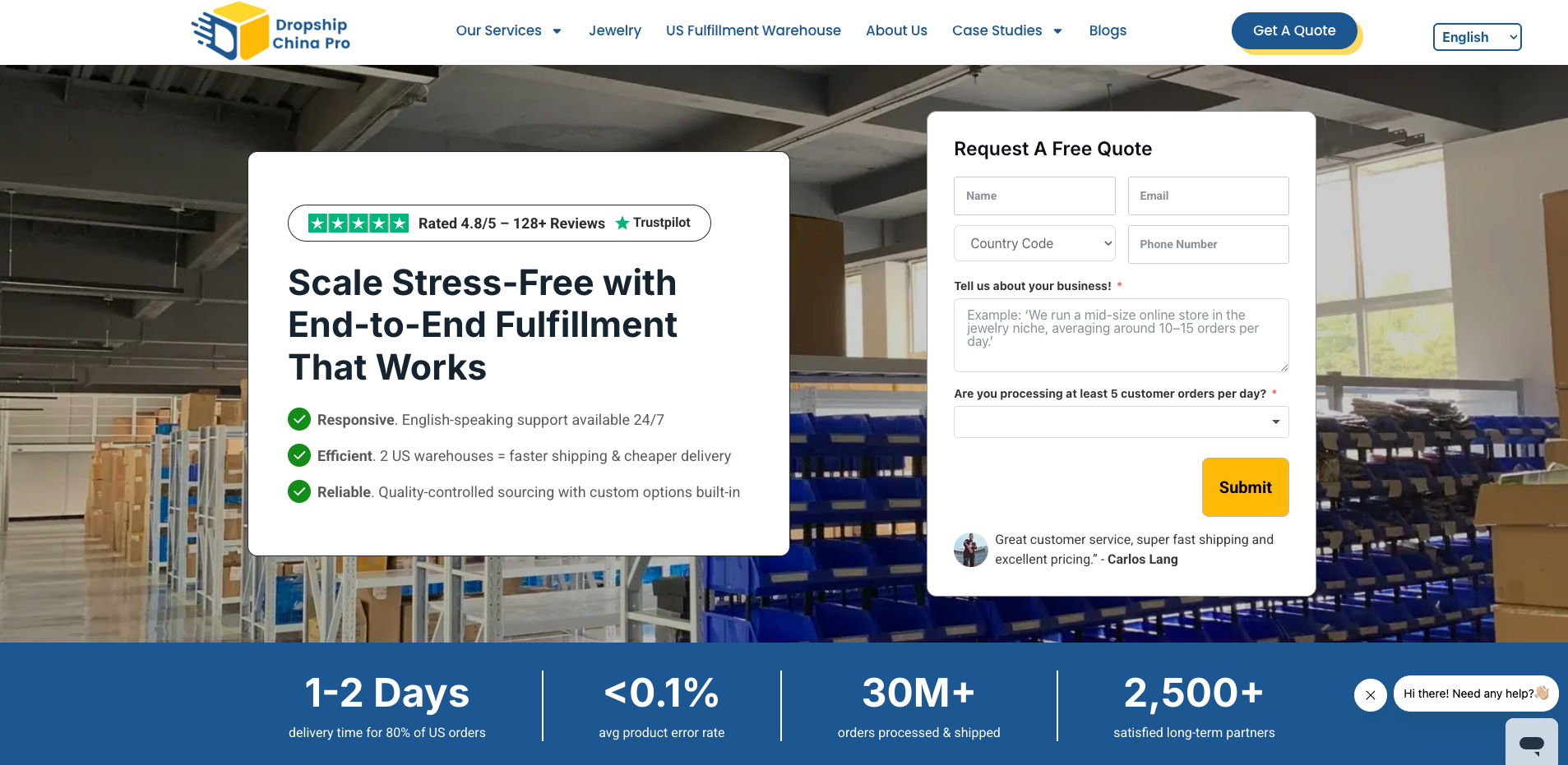
8. DropShip China Pro;China-based 3PL;Dropshipping, POD, private label;Your model is dropshipping or POD
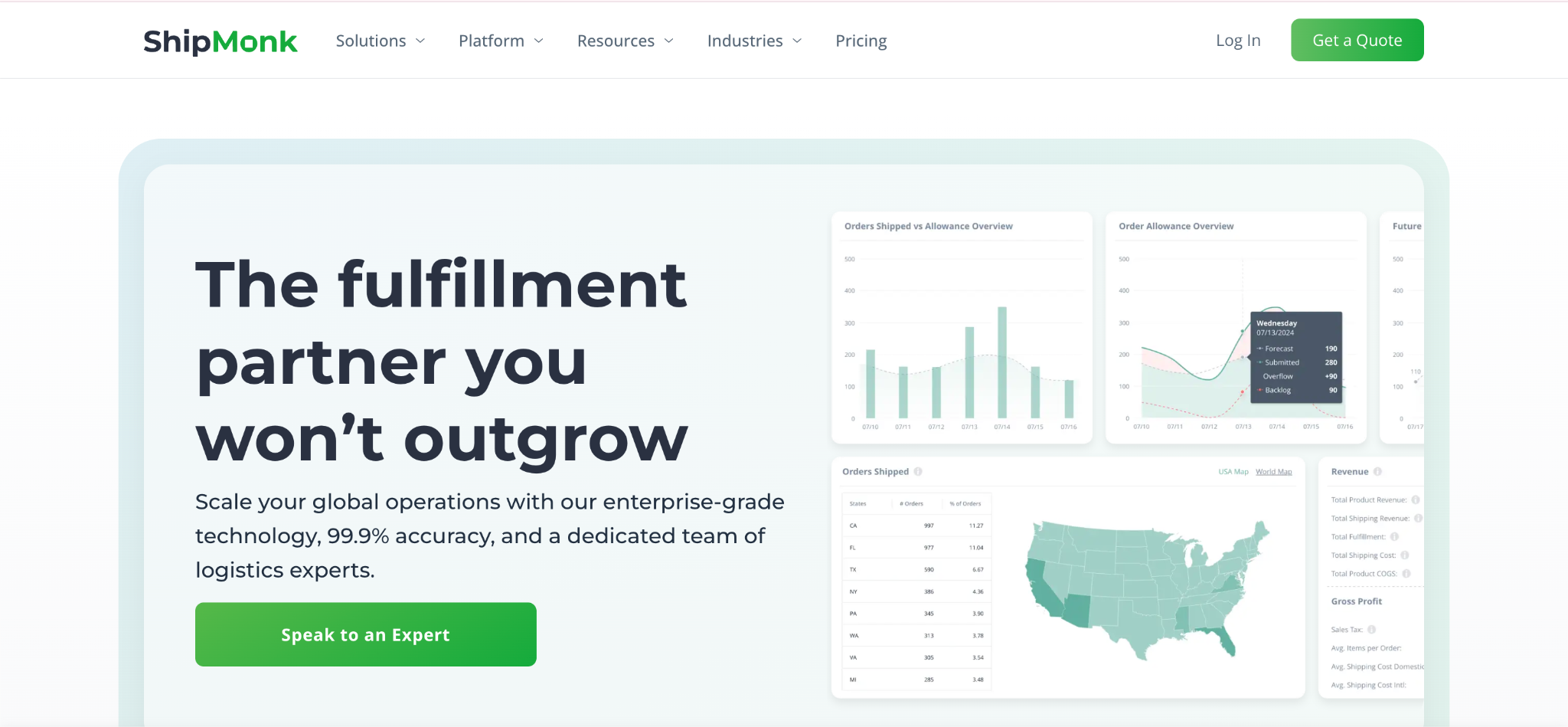
9. ShipMonk;Domestic 3PL;High-volume, high-SKU brands;You need predictive automation for complex catalogs
10. DHL Supply Chain;Enterprise logistics;Large-scale supply chains;You need global enterprise infrastructure
:table
A deep dive into the top 10 Ecommerce fulfillment options
Now that we've given you a snapshot of the ten options, let's take a closer look at each platform. Where each shines, where each falls short, and what real customer feedback says about working with them.
1. Portless
Best for: International DTC brands manufacturing in Asia who want to free up working capital and ship globally without regional warehouses.
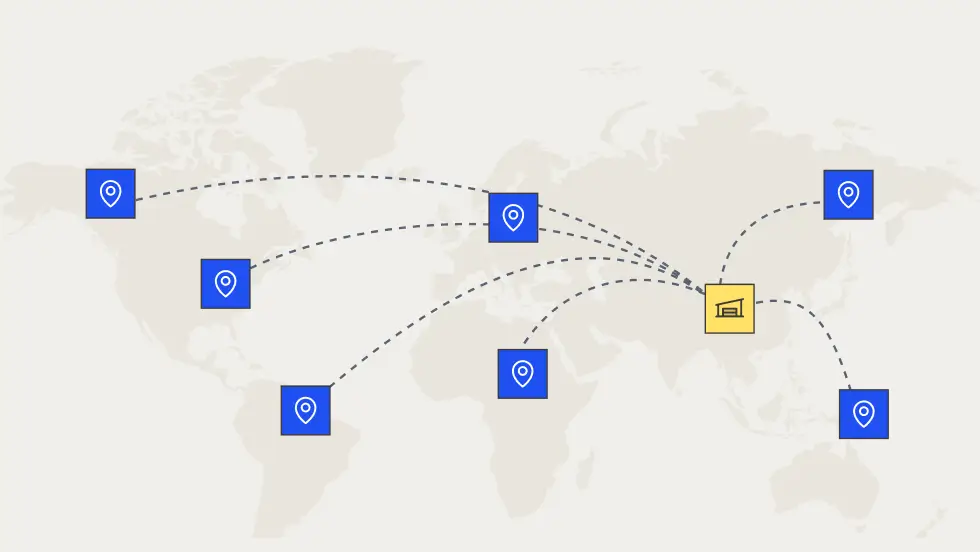
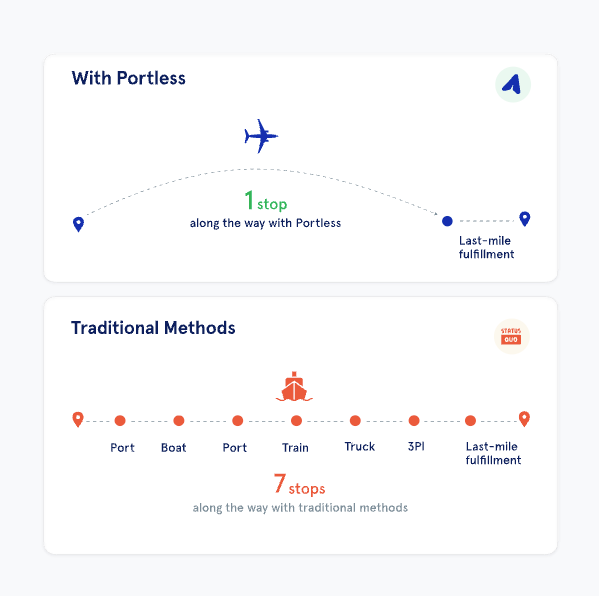
Portless ranks first because it solves the structural problem most ranking lists ignore: capital locked in inventory. Instead of distributing stock across multiple regional warehouses, inventory is held near manufacturing in Asia and shipped per order to customers in 85+ countries by air.
Products are sellable within 48 hours of production. Customers receive deliveries averaging five to eight days globally. Duties are paid per parcel as orders ship rather than as a lump sum on bulk inventory, which means no upfront tariff bill on goods that haven't sold yet.
Why companies choose Portless
Products can be sold within days of production, eliminating four to six weeks of ocean freight lead time
Single inventory pool ships to 85+ countries with no regional warehouse setup costs
Duties applied at the parcel level, matched to revenue from each sale
Integrates with major Ecommerce platforms, including Shopify and WooCommerce
Dedicated account manager with DTC and Shopify experience for every merchant
Offers services like custom packaging, product photography, and financing support
“The reliability and consistency of fulfillment have been impressive. Orders are being handled accurately and on time, and the integration with our systems has made managing multi-market inventory much easier. Overall, Portless has proven to be a reliable, forward-thinking partner who’s helping us scale international logistics more efficiently.” — Portless Trustpilot review
User-flagged challenges
Not optimized for next-day domestic shipping. Brands with significant express-shipping delivery expectations should evaluate a domestic 3PL or hybrid setup.
Not suitable for low-margin, heavy-weight items. Items where per-order air shipping changes the unit economics.
How Portless helps established Ecommerce brands grow
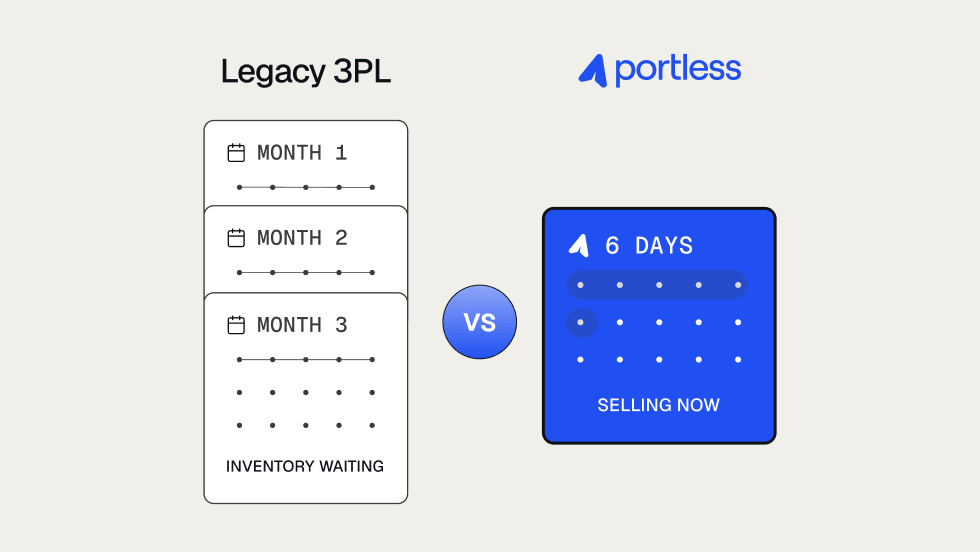
Cosara: 10x revenue growth with reliable fulfillment.Cosara is a fast-growing DTC adult brand selling globally. Before Portless, their previous fulfillment partner was the single biggest drag on the business. Delivery windows stretched to 15+ days, tracking was unreliable, and packages disappeared with no accountability. After switching, Cosara averaged six-day delivery, gained real-time visibility, and 10x'd revenue.
Spartan Kitchen: 90% lead time reduction.Spartan Kitchen is a Canada-based brand selling premium stainless steel kitchen tools. As they grew, six-week lead times, duties, and freight costs blocked reinvestment. After partnering with Portless, lead times dropped 90%, the team reclaimed 20+ hours per week, and the brand expanded into the UK, Australia, and New Zealand.
::callout
RUN THE NUMBERS FOR YOUR BRAND
Curious how direct fulfillment changes your fulfillment economics? Use the Portless shipping rate calculator to model per-order costs, lead times, and cash flow against your current setup.
:callout
2. NextSmartShip
Best for: Self-serve buyers under 1,000 orders per month who prioritize portal control over support quality.
NextSmartShip is a China-based 3PL that operates a network of partner warehouses globally. The company markets itself on a self-service portal with cost estimation, order tracking, and inventory visibility, and is best suited for brands that want to manage fulfillment hands-on without a dedicated account manager.
Pricing varies meaningfully by destination market, and the company accepts brands without volume minimums, including crowdfunding campaigns and pre-launch startups.
Why companies choose NextSmartShip
The ability to switch between shipping directly from China or using global warehouses
Supports both air shipping and ocean freight, depending on your priorities
Routes orders based on speed or cost rather than fixed shipping rules
“Fast and affordable services. Efficient handling of the goods. Customer team offers a quick response. Every step of the way was well documented. We will use this company again in the future!” — NextSmartShip Trustpilot review
Where NextSmartShip falls short
Self-serve model means no dedicated account management. NextSmartShip is built for founders comfortable handling fulfillment hands-on through the portal. Brands that need a single point of contact for time-sensitive issues, peak season planning, or integration troubleshooting often find the experience inconsistent.
Most warehouses are partner-operated. Of the 8 to 10 fulfillment centers in the network, only the Shenzhen facility is owned by NextSmartShip. The rest are operated by 3PL partners, which means service quality and SLAs vary by location. Brands distributing inventory across multiple regions should ask specifically which warehouses are owned versus partnered.
Pricing structure is worth scrutinizing. Some public reviews describe shipping rates increasing meaningfully post-onboarding. As with any China-based 3PL evaluation, request pricing in writing with explicit terms on rate adjustment frequency and triggers before signing.
3. Flexport
Best for: Enterprise importers managing complex multi-country supply chains, not order-level Ecommerce fulfillment.
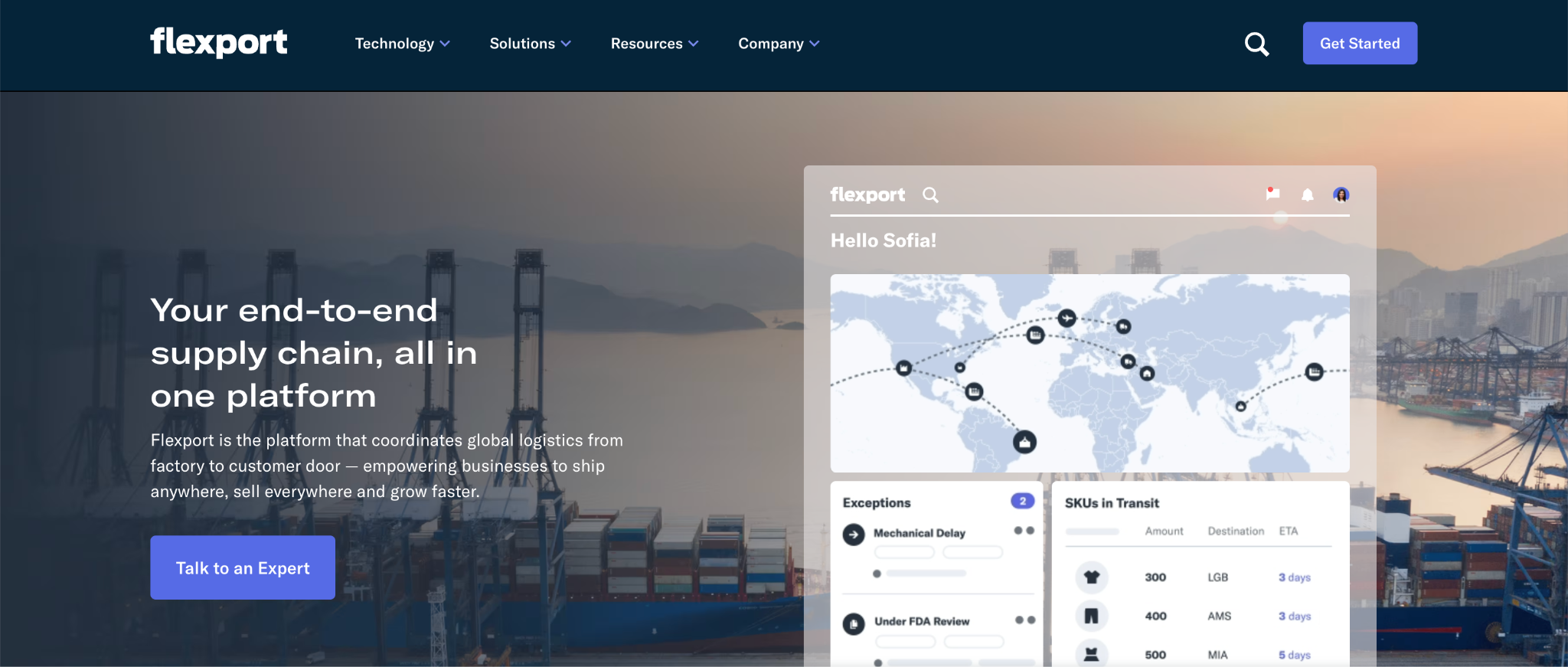
Flexport is an enterprise logistics company that helps you move products from your suppliers to your customers. It’s best understood as a freight forwarder with software on top. That means it doesn’t make or store your products itself. Instead, it organizes everything needed to get goods from one place to another, working with shipping carriers, customs, and warehouses along the way.
What makes Flexport different is that it puts all of this into one system. Instead of dealing with separate companies for shipping, customs, and tracking, everything is managed through a single platform.
Why companies choose Flexport
Central platform to track shipments, costs, and performance
Handles customs and international shipping in one place
Coordinates complex shipments across multiple routes and carriers
“We've had a relationship with Flexport for over 18 months. We started with LCL shipments and have gradually transitioned over most of our FCL shipments to Flexport as well. The portal is an amazing tool; any relevant information is readily available.” — Flexport Trustpilot review
Where Flexport falls short
Wrong fit for SMB DTC brands. Flexport is built for enterprise importers managing complex freight at scale. The platform's complexity and pricing are designed for that audience, not for a brand looking for a fulfillment partner that picks, packs, and ships individual orders.
$5,000 monthly minimum on fulfillment. Brands spending less are typically charged the difference, which makes Flexport unsuitable for most growth-stage DTC operations.
4. Amazon FBA
Best for: Amazon-native sellers where Amazon is the primary or only revenue channel.
Amazon FBA (Fulfilled by Amazon) is a service built directly into the Amazon marketplace. Instead of managing logistics yourself, you send your inventory to Amazon’s warehouses, and they handle storage, packing, shipping, and returns.
The model is tightly integrated with selling on Amazon. Once your products are listed, orders are automatically fulfilled through Amazon’s network, with access to fast delivery options like Prime. This makes it one of the quickest ways to offer reliable shipping without setting up your own fulfillment infrastructure.
However, since you’re plugging into an existing system rather than building your own, it might feel limiting for some entrepreneurs.
Why companies choose Amazon FBA
Fast, reliable delivery through Amazon’s Prime network
Seamless integration with Amazon listings and order management
Handles storage, shipping, customer service, and returns
Storage fees compound for slow-moving inventory. Long-term storage surcharges apply to inventory sitting in Amazon warehouses past 365 days, with significant rate increases for items stored over a year.
Limited brand control. Amazon controls packaging, customer communication, and the post-purchase experience. For brands where unboxing and customer experience are core to the product, this trade-off is structural.
Inventory placement is opaque. Amazon distributes inventory across its network based on its own demand forecasting, which means you have limited visibility into where stock sits or how it moves.
5. ShipBob
Best for: Domestic-first DTC brands with high US order volume and two-day delivery as a competitive advantage.
ShipBob is a traditional domestic 3PL that focuses on fast, local fulfillment through a distributed warehouse network. Instead of shipping directly from the manufacturer, inventory is stored across multiple centers in different regions like the US, UK, and Europe.
Once connected to your store, ShipBob automatically syncs orders, manages inventory across locations, and handles picking, packing, shipping, and returns. The platform also gives you visibility into stock levels and performance metrics across all their global warehouses.
Why companies choose ShipBob
Distributed warehouse network allows for quick local delivery
Two-day shipping options across major markets
Integrates with major Ecommerce platforms and tools
“ShipBob's onboarding was smooth and efficient. The team provided excellent support throughout.” — ShipBob Trustpilot review
Where ShipBob falls short
Multi-region expansion requires upfront commitment. Each new region (EU, UK, Australia) requires bulk inventory pre-positioning and upfront duty payments before any sales happen there. Inventory has to be allocated across regions based on demand forecasts, and missed forecasts can trigger split shipment fees when orders pull from multiple warehouses.
Storage fees compound for slow-moving SKUs. Storage runs roughly $40 to $80 per pallet per month after a 30-day grace period, according to ShipBob's published storage policy. Long-term storage surcharges apply on top for inventory sitting 90+ days.
Total cost can exceed initial quotes. Like most domestic 3PLs, ShipBob's pricing includes per-order rates plus variable surcharges (zone-based shipping, residential delivery, fuel) that fluctuate month to month. Some public reviews describe actual bills running above initial estimates. When evaluating ShipBob (or any domestic 3PL), ask for an itemized breakdown of all fee categories, and compare quotes against your historical zone distribution.
Contracts and volume minimums. ShipBob typically requires 6 to 12 month contracts with monthly volume minimums. Seasonal brands with significant Q4 spikes and Q1 troughs should model the impact of paying minimums during slower months.
6. Stord
Best for: Brands graduating from a basic 3PL who want software-driven routing and cost optimization.
Stord is another tech-enabled 3PL option that is designed for brands that want more control as they grow their operations. They combine fulfillment with their own software, which has the ability to decide how each order should move through the network.
For example, orders can be automatically sent to a slightly further warehouse if it reduces shipping costs or avoids delays.
Plus, with a mix of their own facilities and a partner network, you can use Stord to build a wide network that suits your needs.
Why companies choose Stord
Combines fulfillment and software in one platform
Real-time visibility across inventory and orders
Optimizes routes to improve delivery speed and reduce costs
“After 5+ years in Ecommerce and having worked with over 10 3-PL Companies throughout, Stord, Inc. is by far the best service provider out there. It is a pleasure to be working with them.” — Stord Shopify App Store review.
Where Stord falls short
Implementation is more involved than a standard 3PL, with a longer onboarding window
Service quality can vary depending on whether your account uses owned facilities or partner facilities
Best suited for brands with technical depth to take advantage of routing and optimization features
7. Floship
Best for: Cross-border DTC brands that want duties calculated and collected at checkout.
Floship is a China-based 3PLfulfillment provider focused on international selling. It uses warehouses near the manufacturer alongside a small number of global hubs, with software built specifically for managing cross-border orders.
For example, Floship can calculate and collect duties and taxes upfront at checkout, so customers don’t get surprise fees on delivery. It also sits across multiple partner warehouses and carriers, acting as a coordinator rather than offering fixed shipping pathways.
Why companies choose Floship
Calculates and collects landed costs upfront
Acts as a coordinator across a network of partner warehouses and carriers
Built for cross-border orders and international launches
“Floship’s platform is powerful and feature-rich, offering a wide range of options and integrations that suit our needs perfectly. Overall, Floship is a reliable partner with great service and a solid system.” — Floship Trustpilot review
Where Floship falls short
Pricing varies by use case and isn't published as a standard rate card, so request itemized quotes upfront
Reliance on partner warehouses and carriers means service quality can vary by location
Better suited for established brands with consistent international volume than early-stage testing
8. Dropship China Pro
Best for: Dropshipping, print-on-demand, and private label sellers, not branded DTC brands.
Dropship China Pro (DSCP) is a China-based fulfillment company that operates dual-coast warehouses in Los Angeles and New Jersey, alongside facilities in Hangzhou and Dongguan. The company processes over 30,000 parcels daily across 15+ global locations and serves 2,500+ active stores.
DSCP is structurally different from most providers on this list because its core business is dropshipping and print-on-demand, not branded DTC fulfillment. Sellers using DSCP typically don't own inventory in the traditional sense. They place orders that DSCP fulfills from sourced or POD-produced products. The platform is well-suited to that model and weaker for brands that own inventory and care about the post-purchase brand experience.
Why companies choose Dropship China Pro
Dual-coast US warehouses (LA and NJ) enable 2-4 day domestic delivery for inventory pre-positioned in the US
Integrated product sourcing, quality control, and private label production
Print-on-demand fulfillment with 24-hour customization and shipping for designed products
“They’ve been a consistent and dependable partner throughout every stage of my journey. During quiet periods, their support kept things moving. In busier times, their speed and reliability really stood out.” — Dropship China Pro Trustpilot review
Where Dropship China Pro falls short
Wrong fit for established branded DTC. DSCP is built for the dropshipping and POD segments, where margin is tight, branding is light, and the seller acts more as a marketing operation than a product brand. Established DTC brands evaluating fulfillment partners are typically further up the maturity curve and need different capabilities.
China-to-overseas warehouse transit takes 15+ business days. Inventory pre-positioning to overseas warehouses runs three weeks or more from China, which limits flexibility for brands testing demand or moving fast on trends.
Pricing isn't published publicly. Fees for fulfillment, sourcing, and quality control are quoted by use case rather than published as a standard rate card, which makes upfront comparison harder. Request a written quote with all fees itemized before signing.
9. ShipMonk
Best for: High-volume, high-SKU domestic brands that need predictive automation for complex catalogs.
ShipMonk is a domestic warehouse-based 3PL designed to support businesses that are growing and dealing with increasing complexity.
What makes ShipMonk unique is how much they focus on operational optimization inside their warehouses. For example, they use automation and predictive data to manage things like high SKU counts and large order spikes. They also use this analysis to find the cheapest shipping option for each order.
Why companies choose ShipMonk
Predictive analysis for things like high SKU counts and bundles
Automatically selects the most cost-effective shipping option per order
Built to handle large order spikes or sudden changes
“The system itself is very helpful and makes it much easier to get things done. It is without a doubt an excellent platform and plays an important role in supporting our operations.” — ShipMonk Trustpilot review
Where ShipMonk falls short
Account experience tends to scale with volume, with smaller brands getting less hands-on support
Best suited for higher-volume brands rather than early-stage small businesses
Pricing complexity scales with catalog size and bundle requirements, so request itemized quotes
10. DHL Supply Chain
Best for: Large-scale enterprise brands with complex supply chains and global infrastructure needs.
DHL Supply Chain is the traditional enterprise option. Most people have come across them, either as a customer or on the logistics side. They are one of the oldest and most established providers, built around large, structured supply chains.
Due to this, they offer scale and structure that not many other providers can. They have a huge global network of warehouses, teams, and systems designed to plug into existing supply chains.
Why companies choose DHL Supply Chain
Huge global infrastructure across dozens of countries
Designed to support existing, complex supply chains
Trusted by large, established enterprise businesses
Less flexible than newer, tech-driven fulfillment models
Service experience can vary by region and account size given the scale of operations
Pricing and onboarding complexity make it impractical for SMB and growth-stage brands
When self-fulfillment is the right call
Most "best fulfillment services" guides treat outsourced fulfillment as the default and self-fulfillment as a phase you outgrow. In reality, self-fulfillment is a viable model, sometimes the right model, and worth a real evaluation before you sign with anyone on this list.
The math on when self-fulfillment wins
A founder packing orders from a garage or small leased space typically costs nothing in labor (the founder's time is already sunk) and avoids 3PL fees of $4 to $8 per order plus storage. According to Shopify's fulfillment guide, typical 3PL costs run $3 to $8 per order depending on weight and services, with monthly storage fees on top.
At 100 orders a month, that's $400 to $800 a month you keep. At 500 orders a month, $2,000 to $4,000 a month. The math turns against self-fulfillment when the founder's time becomes more valuable spent elsewhere. That typically happens once order volume passes 30 to 50 orders per day, or when fulfillment starts taking more than 10 to 15 hours a week of focused work.
Self-fulfillment is right for you if
You're under 300 orders per month and your founder's time isn't being pulled away from customer acquisition or product development
Your products are simple to pack with no kitting, no fragile assembly, and no complex personalization
You're testing product-market fit and don't yet know which SKUs will scale
You have warehouse-adjacent space (garage, basement, small office) where storage doesn't add real cost
Your delivery expectations are reasonable, with customers accepting 3 to 5 day shipping rather than next-day
Self-fulfillment becomes the wrong call when
Order volume passes 50 per day and packing eats into your time
You're carrying enough SKUs that pick errors start happening
You want to expand internationally and would need to ship from a country you don't operate in
You're handling returns manually and they're piling up
You can't take a vacation without orders going out late
The honest middle ground
Many brands skip 3PLs entirely and stay on self-fulfillment longer than the industry suggests, because the math works. The trigger to outsource isn't a revenue threshold. It's the moment your time spent on fulfillment is worth more spent on growth. If you're still figuring out which marketing channels work or which products will scale, the time you save by outsourcing fulfillment usually goes back into the same plateau. If you've found product-market fit and your CAC is improving, that's when the math changes.
If you're under 300 orders a month and reading this guide because someone told you to "get a 3PL," consider whether you actually need one yet.
::callout
QUICK SELF-CHECK
Under 300 orders per month, simple products, available space, and founder time that isn't being pulled from acquisition or product? Self-fulfillment likely beats outsourcing. Above 50 orders a day or 15 hours a week of packing? It's time to evaluate the providers above.
:callout
How direct fulfillment supports your Ecommerce business
Direct fulfillment ships your products per order, directly from a fulfillment center near your factory to your customer's door. You own the product the whole way through. You're not handing inventory to a domestic warehouse months in advance, and you're not handing it to a supplier the way dropshipping does.
The legacy model is built for a different era. You produce inventory, ship it across an ocean, pay to warehouse it, and hope demand shows up. Cash is tied up for 60 to 120 days before a single order converts to revenue. Direct fulfillment cuts that cycle. You pay landed costs per order, not per container.
That's why DTC brands scaling globally (and the Shein and Temu playbook the rest of the industry is catching up to) have moved to this model.
Free up cash that would otherwise be tied up at sea
In a legacy model, you're paying for manufacturing, freight, landed costs, and warehousing upfront before a product is sold. With direct fulfillment, you can start selling your products in a couple of days, not weeks, and only pay landed costs for real orders being sent to customers. This gives you more cash on hand to use for marketing, product development, or your next production run.
Reduce inventory risk and avoid overcommitting
Forecasting demand months in advance is difficult, especially if you're testing new markets. Direct fulfillment lets you make and ship products to different parts of the world based on actual demand, rather than committing to large orders upfront.
Go live and start selling faster
Instead of taking months before you can list products on your website as they cross oceans, you can have them ready to ship within days of manufacturing. This shorter lead time helps you launch faster, respond to demand more quickly, and plug any gaps to avoid missed sales.
Expand globally without investing in infrastructure
Entering new markets used to mean setting up warehouses and managing local logistics yourself. This comes with additional risk. With direct fulfillment, you can hold inventory near the manufacturer and ship to multiple countries from a single pool. This makes it easier to test new markets without sending bulk inventory into each country.
Prepare for your business's growth
As order volume increases, traditional fulfillment usually means securing more warehouse space, moving more inventory by sea, and hiring additional logistics staff. With direct fulfillment, products ship per order, so you can grow without building out the same level of infrastructure.
Choose the right fulfillment partner
Fulfillment is no longer a backend function. It's a strategic decision that defines how fast you can grow, how efficiently you use capital, and how quickly you can reach new customers around the world.
The right partner depends on where your customers are, what you manufacture, and how much inventory risk you can carry. Domestic-first brands at scale are usually best served by a domestic 3PL. International brands manufacturing in Asia tend to win on direct fulfillment. Amazon-native sellers often stay in FBA. The honest answer for many growing brands is hybrid, mixing two providers to get speed where it matters and cost efficiency where it doesn't.
If you're an international DTC brand manufacturing in Asia and your fulfillment costs are eating your margins, book a 30-minute walkthrough with Portless to see how direct fulfillment could work for your product mix and target markets.
FAQ
What are the top Ecommerce fulfillment services options?
Based on our research, the top three Ecommerce fulfillment services are Portless, ShipBob, and ShipMonk. Portless ranks first for its ability to reduce inventory risk and accelerate cash flow through direct fulfillment. NextSmartShip offers flexibility between origin-based and warehouse models.
What is an Ecommerce fulfillment service?
An Ecommerce fulfillment service handles the storage, picking, packing, and shipping of your products. Some use warehouse networks across multiple countries, while others use direct fulfillment to ship orders straight from the factory to customers worldwide. The right model depends on your product type, target markets, and how much inventory risk you're willing to carry.
What is the difference between 3PL, dropshipping, and direct fulfillment?
A 3PL stores your inventory in their warehouses and ships orders on your behalf. With dropshipping, a supplier owns the inventory and ships it directly — you don't control quality or packaging. Direct fulfillment means you own the inventory, store it near your factory, and ship individual orders to customers worldwide by air. You keep full control over product quality, branding, and packaging.
How do I choose a fulfillment partner?
Choose a fulfillment partner based on your business model, where your customers are, total costs (not just shipping rates), delivery speed, inventory risk tolerance, and how well their technology integrates with your store. Start by deciding whether you need warehouse-based, origin-based, or direct fulfillment, then evaluate providers within that model.
When does self-fulfillment make more sense than outsourcing?
Self-fulfillment is typically the right call for brands under 300 orders per month with simple products, available warehouse-adjacent space, and a founder whose time is not being pulled away from customer acquisition or product development. The math turns against self-fulfillment around 30 to 50 orders per day, or once fulfillment work exceeds 10 to 15 hours per week.
What is an example of direct fulfillment?
Cosara is a strong example. The DTC adult brand partnered with Portless to ship products directly from manufacturers to customers in 85+ countries. The result was 10x weekly revenue growth, reliable six-day delivery, and real-time order visibility that eliminated the tracking blackouts they experienced with their previous provider.
Frequently asked questions
Heading
Lorem ipsum dolor sit amet, consectetur adipiscing elit. Suspendisse varius enim in eros elementum tristique. Duis cursus, mi quis viverra ornare, eros dolor interdum nulla, ut commodo diam libero vitae erat. Aenean faucibus nibh et justo cursus id rutrum lorem imperdiet. Nunc ut sem vitae risus tristique posuere.
Get operator-level supply chain insights
Thank you! Your submission has been received!
Oops! Something went wrong while submitting the form.







.jpg)
%20(1).jpg)
%20(1)%20(1).avif)