“We generated $70K in package protection revenue in a single quarter by adding a simple $4 protection option at checkout — plus an additional $12K from cashbacks. Customers get peace of mind, and we're making a profit on every protected order with zero effort."
“We generated $70K in package protection revenue in a single quarter by adding a simple $4 protection option at checkout — plus an additional $12K from cashbacks. Customers get peace of mind, and we're making a profit on every protected order with zero effort."
For years, DTC brands faced a forced choice. The legacy fulfillment model meant locking cash into ocean freight for months, pre-committing to inventory six to eight weeks out, and paying to warehouse stock before a single order sold. The alternative was dropshipping: fast to launch, low capital, but no control over product, packaging, or delivery.
Dropshipping exploded because it solved the cash problem. The 2025–2026 tariff cycle broke the math behind it. When every shipment picks up duties, the margin on a $12 phone case stops working. Now, hobby sellers are dropping off. Established Ecommerce brands — the ones with real products, real customers, and real margins — need a different model.
That model is direct fulfillment. You design it, you own it, you manufacture it, and a fulfillment partner ships it per order from near your factory to your customer's door in 5–8 days. You get the agility of dropshipping with the brand control and margin structure of legacy retail.
This piece is for DTC operators deciding between the two. We cover how each model works, what they actually cost, what shipping and quality look like, and which one fits your business.
What is dropshipping?
Dropshipping is a fulfillment method where an Ecommerce store sells products it doesn't own, hold, or ship. A supplier, usually based in China, manufactures the product, stores it, and ships it directly to the customer when an order comes in. The seller handles marketing and customer support.
The global dropshipping market was valued at $365.67 billion in 2024 and is projected to reach $1.25 trillion by 2030. But that growth is uneven. Hobbyist sellers are exiting fast. The model's structural weaknesses — generic product, zero quality control, no brand equity — were always there. Tariffs just exposed them.
How dropshipping works
The seller picks products from a supplier catalog and lists them on a store
A customer places an order and pays the seller
The order forwards automatically to the supplier
The supplier ships the product directly to the customer
The seller handles support, returns, and disputes — usually by absorbing the cost
The seller never touches the product. They also never control it.
What dropshipping is used for
Dropshipping concentrates around low-cost, generic, undifferentiated products. Typical examples:
Phone cases and screen protectors
LED light strips and basic home lighting
Cables and chargers
Mass-produced fitness accessories
Novelty gifts and trending gadgets
These categories share two traits: they're easy to source and impossible to differentiate. Hundreds of other stores sell the exact same SKU from the exact same supplier. The only competitive lever is price, which compresses margin to nothing.
Where dropshipping breaks
The model has three structural problems that no platform or supplier can fix:
No quality control. You never see the product before it ships. Defect rates, materials, and finish are entirely the supplier's call.
No brand. Generic packaging, no inserts, no consistent unboxing. The customer has no reason to remember who they bought from.
No tariff visibility. Duties are baked into supplier pricing or hit the customer at delivery. Either way, you can't plan around them.
None of this matters if you're testing an idea for a weekend. All of it matters if you're trying to build something.
What is direct fulfillment?
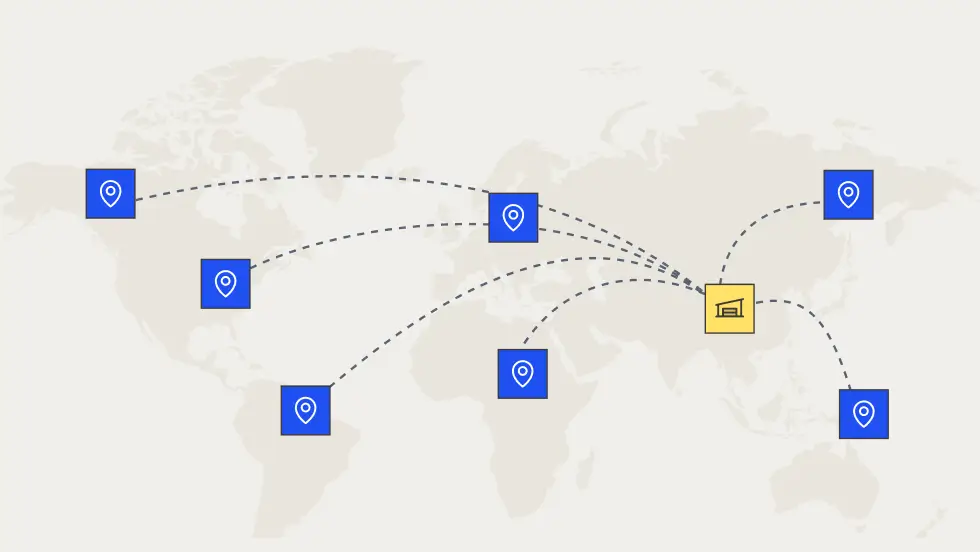
Direct fulfillment is a shipping model where Ecommerce brands manufacture and own their product, then ship per order from a fulfillment center near the factory straight to customers worldwide. Inventory stays close to production. No sea freight. No domestic warehousing.
This is not dropshipping. You own the product. You control design, quality, branding, and the customer relationship. The fulfillment partner handles picking, packing, and shipping — nothing else. It's the model Shein and Temu used to ship billions of parcels globally. Established DTC brands now use it for the same reasons: faster cash conversion, shorter lead times, and affordable global reach.
How direct fulfillment works
You design and manufacture your product (typically in China)
Your Ecommerce store connects to a direct fulfillment partner
Stock is held at a fulfillment center near the factory
When a customer orders, the partner picks, packs, and ships the parcel
The parcel is injected directly into the destination country's carrier network
You manage product, marketing, and customer support — the partner handles the rest
The mechanism behind the speed is direct injection. Instead of routing every parcel through one clogged hub like Los Angeles, the parcel is flown to the regional hub closest to the customer and handed off to the local carrier. A customer in Kansas City gets a parcel that flew straight to Chicago and entered USPS from there. It feels like a domestic delivery.
With Portless, goods are ready to ship 48 hours after production wraps. Orders land at the customer's door in 5–8 days across 75+ countries. You can see the full delivery times by country here.
What direct fulfillment is used for
Direct fulfillment works for any owned-product category that isn't oversized or hazardous. Common categories include:
Apparel and accessories
Beauty and skincare
Jewelry
Home goods and decor
Consumer tech and accessories
Outdoor and fitness gear
Pet accessories
Who direct fulfillment is built for
Direct fulfillment fits brands that already manufacture their own product and want to grow without warehousing capital tied up in every market they sell into.
It's especially useful for brands that want to test international demand without committing bulk inventory to an on-shore warehouse, and for established brands that need to free up cash currently locked in sea freight and domestic 3PL stock.
::callout
SEE IF DIRECT FULFILLMENT FITS YOUR BRAND
If you manufacture in Asia and want to ship per order to customers in 75+ countries, without sea freight or domestic warehousing, talk to our team.
:callout
Direct fulfillment vs dropshipping: key differences
Both models ship from Asia. That's where the similarity ends. The two models differ on who owns the product, who controls quality, who has visibility into costs, and what the customer actually receives.
::table
Factor;Dropshipping;Direct fulfillment
Product ownership;You resell a supplier's generic catalog;You design, own, and brand the product
Supplier relationship;One of hundreds of resellers buying the same SKU;Direct relationship with your manufacturer
Branding;Generic packaging, no inserts, no unboxing;Branded packaging, inserts, and consistent presentation
Quality control;No visibility into materials, specs, or QC;You set the specs and audit the production line
Shipping speed;3–6 weeks via economy international post;5–8 days via direct injection
Tariffs and compliance;Hidden in supplier pricing;Paid per order at point of sale, fully visible
Customer support;Tied to supplier refund policies;You own the relationship end-to-end
Support team;WhatsApp groups and middlemen;Dedicated account manager and 24/7 team
:table
Cost breakdown: what you actually pay for
Dropshipping looks cheaper upfront because there's no inventory cost. The full picture is different. Each model has a different cost structure, and the one that wins on margin depends on what you're trying to build.
Dropshipping costs
Dropshipping removes upfront inventory, but stacks on operating costs that compress margin:
Supplier product cost. You buy one unit at a time at retail-adjacent pricing. Your margin is thinner than if you owned inventory.
Platform and app fees. Supplier-to-store connectors are mostly subscription-based.
Supplier-set shipping. Delivery cost and speed are decided by the supplier, not you.
Refunds and reships. Quality issues happen often and you absorb most of the cost.
Tariffs. Duties hit either supplier pricing or the customer at delivery. Both options shrink your margin or your conversion rate.
Direct fulfillment costs
Direct fulfillment has transparent, line-item logistics costs that you can model against revenue:
Manufacturing. Upfront cost to produce inventory you own.
Freight (by weight). Air freight from the fulfillment center to the destination country.
Direct injection fee. One-time fee to hand the parcel off to the destination country's carrier network.
Pick and pack fee. Per-order fee for preparing the parcel.
Tariffs. Paid per order, at point of sale. You only pay duty on what actually sold.
Why the cash flow math matters
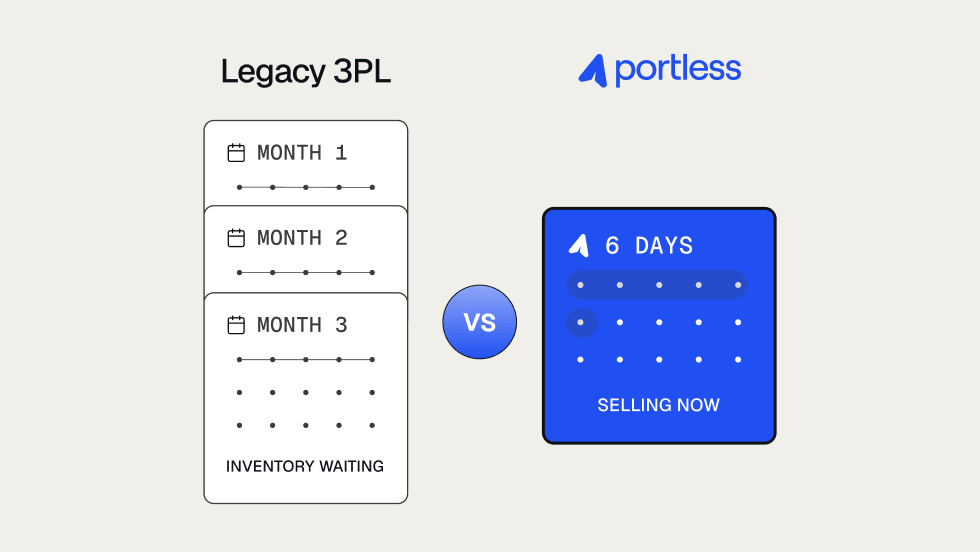
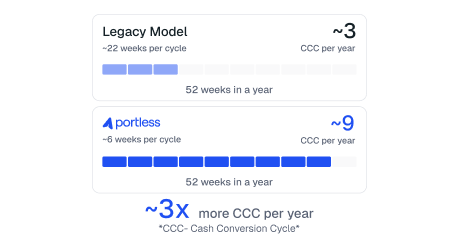
The cost line items are only half the picture. The bigger advantage of direct fulfillment is what it does to cash flow. You're not pre-buying six months of inventory or floating duties on stock that may not sell. You're shipping what your customers actually ordered.
That structure compresses the cash conversion cycle. Customers pay you before you pay for ocean freight or domestic warehousing — because there's no ocean freight and no domestic warehousing. Inventory turns into cash in days instead of months.
Shipping speed and customer experience
Speed and presentation are where the two models look most different from the customer's side of the screen.
Typical shipping timelines
Dropshipping: 3–6 weeks for an order from China to the US via economy international post. Tracking is inconsistent. Customers don't always know when — or if — the parcel will arrive.
Direct fulfillment: 5–8 days from China to the US. The parcel is air-freighted and injected into USPS at the regional hub closest to the customer. Tracking is end-to-end.
Packaging and branding
Dropshipping ships in whatever generic mailer the supplier uses. There's no unboxing moment, no insert, no brand cue. For a $12 impulse buy, customers expect that. For a brand asking for repeat purchase, it's a wasted touchpoint.
Direct fulfillment ships in your packaging, with your inserts, in your presentation. Apparel arrives moisture-controlled and wrinkle-free. Beauty arrives in branded mailers. Every parcel reinforces the brand.
Customer support and disputes
Either way, you own the customer relationship. The difference is who you have to coordinate with to resolve an issue.
With dropshipping, every dispute routes through a supplier you may have never spoken to. Refund policies vary by supplier. Time zones and language gaps slow things down. You usually absorb the cost just to keep the customer happy.
With direct fulfillment, you work with one partner. Resolution is faster. The fulfillment team has visibility into the parcel, the carrier, and the inventory.
Inventory and quality control
Owning inventory changes what you can promise customers and what you can control about your product.
Stock accuracy and backorders
Dropshipping stock feeds aren't always synced with your storefront. Suppliers sell out and update inventory slowly, leaving you to cancel orders or scramble to source alternates.
With direct fulfillment, you own the inventory. You see exact stock levels in real time. You decide when to manufacture the next run. Stock-outs become a planning problem instead of a supplier problem.
Product quality and consistency
Dropshipping quality depends entirely on the supplier. Specs change without notice. Materials get swapped. Two units of the same SKU may arrive with visible inconsistencies.
Direct fulfillment puts QC where it belongs: in your hands. You set product specs, approve samples, and audit the production line. Consistency becomes a manufacturing decision, not a hope.
Returns and refunds
Dropshipping returns route back through the supplier, which usually means refunds without a physical return, replacements that take weeks, or write-offs you eat. Direct fulfillment returns are handled by your fulfillment partner or a returns specialist. Portless partners with Onward for returns handling, so the parcel comes back, gets inspected, and either restocks or gets disposed of locally.
Which shipping model is right for your Ecommerce business?
The choice between dropshipping and direct fulfillment comes down to what you're trying to build, not what you're trying to save.
Dropshipping is a starting point for testing a product idea on the side. It's not a business model. There's no product you own, no brand you control, no margin structure that survives tariff cycles.
Direct fulfillment is for brands that already have a product or are ready to develop one. It costs more upfront because you're investing in inventory you own. It pays back in margin, speed, brand control, and the ability to scale internationally without warehousing capital.
::table
;Dropshipping;Direct fulfillment
Best for;Testing a product idea on the side;Building an Ecommerce brand with real margins
Choose this if you want to…;Launch in a weekend with zero inventory;Design your own product and ship globally in 5–8 days
Capital required;Minimal upfront;Manufacturing investment, no warehousing investment
Margin profile;Compressed by supplier pricing and tariffs;Protected by ownership and per-order duty payment
Time to scale;Capped by supplier dependency;Scales with manufacturing capacity
:table
If you're building a brand, the model that protects margin and ROI is direct fulfillment.
Common cross-border Ecommerce mistakes (and how to avoid them)
Most failed expansions don't fail because the product is wrong. They fail because the operational model doesn't fit the market.
Expanding with local warehouses too early
Setting up a warehouse in every new market locks up capital and forces demand forecasting you can't realistically do. Hold stock near the factory and ship per order to reach 75+ countries without local warehouse overhead.
Sending too much inventory overseas
Bulk shipping to a new region before you have proven sales ties up cash and creates holding cost exposure. Direct fulfillment ships per order, so you only commit inventory to a region as demand materializes.
Underestimating tariffs, duties, and customs
Cross-border duty rules change. The customs valuation you used last quarter may not apply this one. Paying duty per order (instead of upfront on bulk inventory) keeps you from over-committing capital to stock that might sit.
Treating expansion as a logistics-only problem
Currency, payment methods, and messaging localization matter as much as shipping speed. Shopify Markets and similar tools handle the storefront side. Pair that with a fulfillment model that doesn't require warehouse investment per market.
Managing too many logistics providers
Stacking freight forwarders, 3PLs, and last-mile carriers across regions creates visibility gaps. One fulfillment partner with end-to-end ownership cuts the coordination cost and surfaces real inventory data.
How Portless can help
Dropshipping and direct fulfillment both move product from Asia to your customer. Only one builds a brand.
Direct fulfillment gives you brand control, faster delivery, transparent costs, and the cash flow structure to scale without warehousing capital. Portless runs the model end-to-end: 5–8 day delivery to 75+ countries, 48-hour post-production readiness, and a dedicated team — account manager, 24/7 support, ops, and customer success — behind every brand we work with.
If you're ready to move past dropshipping or off legacy warehousing, talk to our team.
FAQ
Is direct fulfillment the same as dropshipping?
No. Direct fulfillment ships products you design, manufacture, and own. Dropshipping ships generic products owned by a supplier. Direct fulfillment gives you brand control, quality control, and end-to-end customer ownership. Dropshipping gives you none of those.
Is dropshipping risky in 2026?
Yes, more than it used to be. The 2025–2026 tariff cycle has crushed margins on the low-cost, generic products that dropshipping depends on. Hobbyist sellers are exiting in volume. The model still works for short-term product testing, but it's not a foundation for a serious brand.
Which is faster, dropshipping or direct fulfillment?
Direct fulfillment is significantly faster. From China to the US, direct fulfillment delivers in 5–8 days. Dropshipping typically takes 3–6 weeks via economy international post.
Can I switch from dropshipping to direct fulfillment later?
Yes. Many brands start with dropshipping to validate demand, then move to direct fulfillment once they know what sells. The switch usually involves picking a manufacturer, committing to an initial production run, and connecting your store to a direct fulfillment partner.
What products work best for direct fulfillment?
Any owned-product category that isn't oversized or hazardous. Apparel, beauty, jewelry, accessories, consumer tech, home goods, and pet products are all common. Margin-rich categories — beauty, skincare, jewelry, supplements — benefit most because the brand control compounds with the margin profile.
Frequently asked questions
Heading
Lorem ipsum dolor sit amet, consectetur adipiscing elit. Suspendisse varius enim in eros elementum tristique. Duis cursus, mi quis viverra ornare, eros dolor interdum nulla, ut commodo diam libero vitae erat. Aenean faucibus nibh et justo cursus id rutrum lorem imperdiet. Nunc ut sem vitae risus tristique posuere.
Get operator-level supply chain insights
Thank you! Your submission has been received!
Oops! Something went wrong while submitting the form.







.jpg)
.jpg)
%20(1).jpg)