“We generated $70K in package protection revenue in a single quarter by adding a simple $4 protection option at checkout — plus an additional $12K from cashbacks. Customers get peace of mind, and we're making a profit on every protected order with zero effort."
“We generated $70K in package protection revenue in a single quarter by adding a simple $4 protection option at checkout — plus an additional $12K from cashbacks. Customers get peace of mind, and we're making a profit on every protected order with zero effort."
Inventory management during periods of tariff uncertainty means deciding how much stock to hold, when to order it, and how to structure your fulfillment so that shifting duty rates don't turn into a cash flow crisis. For most DTC brands right now, that decision is being made reactively, and the most common response is making the underlying problem worse.
According to our Ecommerce Tariffs Benchmark Report, 60% of brands are carrying more inventory than before tariffs hit (mid-2025), and 79% still saw margins compress despite raising prices.
Holding more stock didn't protect them. It just moved the problem.
Free reportTariffs have reshaped Ecommerce. Here's the data.Find out how 100+ Ecommerce operators are responding on pricing, inventory, and international expansion — and where you stand.Get the free report
This guide covers what actually works — the inventory practices that reduce your exposure to tariff volatility without requiring you to overhaul your entire supply chain overnight.
In this article, we’ll cover:
What managing inventory during tariff changes in 2026 looks like
Why front-loading inventory makes the problem worse
Six inventory practices for tariff-volatile conditions
How brands are actually responding
Two brands that restructured and what happened
Is your inventory strategy ready? A readiness table
Limitations to know
What managing inventory during tariff changes in 2026 looks like
Every piece of advice about managing inventory eventually lands on the same tension: hold more stock to protect against disruption, or hold less to protect your cash flow. Both options have real costs, and neither one is universally right.
The brands that navigate this best aren't picking one side of that tension. They're restructuring so the tension itself is smaller. That means changing when duties hit their P&L, how much finished goods inventory they're carrying at any one time, and how quickly they can respond when conditions shift.
Managing inventory well during tariff changes comes down to three things:
Understanding exactly where your exposure sits (e.g., specific SKUs, sourcing countries, duty rates) before a change forces you to find out
Reducing the volume of inventory that crosses a border before it's been sold
Building enough flexibility into your ordering and fulfillment model that a rate change doesn't immediately require a pricing decision or a cash injection to survive
The rest of this guide covers how to do all three.
Why front-loading inventory makes tariffs worse
When tariffs rise or look likely to rise, the instinctive move is to import more inventory before the new rates kick in. It's not an irrational response. Locking in a lower landed cost on stock you know you'll sell is genuinely a smart tactical move.
The problem is that most brands don't stop at "stock you know you'll sell." They import as much as their cash and warehouse capacity will allow, because uncertainty makes over-ordering feel safer than under-ordering. And that's where the tactic becomes a liability.
Inventory levels across many industries remain high heading into year-end, partly due to companies ordering more earlier in the year to avoid future tariff increases or supply chain delays. But at the same time, increasing the risk of carrying excess or obsolete inventory.
For DTC brands, this plays out in three specific ways:
What brands do
What it actually costs
Pre-import large volumes to beat a rate increase
Duties paid upfront on stock that hasn't sold, capital locked for 60–90 days
Increase safety stock across all SKUs
Carrying costs of 20–30% of inventory value per year, applied to a larger base
Hold excess inventory post-rate-hike
Goods now priced at margins that no longer work, hard to discount without further erosion
The deeper issue is that front-loading treats tariffs as a one-time event to prepare for. In 2025 and 2026, they've been an ongoing condition with no stable baseline to plan around. A strategy built for a single rate change doesn't hold up when rates shift repeatedly and unpredictably. 62% of brands we surveyed named high or unpredictable tariff costs as their number one challenge — not just the cost itself, but the inability to plan around it.
That unpredictability is exactly why structural changes to how you hold and move inventory matter more than tactical stockpiling.
Six inventory practices for tariff-volatile conditions
1. Audit your landed cost per SKU and do it at multiple tariff scenarios
Most brands know their COGS. Fewer know their actual landed cost per SKU including duties, freight, insurance, and last-mile charges. And almost none have modeled what that number looks like if tariff rates rise by 10% or 25%.
That gap is where margin surprises come from. Before you make any inventory decisions, calculate your landed cost for every meaningful SKU and run it at your current duty rate, then at two higher scenarios. Our landed cost calculator is a free tool built for exactly this. Once you know your margin floor at each scenario, your inventory decisions have a real cost basis rather than an optimistic one.
2. Cut your reorder quantities and increase your reorder frequency
The traditional approach (large orders placed infrequently to hit MOQ thresholds and minimize freight cost per unit) made sense when tariff rates were stable. When they're volatile, large infrequent orders mean you're committing capital to inventory priced at assumptions that may not hold by the time the goods land.
Smaller, more frequent orders increase your per-unit freight cost slightly. What they reduce is how much capital you have deployed at any one time at a specific duty rate, how much inventory you're stuck with if rates change mid-cycle, and how quickly you can adjust quantities when demand signals shift. For most DTC brands in the current environment, that trade-off is worth making.
Jeremy Horowitz, CEO of Let’s Buy a Biz! spoke the importance of agile inventory management in a conversation with our CEO, Izzy, on an episode of The Modern Supply Chain podcast:
3. Stop paying duties before you've made a sale
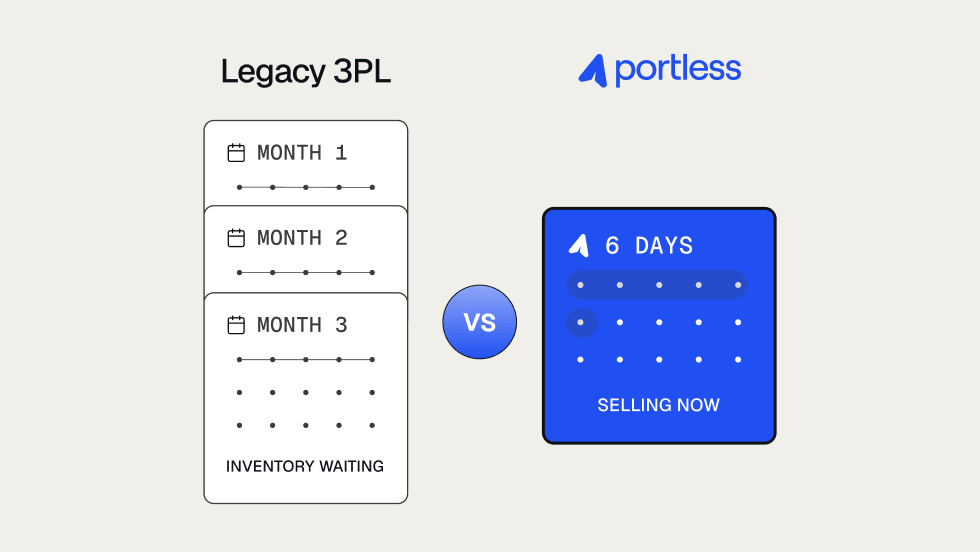
This is the structural change that separates the brands absorbing tariff shocks from the ones being flattened by them. Under a bulk import model, you pay duties when your container clears customs — before a single unit sells. Under a direct fulfillment model, duties are applied at the parcel level when an order ships to a customer, matched against the revenue from that specific sale.
Same product, same duty rate, completely different cash flow profile. You're not paying a lump-sum tariff bill on inventory that might sit in a warehouse for months. You're paying duty per order, as orders come in.
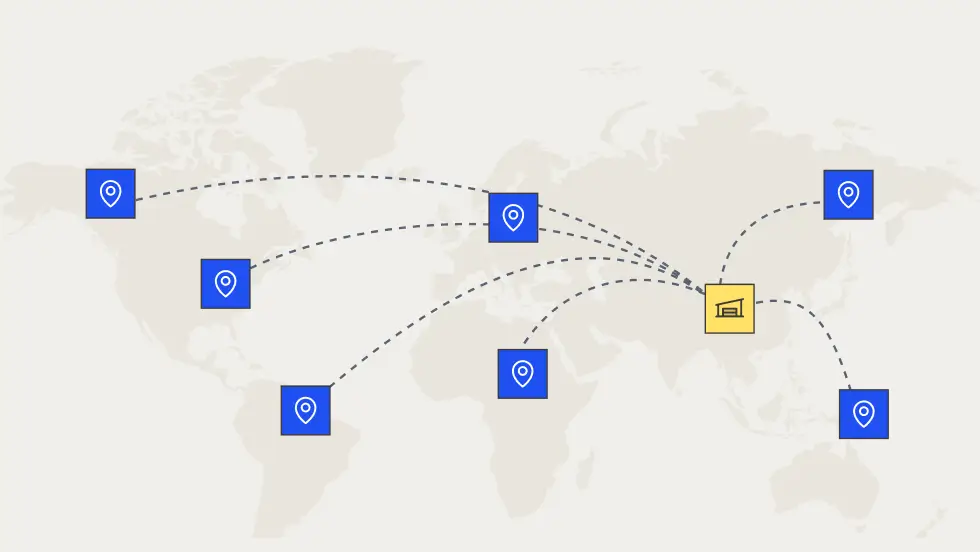
For brands manufacturing in Asia, this is exactly what the Portless direct fulfillment model enables. Orders are fulfilled direct from China, duties applied at the parcel level, and no bulk import is required.
4. Identify your high-exposure SKUs and reduce their tariff burden
Not every SKU in your catalog has the same tariff exposure. Some are classified under HS codes with higher duty rates, some are sourced exclusively from high-tariff countries, and some have thin enough margins that even a small duty increase makes them unprofitable. Map your SKUs against their actual exposure and treat the high-risk ones differently — lower safety stock, smaller production runs, or prioritizing them for a direct fulfillment model where duty timing is more favorable.
Then look at whether the rate itself can come down. Tariff rates are set by HS code classification, not by product. Small, legal changes to materials, components, or product construction can shift your classification into a lower bracket. This is tariff engineering — reviewing your HS codes for accuracy, working with a trade attorney on reclassification opportunities, or exploring country-of-origin engineering where final assembly location changes the duty rate.
HS code strategy requires trade expertise and getting it wrong creates compliance risk. But for high-exposure SKUs, even a small reclassification can meaningfully change landed cost. Portless CEO, Izzy, discussed these strategies in detail on NPR's The Indicator from Planet Money.
5. Build scenario plans before you need them
Trade policies change fast. Equip your forecasting tools to model multiple scenarios so you're ready for best- and worst-case outcomes before they hit the bottom line.
In practice, this means having a documented answer to three questions before a tariff change is announced:
What do we do if rates rise by 10%?
What do we do if a key sourcing country is hit with new duties?
What do we do if a shipment is delayed by 30 days beyond forecast?
Brands that have thought through these scenarios in advance make faster, better decisions when conditions actually shift. Brands that haven't tend to react by front-loading inventory — which as covered above, often compounds the problem.
6. Use international expansion as a revenue hedge, not just a growth play
71% of brands in our benchmark report are accelerating or newly considering international expansion because of tariffs. The logic is sound: if your US margins are compressed by tariff costs, revenue from markets where those same tariffs don't apply becomes proportionally more valuable.
International expansion doesn't directly solve your inventory management problem, but it changes the denominator. More revenue channels sharing the same inventory base means tariff-driven margin compression on US sales hurts less when international sales are contributing meaningfully to total revenue. Through our partnership with OpenBorder, customs classification and compliance for international orders are handled automatically — making the operational barrier to adding new markets lower than most brands expect.
How brands are actually responding: benchmark data
We surveyed 133 US Ecommerce brands on how they're managing tariff-driven cost increases. The data shows a consistent pattern: most brands are pulling multiple levers at once rather than committing to a single strategy. Those managing best are the ones that have changed how their inventory and cash flow interact, not just how much they're holding.
A few findings worth noting for inventory strategy specifically:
88%of brands report tariffs have impacted their costs or margins. The brands holding up share something in common: they didn't wait to act, and they didn't rely on a single fix.
60%are carrying more inventory than before. Capital is tied up in goods that are expensive to hold and difficult to reprice if conditions shift again.
79%saw margins compress despite raising prices. The brands with the most room to maneuver changed where in the supply chain they pay tariffs, not just what they charge.
40%now rank customs and tariff expertise as a top criteria when choosing a fulfillment partner, up from near the bottom of the list in prior years.
Examples of companies adapting inventory strategy to tariffs
&Collar: 5% in-stock to a record-breaking peak season in 30 days
&Collar had grown past $10M in annual revenue when their supply chain hit a wall. Heading into Father's Day 2023 — their second-biggest sales event of the year — they were at 5% in-stock on their hero SKU. The inventory was in production in China. Ocean freight wouldn't get it to their Utah warehouse in time. Emergency air freight on 50,000 units would gut their margins. Neither option was good.
They found Portless, onboarded in 30 days, and rerouted 40,000 units via direct fulfillment. Instead of waiting for a container to cross the Pacific, land, clear customs, and truck to a warehouse, orders shipped direct from Shenzhen to customers as they came in. They went from 5% in-stock to 100% and posted a 35% year-over-year revenue increase during that peak season.
"We were growing, growing, growing. And then we had to take a step back and ask, ‘Do we have to build a solid base to grow to the next phase?’" — Mark Brown, Founder at &Collar
That base — a fulfillment model with slack in it, where a production delay or a tariff spike doesn't eliminate all your options at once — is exactly what tariff-resilient inventory management looks like in practice.
Is your inventory strategy tariff-resilient?
Signal
Resilient
Not resilient
Landed cost visibility
Per-SKU landed cost calculated including duties, modeled at +10% and +25% tariff scenarios
Rough COGS estimate, duty rate treated as fixed
Duty timing
Duties applied per order at fulfillment against confirmed revenue
Lump-sum duties paid at bulk import before goods sell
Reorder cadence
Smaller, more frequent orders with lower capital commitment per cycle
Large infrequent orders driven by MOQ thresholds
High-exposure SKUs
Identified and managed separately from low-exposure catalog
All SKUs managed under a single inventory approach
Scenario planning
Documented response to 10%, 25%, and supply disruption scenarios
No formal plan — tariff changes trigger reactive decisions
International revenue
Multiple markets contributing to revenue base
US-only, full exposure to US tariff environment
Limitations to know
Direct fulfillment and on-demand inventory models aren't the right fit for every brand or every product. A few honest constraints worth knowing before you evaluate them.
Product weight and value. Air-based direct fulfillment works within specific weight and value bands. Heavy or oversized products may not pencil out on a per-order air freight basis. Get a landed cost comparison on your specific SKUs before assuming the economics work.
MOQ and production minimums. Shifting to smaller, more frequent orders sounds straightforward. In practice, your manufacturer may have minimum order quantities that constrain how small you can actually go. That's a supplier negotiation, not a fulfillment one. But it affects how much flexibility the strategy actually delivers.
Existing 3PL commitments. If you're locked into a warehouse contract, that's a real constraint on how quickly you can shift your inventory model. Portless supports brands that want to use direct fulfillment for international orders while keeping their existing domestic setup for US fulfillment — that's a common starting point that doesn't require breaking existing contracts.
The brands that got ahead didn't wait
The brands holding up best in the current tariff environment aren't the ones that stockpiled the most inventory. They're the ones that changed how their inventory interacts with their cash flow, specifically, when duties hit their P&L and how much capital they have deployed at any one time in unsold stock.
That structural shift is available to most DTC brands, and it doesn't require moving your manufacturing or rebuilding your entire supply chain. It starts with understanding where your exposure actually sits and making one or two targeted changes to how you order and fulfill.
If you want to see what that looks like for your specific numbers, talk to our team and we'll model it out.
FAQ
What is the best way to manage inventory during tariff changes?
The most effective approach combines landed cost visibility per SKU, smaller and more frequent ordering to reduce capital commitment per cycle, and a fulfillment model where duties apply at the point of sale rather than at bulk import. So tariff costs are matched against revenue rather than paid in advance.
Should I stockpile inventory before tariff increases?
Strategic pre-buying can make sense for SKUs with high confidence on demand and a predictable rate change. The risk is over-committing capital to inventory that may not sell at the margins you planned, particularly when tariff changes keep coming rather than stabilizing after a single increase.
How do tariffs affect inventory carrying costs?
Tariffs increase your landed cost per unit, which increases the capital value of your inventory on hand. Higher inventory value means higher carrying costs in absolute terms — typically 20–30% of total inventory value per year in storage, handling, insurance, and obsolescence. Front-loading inventory ahead of rate increases compounds this effect.
What is the difference between duty timing and duty rates?
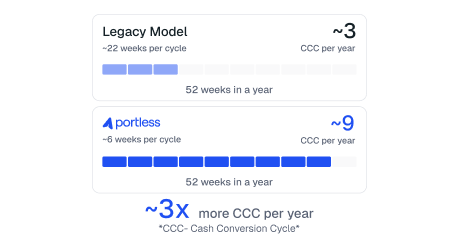
Duty rates determine how much you pay per unit. Duty timing determines when you pay it. Under bulk ocean freight, you pay duties upfront at import before goods sell. Under direct fulfillment, duties apply per order at the point of fulfillment. Changing your duty timing can improve your cash conversion cycle significantly even if your duty rate stays the same.
How are other Ecommerce brands managing tariff costs right now?
According to our Ecommerce Tariffs Benchmark Report 2026, most brands are splitting the impact between margin and pricing rather than committing fully to either, while simultaneously working supplier relationships and rethinking their inventory and fulfillment models. The brands managing best aren't relying on any single lever.
Can I use direct fulfillment for some SKUs and keep my existing 3PL for others?
Yes. Portless supports brands that want to run direct fulfillment alongside an existing domestic setup, either for international orders specifically or for high-tariff-exposure SKUs where the duty timing advantage is most valuable. It's a common entry point that doesn't require switching everything at once.
Frequently asked questions
Heading
Lorem ipsum dolor sit amet, consectetur adipiscing elit. Suspendisse varius enim in eros elementum tristique. Duis cursus, mi quis viverra ornare, eros dolor interdum nulla, ut commodo diam libero vitae erat. Aenean faucibus nibh et justo cursus id rutrum lorem imperdiet. Nunc ut sem vitae risus tristique posuere.
Get operator-level supply chain insights
Thank you! Your submission has been received!
Oops! Something went wrong while submitting the form.







.jpg)