“We generated $70K in package protection revenue in a single quarter by adding a simple $4 protection option at checkout — plus an additional $12K from cashbacks. Customers get peace of mind, and we're making a profit on every protected order with zero effort."
“We generated $70K in package protection revenue in a single quarter by adding a simple $4 protection option at checkout — plus an additional $12K from cashbacks. Customers get peace of mind, and we're making a profit on every protected order with zero effort."
Building a DTC brand used to be a growth story. Raise a round, buy attention, grow the top line, and raise again at a higher price. That playbook is finished. Venture funding for DTC brands has collapsed since its 2021 peak, down by as much as 97% on some estimates, interest rates have made cheap debt scarce, and the brands that get bought today are the ones that are profitable and well run. Growth alone no longer gets you bought.
That changes what you should be building toward. A profitable, exit-ready brand rests on a few operational fundamentals: a supply chain run as a financial asset, sourcing chosen for fit over price, and a business designed for optionality from the start. Here's how to put those in place, and what the brands clearing billion-dollar and clean nine-figure exits are doing differently.
Why profitability beats growth in DTC 2.0
The shift is structural, not temporary. A decade ago, founders often made their money on secondaries, selling shares into each new round long before the business proved it could stand on its own. Cheap capital meant an unprofitable brand with a good story was still fundable. With money out of the system and rates higher, acquirers have stopped paying for the story. They want margin and a credible path to scale.
Aaron Alpeter, founder and CEO of Izba, the operations firm he says has been part of roughly $2.5 billion in founder exits, has watched the standard change up close.
Acquirers aren't interested in those companies anymore. That is a hard pass if you're not profitable or if it doesn't look like you're scaling. — Aaron Alpeter, CEO at Izba
The penalty for missing this shows up at the top of the market. Allbirds, once valued at more than $4 billion, sold its assets in early 2026 for about $39 million after years of unprofitable growth and aggressive store expansion. Growth didn't save it. Without profit, growth no longer creates value. And the lever that most directly decides whether a brand is profitable is the one founders tend to treat as an afterthought: the supply chain.
Treat your supply chain as a financial asset
Most early brands leak margin in the same place: they never build a real planning process. Sales and operations planning, sometimes called integrated business planning, is the discipline of lining up demand, inventory, cash, and production on a regular cadence so decisions get made on purpose instead of in a panic. It's more than a recurring meeting or a forecasting spreadsheet. Done well, it's how the whole business makes decisions.
Really what it is, is the DNA of how a company makes decisions, deals with conflict and set goals. — Aaron Alpeter, CEO at Izba
There's no single template. A five-person brand shouldn't run a Fortune 500 process; the goal is identical at every size, but the solution fits the size of the company. In practice it's a simple loop. Compare three numbers: what you expected, what you wanted, and what actually happened. Then adjust. That works in Google Sheets as well as in NetSuite. The habit is what protects margin.
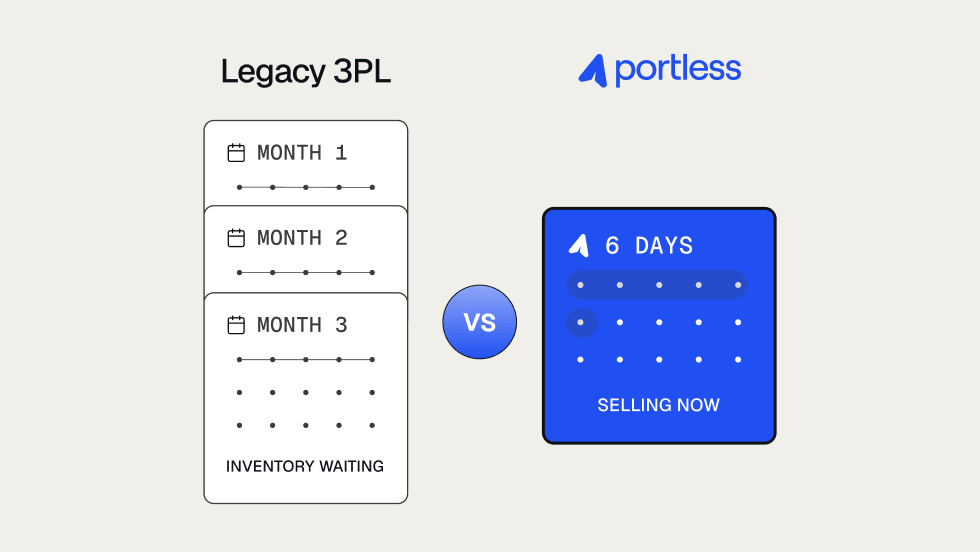
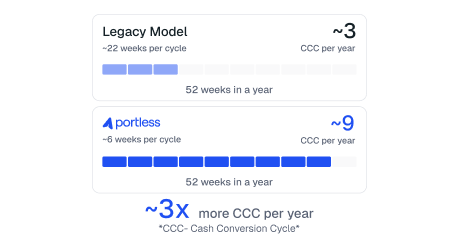
Run this way, the supply chain frees up cash instead of tying it up. The biggest culprit is working capital frozen in inventory sitting in a warehouse. Direct fulfillment removes that by shipping inventory straight from the manufacturer to the customer, so cash isn't locked in stock. It's the model Portless runs, and its case studies show brands compressing their cash conversion cycle by more than 100 days. The faster inventory turns, the more growth a brand can fund out of its own operations.
Source for the relationship, not just the price
Price gets the most attention in sourcing and deserves the least. A manufacturing partnership only works when the economics work for both sides. If a factory can't make money on your order, the great rate you negotiated turns into a deprioritized account, late runs, or a supplier who won't scale with you. The right price is the one that protects your margin and theirs.
The most important thing you're sourcing is a relationship. — Aaron Alpeter, CEO at Izba
Once the economics clear, the decision is about fit. Where the factory sits shapes your time zone overlap and how fast you can turn inventory. Certifications matter if your category requires them. Being the smallest brand in a giant factory is a different experience than being the biggest brand in a small one. So is whether you can text the owner for a quick answer or need two months to get an NDA signed. None of these has a universally correct answer. They have to match how you actually want to operate.
Technology helps, but it doesn't replace the relationship. The strongest sourcing operators use AI to speed up vetting and still treat the human connection as the deciding factor.
The future isn't going to be AI, the future is going to be you and I. — Aaron Alpeter, CEO at Izba
Build for optionality, not just a sale
Every founder exits their business eventually, by selling, stepping back, handing it down, or walking away. Because some exit is inevitable, the smartest goal isn't to build to sell. It's to build for optionality, so the choice stays open when you want it.
I don't know if it's necessarily built to sell, but it's more built to exit. — Aaron Alpeter, CEO at Izba
Most of the work is the same regardless of the ending. Roughly 80% of running the business looks identical whether you plan to sell, pass it on, or keep it for the cash flow. The final 20% is how aggressive you get with cash, inventory, and redundancy. A lean one-person Shopify business throwing off a few million in cash flow is a great outcome, even though it's hard to sell because everything lives in the founder's head. A business you can step away from needs the team, pipeline, and documented processes to run without you. The company is the same either way; only that last slice changes.
A sale isn't the only definition of winning. Decide what season you're in, set goals you're allowed to change, and don't harden the supply chain so early that you never get to prove the business works.
You don't have to be a billion dollar exit to be successful as an entrepreneur. You really just have to be a profitable business and enjoy what you're doing and be making an impact for your customers. — Aaron Alpeter, CEO at Izba
What acquirers actually pay for: a defined category
Acquirers rarely pay a premium for category creators. They pay for category definers, the brands that take a known space and own the modern version of it. You don't have to invent something new. You have to become the reference point for what the category should be.
The recent exits make the pattern obvious. Nutrafol built the hair-loss supplement category and was acquired by Unilever. Grüns, founded in 2023, defined the daily-gummy greens category and sold to Unilever for about $1.2 billion in roughly three years. LesserEvil didn't invent popcorn; it defined the organic, better-for-you version and went to Hershey for about $750 million. None of them created a market from nothing. Each became the obvious choice in one.
There's a structural tailwind behind this. The big strategics are reshuffling, splitting and specializing instead of bundling everything under one roof. When a conglomerate doing tens of billions in revenue spins off divisions, a sharp $100 million brand becomes interesting again. A focused, category-defining business is more acquirable today than a sprawling one was a decade ago.
If you're just starting out, keep it simple
In the first phase of a brand, simplicity beats optimization. The only question that matters is whether people want the product and will pay for it. Almost everything else is a distraction until that's answered.
That argues for keeping the operation lean and favoring variable costs over fixed ones. Use consultants and outsourced operations even if they cost more per order, because at this stage what you need is proof that the product sells, not a few extra points of margin. The advice for a brand-new founder is to “keep things as simple as possible” and protect the hours that go toward the customer instead of the warehouse.
Outsourcing comes with one rule: outsource the work, not the responsibility. Whoever you bring on should be teaching you as they go, because at this stage that knowledge is part of what you're buying. Printing labels doesn't tell you whether the product is good. Talking to customers does.
From zero to your first million in revenue, the job is proving demand and a way to reach it. Supply chain optimization, margin, and cash flow come after that's clear, not before. Get the order wrong and you burn scarce time perfecting a business before you know anyone wants it.
Watch the full episode
This playbook draws on a conversation between Portless CEO Izzy Rosenzweig and Aaron Alpeter on The Modern Supply Chain. The full episode goes further: how AI shopping agents could turn product discovery into a winner-takes-most game, how to separate everyday firefighting from long-term strategy when you bring in operational help, and a closer look at the Grüns and Allbirds deals as two ends of the new exit playbook.
Lorem ipsum dolor sit amet, consectetur adipiscing elit. Suspendisse varius enim in eros elementum tristique. Duis cursus, mi quis viverra ornare, eros dolor interdum nulla, ut commodo diam libero vitae erat. Aenean faucibus nibh et justo cursus id rutrum lorem imperdiet. Nunc ut sem vitae risus tristique posuere.
Get operator-level supply chain insights
Thank you! Your submission has been received!
Oops! Something went wrong while submitting the form.






.avif)

.jpg)
%20(1).jpg)
%20(1)%20(1).avif)