
One missed fulfillment window during BFCM can cost you your biggest week of the year. Shopify merchants moved a record $14.6 billion over the 2025 weekend, and more than 94,900 of them had their single best sales day ever.
If your 3PL buckled last year, you're weighing your options for this one. Adding a backup fulfillment provider is the fastest way to protect this peak. You put it in place alongside the one you already have, get it live before Black Friday, and let it prove itself on real orders.
You already apply this logic to your factories. You keep a second supplier warm so one production problem can't take a hero SKU offline. A backup fulfillment provider does the same job one step downstream, keeping a second path to your customer open so one warehouse problem can't take your peak offline.

A backup fulfillment provider is a second fulfillment operation that runs alongside your primary 3PL. It absorbs overflow, covers a specific channel, or steps in when your main provider misses. You don't move your whole operation. You route a slice of volume through a second path, so no single failure can take down your entire fulfillment.
A backup does three things for you during peak:
This is fulfillment-side redundancy, the natural companion to supply-side redundancy. If you've read our guide to dual sourcing without the cash drag, you know the case for keeping a second factory warm on your top SKUs. A backup fulfillment provider extends that same insurance from production to delivery.
A backup strengthens your peak without changing what already works. You keep your current 3PL running the inventory and orders it already handles, and add a second, more capable path for the volume that needs it most. Nothing about your existing setup has to move before Black Friday.
A direct fulfillment backup can be live in two to four weeks, so it's in place for peak while your primary keeps doing its job.
Direct fulfillment is the strongest backup for BFCM because it removes the two things that break most during peak, inventory lead time and the forecast you locked in months ago. Instead of shipping bulk containers into a domestic warehouse, direct fulfillment stages your inventory at a factory-adjacent center and ships orders straight to the customer once they sell. That structural difference is what makes it a real backup, not a second version of the same problem.
You can replenish a bestseller in five to eight days with direct fulfillment, instead of the 60 to 90 a bulk-freight-and-warehouse cycle takes end to end. Ocean transit alone runs 25 to 35 days from China to the US East Coast before you add production, inland trucking, and receiving. When a SKU sells faster than you planned during BFCM, you produce more and it's back in stock within the week, instead of going dark while you eat the lost sales. Our BFCM inventory strategy guide goes deeper on staying in stock without trapping cash.
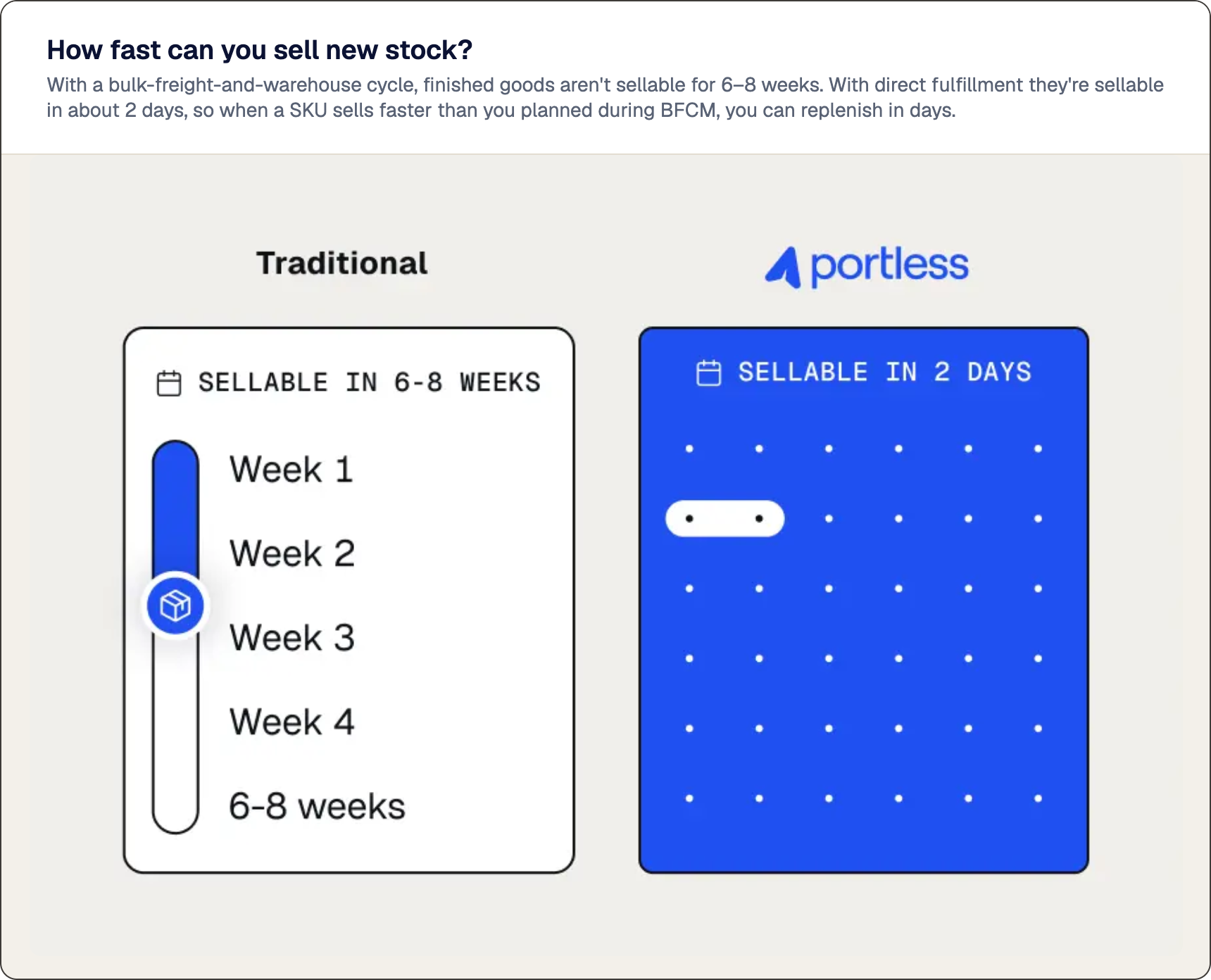
You produce and ship based on what's actually selling, not a bet you placed in August. If a color, size, or bundle you underweighted becomes the BFCM winner, you can run a small last-minute batch and have it selling within days, with no ocean freight and no receiving queue. That's impossible when your entire peak position was locked in and shipped months ago. A backup running on direct fulfillment is where you put the demand your forecast got wrong.
Because you route only a slice of volume, a direct fulfillment backup doesn't touch the rest of your setup. Your primary 3PL keeps running as it is. You point a few hero SKUs, your overflow, or one channel at the backup, and you've added capacity and redundancy without a migration. If it performs during your highest-stakes window, you'll know from real orders whether it deserves more of your volume in Q1.
::table
What breaks during peak;Primary 3PL alone;Primary 3PL + direct fulfillment backup
Bestseller sells out;Wait 60 to 90 days for the next container;Replenish in 5 to 8 days from a factory-adjacent center
A SKU you underweighted takes off;Locked out until the next production cycle;Run a small last-minute batch, selling within days
Warehouse hits a receiving or labor backlog;Every order stalls;Overflow reroutes to the second path
Volume spikes past dispatch capacity;Late dispatches and missed SLAs;Backup absorbs the surge
:table
Privacy Clo, an apparel brand run out of Perth, hit exactly this wall. Peak season and BFCM 2024 pushed its in-house setup past its limit, capping out its warehouse and letting a single printer outage derail a full day of orders. After moving fulfillment to Portless, inventory became sellable within 24 hours of arriving, instead of the 90 days sea freight had taken, and replenishment turned in days rather than quarters.
"Speed to market is very important, especially in fashion, because so many things can go wrong, and there can be so many delays. Reducing the potential for those delays is a massive win." — Ryan De Gennaro, founder, Privacy Clo
A backup protects you from the two outside forces that hit hardest when your primary 3PL is most stretched.
You can stand up a backup in two to four weeks, so there's still time before peak. The play is small on purpose. You get a foot in the door on a slice of volume, prove it under real conditions, and expand later. Four steps get you there:
For the other operational gaps you can close before peak, our final 18-day BFCM ops checklist covers carriers, returns, and customer comms. To pressure-test the cash impact first, the Direct Fulfillment ROI Calculator models how a shorter production-to-cash cycle changes what you can afford.
The brands that come through BFCM clean gave themselves a second path to the customer before peak, so no single provider can take down their best week. A direct fulfillment backup does that with a two-to-four-week setup and a slice of your volume. Better still, it turns your highest-stakes season into a low-risk trial of a provider that could carry far more of your business next year.
If your setup is one bad week away from a missed peak, that's worth a conversation with our team while there's still runway before November.
You can, and if your current provider isn't cutting it, a change may be the right move. If you'd rather not move everything before peak, adding a backup fulfillment provider is a lower-commitment way to strengthen this BFCM now. Many brands start with a backup, see how it performs on real orders, and decide in Q1 whether to shift more volume to it.
A backup supplier is a second factory that protects your ability to produce a product. A backup fulfillment provider is a second fulfillment operation that protects your ability to ship it. Both are redundancy on your top SKUs. Supplier redundancy is covered in our guide to dual sourcing; a backup fulfillment provider extends the same insurance from production to delivery.
A direct fulfillment provider can typically onboard a brand in two to four weeks, so a backup started in late summer or early fall is live well before Black Friday. Because you're only routing a slice of volume, setup is far faster than a full 3PL migration.
Not if you split by SKU or channel rather than duplicating your whole catalog across both. Each provider owns a defined set of inventory, your store routes orders accordingly, and tracking flows back through your existing integrations. Keeping allocations clean is what prevents the overselling and sync issues brands worry about.
Start small, with your top three to five hero SKUs, expected overflow above your primary's capacity, or a single channel that carries a strict dispatch SLA. The goal for BFCM is to prove the backup under real conditions and protect your most exposed volume, not to redistribute everything. You can expand the allocation in Q1 once you've seen how it performed.
