“We generated $70K in package protection revenue in a single quarter by adding a simple $4 protection option at checkout — plus an additional $12K from cashbacks. Customers get peace of mind, and we're making a profit on every protected order with zero effort."
“We generated $70K in package protection revenue in a single quarter by adding a simple $4 protection option at checkout — plus an additional $12K from cashbacks. Customers get peace of mind, and we're making a profit on every protected order with zero effort."
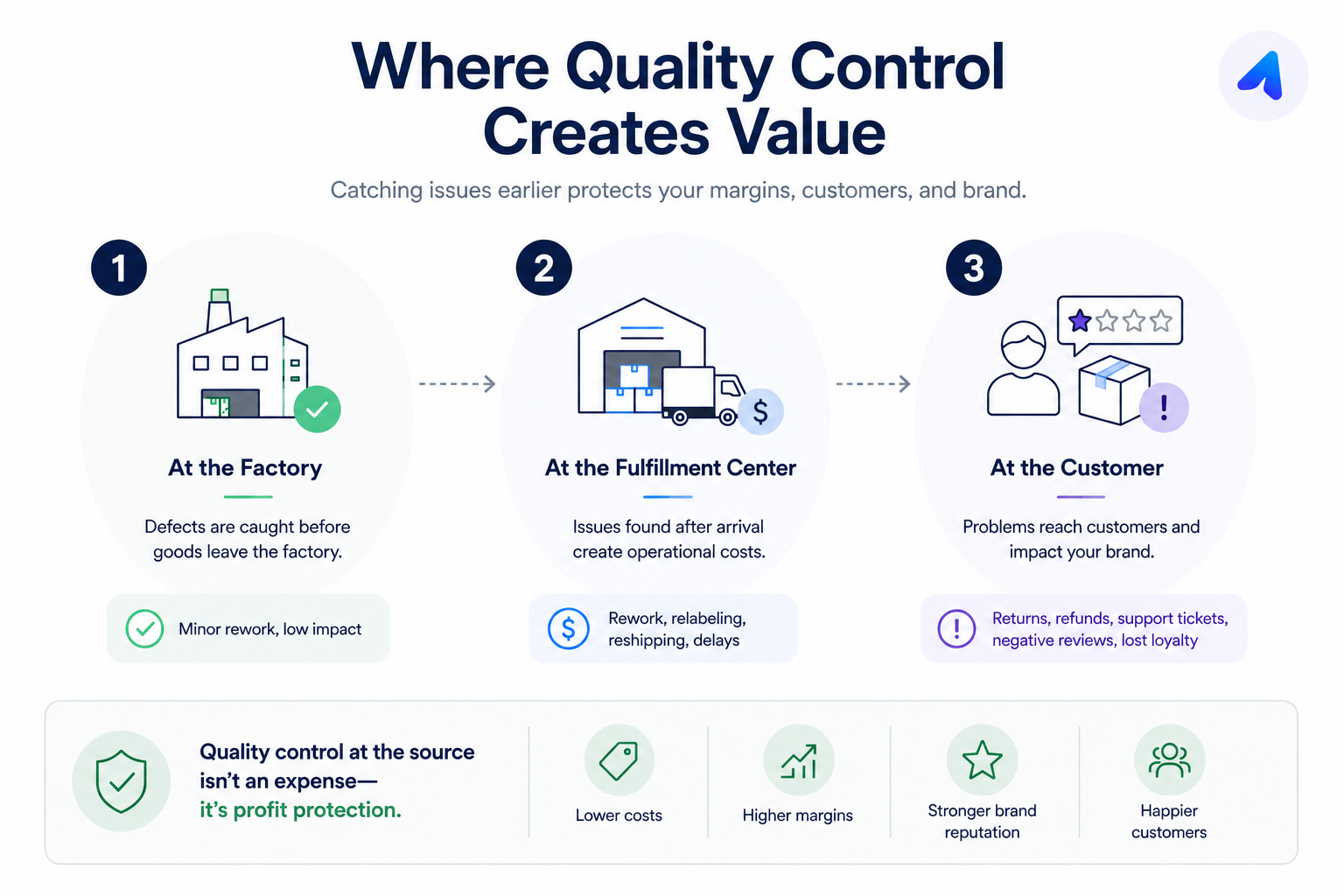
Every shipment that reaches a customer is a brand impression, and every shipment that leaves a factory unchecked is a bet that nothing went wrong.
Returns are one of retail's largest costs: US shoppers are on track to return roughly $850 billion of merchandise in 2025, and online orders come back more often than in-store ones, according to the National Retail Federation.
Defects, wrong counts, and items that don't match the order are an avoidable slice of that. Product quality control is how you catch those problems at the factory, before you pay the final balance and before the container ships.
What product quality control actually is
Quality control (QC) is an independent, on-site inspection at your supplier's factory, carried out by a trained third-party inspector rather than the factory itself. The inspector verifies that what's being produced matches what you ordered, and documents everything in a formal report. Three things make that worth paying for.
Verification, not trust
Your factory says the order is ready and correct. QC is how you confirm that independently, before you pay the final balance or load a container. This isn't about distrusting your supplier. Even good factories have off days, and verifying is simply cheaper than assuming.
Statistical sampling you can defend
Inspectors pull a random sample using Acceptance Quality Limit (AQL) standards, so defects are caught across random units, not just the polished pieces a factory chooses to show. AQL is the maximum share of defective units considered acceptable in a lot, defined internationally in ISO 2859-1, which means the pass-or-fail call rests on a recognized method, not a gut feeling.
A paper trail that protects you
The inspection report is formal documentation. If a problem surfaces later, you have a written record of what was, or wasn't, present at shipment, which you can point to in any supplier dispute.
Why skipping QC costs more than doing it
QC is one of the cheapest checks in your supply chain, and the math is simple. A defect caught at the factory costs pennies to fix. The same defect caught by a customer costs you the return, the refund, the replacement, and the review.
Few people have seen more sourcing disasters than Isaac Hetzroni, the specialist known as The Sourcing Guy and founder of Imprint Genius. On Portless's podcast, The Modern Supply Chain, he made the case that QC is the highest-ROI move a brand can make, and pointed to a cautionary tale: a brand that received a shipment of beauty products in bottles that were only partially filled. From the outside, the bottles looked fine. The order still cost the brand time, money, and customer trust.
“[Quality control] is the highest-ROI thing you can do within product sourcing by a mile.” – Isaac Hetzroni, Founder of Imprint Genius
The savings show up in more than one place:
Cut returns and refund rates. Returns are expensive and common, on track to reach about $850 billion across US retail in 2025, and online orders are returned at a higher rate than in-store, an estimated 19% (NRF). Every defect you keep out of a customer's hands is a return you never pay to process, and pairing clean product with reliable delivery and easy returns compounds that advantage.
Avoid shipping rejected goods. Customs can hold or detain a shipment over labeling, certification, or safety issues. In the US, both CBP and the Consumer Product Safety Commission can flag imported consumer products and hold them at the port (CPSC). QC verifies conformity before the container leaves, not after.
Protect your brand reputation. A bad product experience follows you: about 71% of consumers say they're less likely to shop with a retailer again after a poor experience, and roughly four in five share that experience with friends and family (NRF). Catching defects upstream keeps that impression sharp.
Negotiate from evidence. A written inspection report is documentation you can point to when you ask a supplier for rework, a credit, or a replacement, before you wire the final balance. Without it, you're arguing in the dark.
Keep suppliers consistent across reorders. The AQL system exists specifically to pressure a supplier, through the cost of a rejected lot, to hold quality at least as good as the agreed standard from batch to batch (ISO 2859-1). That's also how you catch quiet spec drift, where materials or dimensions change between runs.
What you get in every inspection
Every booking includes a professional inspector at the factory, a full quality check, and a detailed report within one business day. In practice, that means:
An on-site QC inspector deployed to your supplier's factory.
Quantity verification to confirm units match your PO before shipment.
Defect sampling using AQL standards to catch issues early.
A product conformity check against your specifications and approved samples.
Measurement checks for dimensional accuracy against your specs.
An official inspection report delivered as a detailed PDF within one business day.
The inspection types, and when to use each
Different stages of production call for different checks. The five most common:
::table
Inspection type;When to use it
Pre-shipment inspection;A final check once production is complete, just before goods leave the factory. The most common type.
Inline / during production;A mid-production check to catch issues before the full order is finished and expensive to fix.
Full inspection (100% QC);Every single unit checked. Best for high-value or high-risk orders.
Truck loading supervision;Confirms the correct goods are loaded and properly secured for transport.
Inventory count or audit;A physical count and condition check of stock at the factory or warehouse.
:table
How it works, from booking to report
The process is built to be fast. Most of the timeline is the factory's production schedule, not paperwork on your end.
::table
Step;Timeline;What happens
Submit your booking;Day 0;Fill out the inspection request form with factory details, product info, and your preferred date.
We review and confirm;Day 1–2;The team reviews the booking, coordinates with the inspection agency, and sends you a quote.
You approve the quote;Day 3–5;Confirm the quote. The inspection is scheduled and you get the date and inspector details.
Inspection day;Scheduled date;A professional inspector visits the factory and runs the full quality check on your behalf.
Report delivered;+1 business day;You receive the official PDF report within one business day of the inspection.
:table
Stop shipping without inspecting
A defective batch usually isn't bad luck. It's an unchecked one. For the price of a few good orders' shipping, an independent inspector can confirm your goods are right before you pay the balance or load the container.
AQL (Acceptance Quality Limit) is the maximum percentage of defective units considered acceptable in a production lot. It's defined by the international standard ISO 2859-1 and tells the inspector how many units to pull from a batch and how many defects are allowed before the lot fails, so a whole order can be judged from a random sample instead of checking every unit.
How long does it take to get the inspection report?
The official PDF report is delivered within one business day of the inspection. Bookings are reviewed within one business day of submission, and inspections are typically scheduled about two days after you approve the quote.
What's the difference between a pre-shipment and an inline inspection?
A pre-shipment inspection is a final check once production is complete, just before goods leave the factory, and it's the most common type. An inline inspection happens mid-production, so you can catch problems before the full order is finished and expensive to fix.
Does the factory see the inspection results?
No. The inspector reports findings exclusively to you, not the factory, and doesn't issue shipping approvals on site. That keeps control of your supply chain decisions with you.
Do I need to inspect every order?
Not necessarily, but factories that know you inspect tend to produce more consistently, an effect the AQL standard is designed to create (ISO 2859-1). High-value or high-risk orders are the best candidates for a full (100%) inspection.
Frequently asked questions
Heading
Lorem ipsum dolor sit amet, consectetur adipiscing elit. Suspendisse varius enim in eros elementum tristique. Duis cursus, mi quis viverra ornare, eros dolor interdum nulla, ut commodo diam libero vitae erat. Aenean faucibus nibh et justo cursus id rutrum lorem imperdiet. Nunc ut sem vitae risus tristique posuere.
Get operator-level supply chain insights
Thank you! Your submission has been received!
Oops! Something went wrong while submitting the form.






.avif)

.jpg)
.jpg)
%20(1).jpg)