
Last updated: April 21, 2026
Anyone who runs an Ecommerce brand will recognize the pressure: your inventory and cash trapped in a container on the water. Between manufacturing costs, ocean freight, duties, and warehousing, a large chunk of working capital is tied up months before you've made a single sale.
Many businesses see this as an unavoidable part of doing business. It isn’t.
The direct fulfillment supply chain model — the same one used by Shein and Temu — make it possible to move products from the factory to customers faster, with less upfront risk. Products are stored near the factory and shipped directly to customers when an order is placed, rather than sending large batches of inventory to overseas warehouses first.
In this guide, you’ll find a complete breakdown of direct fulfillment, why it beats the legacy ecommerce fulfillment model, and why many Ecommerce brands are adopting it to reduce lead times, improve cash flow, mitigate risk, and test global expansion.
Direct fulfillment is a supply chain model where Ecommerce brands store and fulfill inventory near their point of manufacture — typically in Asia — and ship orders directly to customers worldwide by air.
Instead of sending bulk inventory to overseas or domestic warehouses months before a sale, products ship individually as orders come in. Delivery typically takes five to eight days.
While some refer to this as a "China 3PL," it's a fundamentally different model — one that centralizes global distribution from a single hub, using air freight and proximity to manufacturers to replace the legacy network of warehouses, ocean containers, and fragmented inventory.
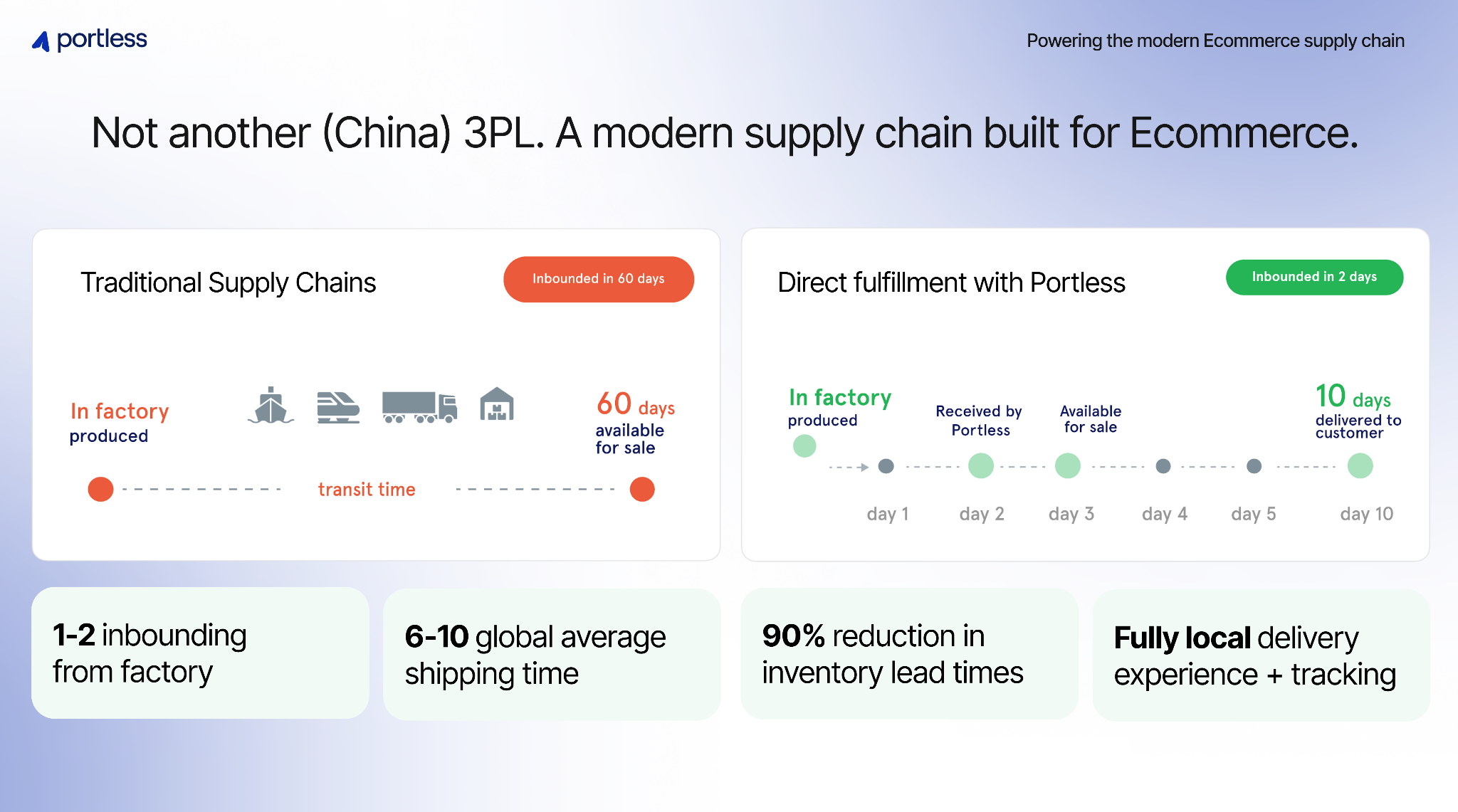
Direct fulfillment also changes how inventory moves through the supply chain. In a legacy Ecommerce fulfillment model, brands manufacture large batches of inventory and ship them to overseas warehouses months before they sell. That means their cash is locked up, which makes it hard to grow your business, advertise, hire new team members, and respond if demand shifts.
With direct fulfillment, you unlock the ability to manufacture in smaller batches and store them closer to where they're produced. When a customer places an order, the product is picked, packed, and shipped directly to them. This model gives independent Ecommerce brands the same supply chain speed advantage as global giants like Temu and Shein.
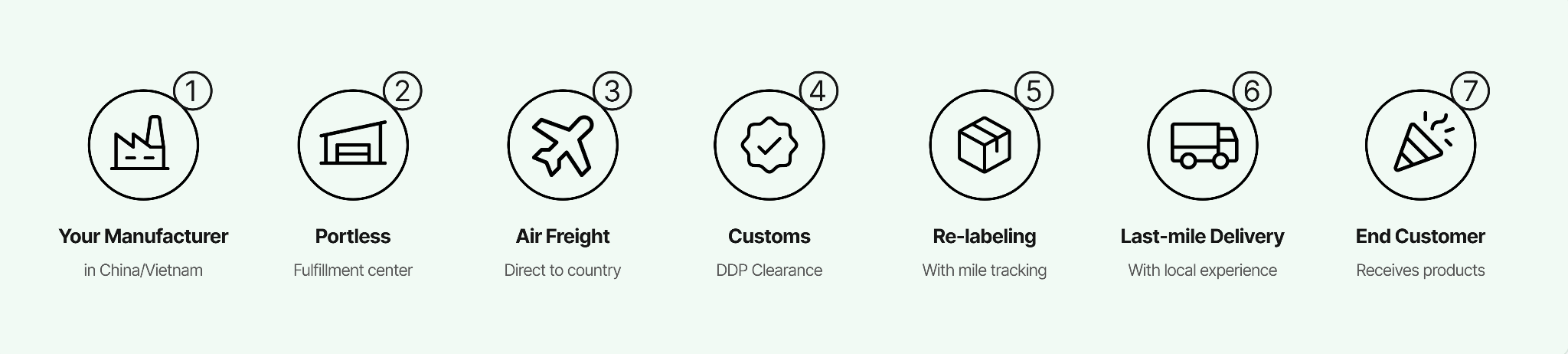
Direct fulfillment gives brands full control over their products and supply chain. Here's how it works:
Because inventory sits close to the factory, quality issues can be caught and fixed fast. Portless runs QC checks at inbound — if there's a defect, products go back to the factory for same-day rework. In a legacy supply chain model, that error wouldn't surface until inventory arrived in North America, meaning it would all have to be scrapped.
Direct fulfillment is not the same as standard air freight. Air freight simply means flying large shipments of inventory to a warehouse in another country. From there, products are stored locally and shipped domestically when customers order. You still have all the upfront duty, warehouse, and insurance costs.
Direct fulfillment uses a different approach called direct injection. Individual orders ship directly to the end customer rather than moving bulk inventory around the world.
One of the biggest reasons direct fulfillment can move so quickly is a shipping method called zone skipping.
In a legacy international shipping model, packages enter a country through a single busy port — most likely the port of Los Angeles — before being sorted and routed across multiple domestic shipping zones. This adds several days of delays as parcels pass through distribution centers.
With direct injection, your shipments fly directly to the region where the customer lives, bypassing several domestic shipping zones. Here's how this looks in practice:
One of the biggest financial advantages of the direct fulfillment supply chain model is how it impacts your cash conversion cycle — the time it takes to turn money spent on inventory into revenue from sales.
This matters because the longer your money is tied up in inventory, the less cash you have available for marketing, product development, or your next production run.
The legacy way (ocean freight): You pay the factory, they make your goods, those goods go to a port, they get loaded on a container, it takes 45-60 days (or longer) to travel and clear customs. Then goods are sent to a domestic warehouse where they are finally inbounded and made available for sale. . During that time, you've got no cash to pay for ads or fund the next batch of inventory.
The direct fulfillment way: Inventory is available for sale almost immediately after manufacturing. You're selling goods before you would have even received them via ocean freight. This creates the potential for a negative cash conversion cycle — meaning you're generating revenue before your supplier payment is due, freeing up working capital to reinvest in marketing and growing your business.
Here's how legacy ocean freight compares to direct fulfillment by air:
For most Ecommerce brands, expanding internationally used to mean finding a new 3PL, signing a warehouse lease, shipping inventory overseas, and hoping demand matched the forecast. All while juggling this new pool of inventory. This legacy approach could leave you with too much stock in one country while another market runs out.
Direct fulfillment changes the equation.
Instead of splitting inventory across countries, you keep one central hub near your manufacturing facility. From there, products ship directly to customers in different countries as orders are placed via air freight. No need to guess how much each market will need.
You could start shipping to a country like Japan to see how customers respond. If the market performs, scale up. If it doesn't, leave without having committed bulk inventory to a local warehouse.
Craft Club did exactly this. They consolidated from three warehouses to a single fulfillment center with Portless and grew 3x.
Darwish Gani, founder of OpenBorder, talked about how to test a new market on The Modern Supply Chain podcast:
In practice, this means brands can start shipping to more than 75 countries almost overnight, without setting up warehouses or new logistics partners in each location.
You don't need to move your entire business to Asia. Some brands keep their domestic warehouse for local or express shipping orders and use direct fulfillment exclusively for international orders or short-term product launches where speed matters most.
Solving logistics doesn't solve everything. You still need to localize marketing, pricing, and messaging for each market. For many businesses, the easiest starting point is markets that speak the same language. If you're a North American business, consider expanding to the UK, Australia, or New Zealand first.
Craft Club launched in 2021 as a DTC craft kit brand. As demand grew, the legacy supply chain created friction — each product took weeks to manufacture and another five weeks to arrive by ocean freight. Cash was locked in inventory sitting in transit, and the business frequently sold out while waiting for containers to land.
After partnering with Portless, products now move quickly from factory to fulfillment and fly directly to customers worldwide. Craft Club has reduced its cash conversion cycle and grown the business by 3x.
Cosara is a fast-growing DTC adult brand selling across global markets. Before Portless, their previous fulfillment partner was the single biggest drag on the business — delivery windows stretched to 15+ days, tracking was unreliable, and packages regularly disappeared into the network with no accountability. The customer service team spent every day fielding complaints.
After switching to Portless, Cosara gained real-time order visibility, reliable delivery averaging six days, and a partner that grew alongside them. The result: 10x weekly revenue growth.
Direct fulfillment works best for brands that manufacture in Asia and want more control or flexibility over how their products reach customers worldwide.
Direct fulfillment works best for products that are lightweight, compact, and carry enough margin to support air freight. Since orders ship directly from Asia to the customer, size, weight, and product value all play a role.
Products that work well

Products that don't work well
These are better suited to legacy 3PL fulfillment because they're heavy, large, or logistically challenging to ship by plane:
Legacy Ecommerce supply chains force brands to commit large amounts of inventory months before it can be sold. Direct fulfillment offers a more flexible alternative.
Instead of shipping bulk inventory to warehouses and waiting for it to sell, products stay closer to where they're manufactured and ship directly to customers as orders come in. This lets you reduce lead times, improve your cash flow, and test new markets without committing large amounts of capital upfront.
At Portless, we help Ecommerce brands adopt the direct fulfillment model so they can scale as fast as possible — shipping directly from our Asia-based fulfillment centers to customers in more than 75 countries. If you'd like to learn more about how it could work for your business, reach out to our team for a quote.
Direct fulfillment is a shipping model where your products are sent from the factory to a fulfillment center nearby (in the case of Portless, in Asia). When a customer places an order, it's packed and shipped by air to the region closest to them. After clearing customs, it's passed to a local carrier who provides a tracking number. To the customer, it's indistinguishable from a domestic delivery — and the full process takes six to 10 days.
The modern supply chain replaces the legacy model of bulk ocean freight, overseas warehouses, and months-long lead times with a faster, leaner approach. Instead of committing large amounts of capital to inventory before a single sale, brands manufacture in smaller batches, store products near the factory, and ship individual orders directly to customers by air. This is the model used by Shein and Temu, and it's now accessible to independent Ecommerce brands through direct fulfillment.
Direct fulfillment works best for brands that manufacture in Asia, own their products, and want to ship globally without setting up warehouses in every market. It's a strong fit for lightweight, high-margin products like apparel, beauty, accessories, and electronics. It also suits cash-constrained brands that need faster lead times, brands testing international expansion, and businesses that want to run a hybrid model — keeping a domestic warehouse for local orders while using direct fulfillment for international.
Direct fulfillment orders ship by air rather than ocean freight. This allows orders to reach the destination country much faster. Once the shipment arrives, it enters the local delivery network and is delivered through domestic carriers like USPS.
Portless doesn't currently offer a dedicated returns solution. However, we partner with Onward, which gives our customers a way to handle international returns.
Not necessarily. While air shipping costs more per unit than ocean freight, many brands find that overall costs are lower. You eliminate local warehousing fees, reduce freight insurance exposure, and free up working capital that was previously tied up at sea for months. This cash can go toward your next production run or marketing.
Most direct fulfillment orders arrive within six to 10 days depending on the destination. US deliveries typically take around six days. Australian deliveries are closer to five.
Direct fulfillment can help in emergency shipping situations. If your brand runs out of domestic warehouse inventory or needs to respond quickly to a surge in demand, products can ship directly from the factory to customers. This keeps your business selling while you resolve inventory or logistics challenges.
No, not unless you disclose it. Once the package arrives in the destination country, it receives a local shipping label and tracking number. The customer experience looks the same as a standard domestic delivery.
