"We generated $70K in package protection revenue in a single quarter by adding a simple $4 protection option at checkout — plus an additional $12K from cashbacks. Customers get peace of mind, and we're making a profit on every protected order with zero effort."
"We generated $70K in package protection revenue in a single quarter by adding a simple $4 protection option at checkout — plus an additional $12K from cashbacks. Customers get peace of mind, and we're making a profit on every protected order with zero effort."
Australian brands run out of home market quickly. California alone has more people than all of Australia, so growth means selling overseas sooner than it does for a US brand. That raises a distance problem. An order shipped from a warehouse in Sydney to a customer in London travels more than twice as far as the stock did from the factory in China, and many brands answer it by opening a warehouse in each market they sell to.
Two Australian brands took another route. memobottle, which makes flat reusable water bottles for customers in 70+ countries, used to run six warehouses. Craft Club, a Sydney maker of beginner craft kits, used to run three. Both now ship every order, including their Australian ones, from one fulfillment center in China.
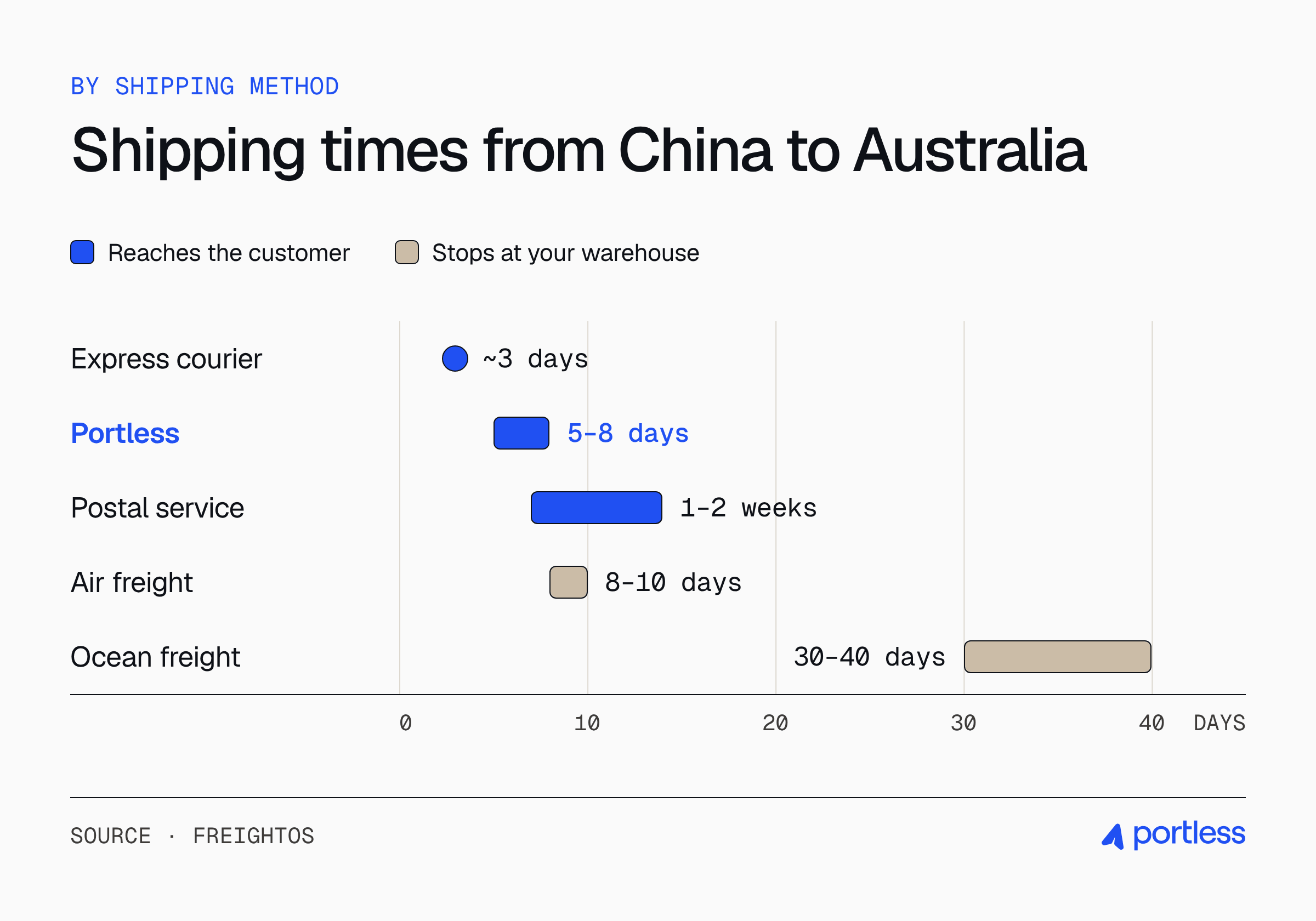
Shipping times from China to Australia by method
A single parcel reaches an Australian customer in about three days by express courier, five to eight days with direct fulfillment, and one to two weeks by post. Freight to an Australian warehouse is slower, and every order still ships again from there.
::table
Method;What it carries;Typical transit to Australia;Where it ends
Air freight;Cartons and pallets;8 to 10 days;Your Australian warehouse
Ocean freight;Containers;30 to 40 days, door to door; Your Australian warehouse
:table
Direct fulfillment orders are packed one at a time in China, then fly to Australia in bulk and clear customs together. Australia Post delivers each parcel with a local tracking number.
Express couriers are the fastest option and the most expensive per parcel, so they suit samples and urgent orders. Postal services cost the least for light parcels but offer limited tracking. Direct fulfillment sits between them on price and gets close to express on speed. Our guide to the cheapest way to ship from China compares the options in more detail.
What a warehouse in every market costs
Every regional warehouse needs its own buffer stock, its own storage bill, and its own sea freight. Stock for the US, the UK, and Australia gets ordered months ahead against three separate forecasts, and a best-seller can run out in one market while it sits unsold in another.
As our own CEO, Izzy Rosenzweig once put it:
The one way to kill a business is put your product on the water to five countries or 10 countries around the world.
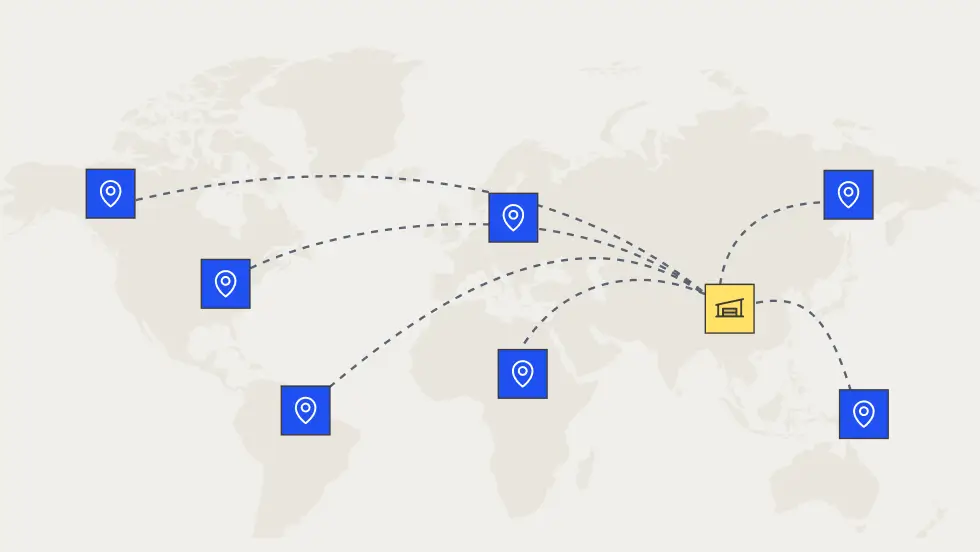
A fulfillment center in China pools that stock. Products move from the factory to the warehouse in days, and each order ships from there to whichever country it came from. The brand reorders against what's selling now instead of a forecast for each region.
How memobottle replaced six warehouses with one
memobottle makes flat reusable water bottles designed to slip into a laptop bag. Jesse Leeworthy and Jonathan Byrt launched it on Kickstarter in 2014, sold 14,000 bottles in 30 days, and shipped to more than 70 countries from the start. It's now stocked in about 2,000 retail stores as well.
To keep up with demand abroad, memobottle ran six regional 3PL warehouses and stocked every SKU in each one just in case. Sea freight to those warehouses took 45 to 80 days, which pushed its cash conversion cycle past 120 days. Storage cost US$25,000 to US$30,000 a month in peak periods. Byrt, who trained as a chartered accountant, said they "weren't recouping any cash from sales for 120 days, if not more."
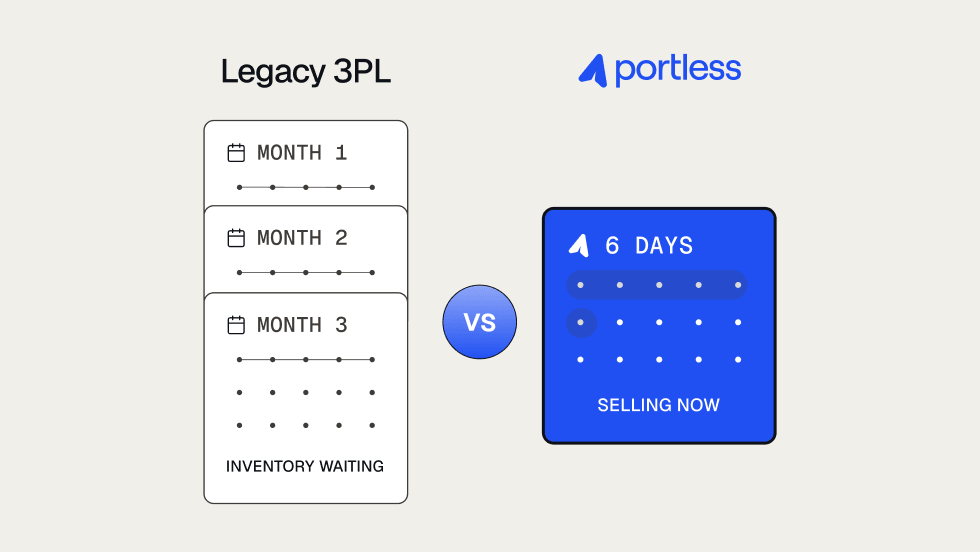
memobottle ran Portless alongside its existing setup for over six months before it committed. It's now moving its entire fulfillment footprint to one Portless warehouse minutes from its factories, with average global delivery of about six days. Leeworthy says the change has brought product launches forward by 100+ days.
How Craft Club grew 3x by shipping direct from China
Craft Club makes beginner-friendly craft kits, starting with cross-stitch and growing into other crafts. Husband-and-wife team Nikos Maniaty and Nakisah Williams launched it in 2021 as an online DTC brand and now sell to customers worldwide.
Before Portless, each production run took two to three weeks, then about five more weeks at sea, and stock sat in three warehouses. Maniaty said that setup left "capital tied up on a boat doing nothing."
Craft Club first chose a cheaper China-based fulfillment provider, then moved to Portless a few months later for better processes and tariff handling. Its cash conversion cycle fell from 22+ weeks to six weeks, revenue grew 3x, and orders now reach customers in seven days on average. Watch the video below to hear how they did it, or read the full Craft Club case study.
How Australian brands should choose their next market
Portless and Global-e ran a webinar on how APAC brands enter new markets with Izzy Rosenzweig and Stewart Smith, who runs APAC for Global-e. Smith said Australian brands used to copy their home pricing into the US as an afterthought, and now focus on margin and cash flow in each market. Both recommended the same approach for Australian brands.
Start with English-speaking markets. Look at where your traffic already comes from. Smith's suggested order is English-speaking markets first, then the EU, then Southeast and North Asia, the Gulf, and South America.
Test demand before you stock a market. When every order ships from one hub, opening a country means switching on ads and shipping from the inventory you already have. Rosenzweig's advice is to watch real orders and scale where the numbers work, without sending stock ahead of demand.
Sell like a local. Show prices in the shopper's currency with local rounding, offer the payment methods each market expects, and include tax and duty in the price. Afterpay means little to a shopper in Germany, and as Smith put it, "Shoppers don't like surprises."
The webinar also lays out a 90-day plan to assess, launch, and scale three new markets.
GST and duty on goods from China to Australia
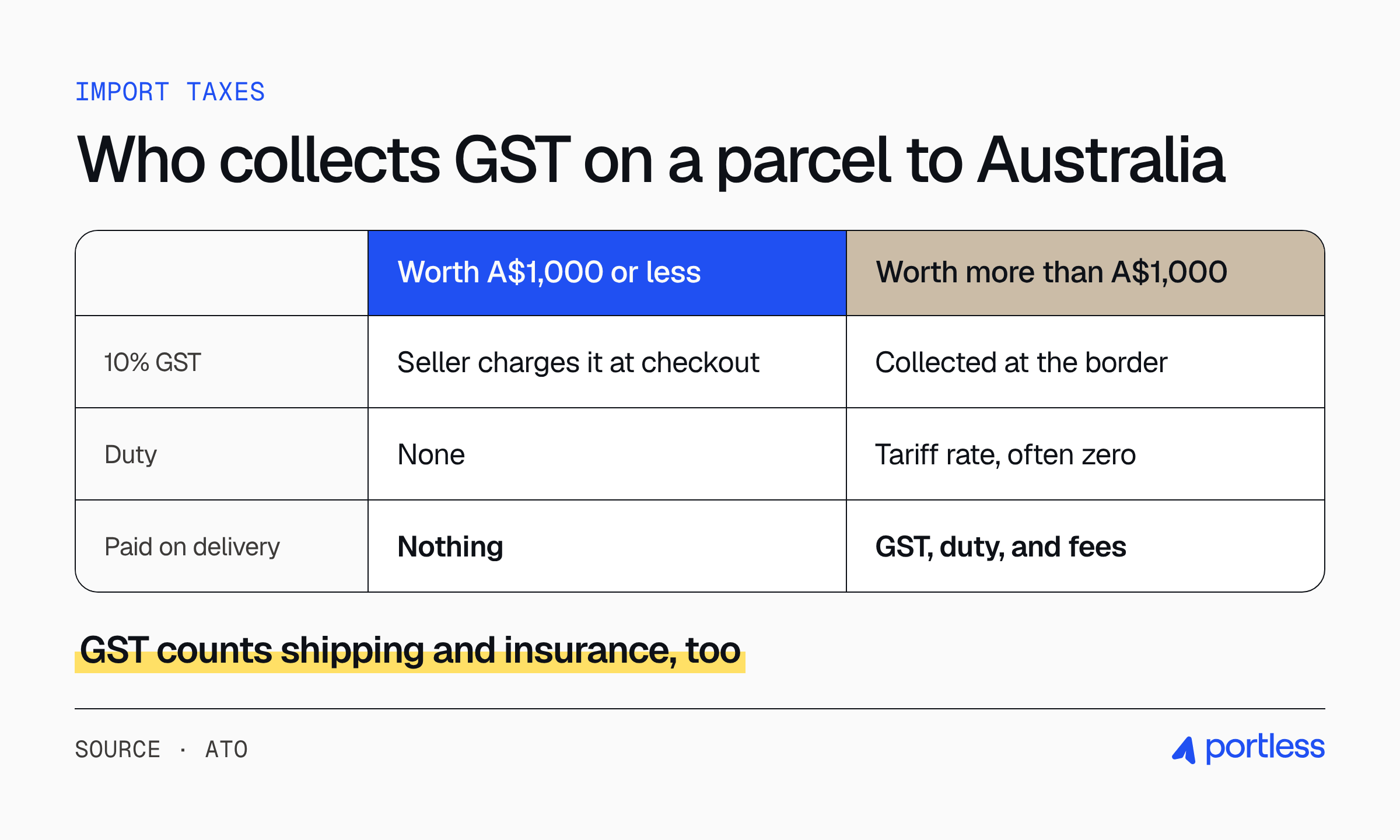
Australia charges 10% GST on most goods, and the A$1,000 line decides who collects it.
Duty is often zero for goods made in China. The China-Australia Free Trade Agreement eliminates tariffs on the vast majority of trade between the two countries, though the rate still depends on each product's tariff classification.
How Portless ships to Australia
From our warehouse in Shenzhen, Portless delivers to Australian customers in five to eight days. The same inventory pool ships to New Zealand, the US, the UK, and 85+ countries, so you can open a new market without opening a warehouse there. Our guide to Ecommerce fulfillment in Australia compares direct fulfillment from China with a local 3PL. When you're ready, talk to our team to see what shipping from China to Australia and beyond would cost for your products.
FAQ
How should Australian brands plan stock around Chinese New Year?
Place production orders well before the holiday. Factories close for two to four weeks, and carriers run on reduced staff while factories are shut. Our guide to Chinese New Year shipping goes into more detail.
Get operator-level supply chain insights
Thank you! Your submission has been received!
Oops! Something went wrong while submitting the form.