"We generated $70K in package protection revenue in a single quarter by adding a simple $4 protection option at checkout — plus an additional $12K from cashbacks. Customers get peace of mind, and we're making a profit on every protected order with zero effort."
"We generated $70K in package protection revenue in a single quarter by adding a simple $4 protection option at checkout — plus an additional $12K from cashbacks. Customers get peace of mind, and we're making a profit on every protected order with zero effort."
Your 3PL invoice climbs every quarter, and you start to wonder whether owning the operation would cost less. In the build vs buy warehouse or 3PL decision, building or buying only gets cheaper when your order volume is high, steady, and large enough to keep the space full all year. Below that point, a 3PL's per-order and per-pallet fees usually cost less than the fixed bill for a building, a crew, and equipment.
The choice comes down to these options.
Build: You buy land, put up a new building, and carry every cost from permits to the roof.
Buy: You purchase an existing building and fit it out for fulfillment.
Lease: You rent space, usually on a triple-net lease, and run the operation with your own staff and systems.
Outsource: A third-party logistics provider (3PL) stores your stock and picks, packs, and ships orders for per-order, per-pallet, and monthly fees. If you've never outsourced before, start with how a 3PL works.
Every one of these options rests on the same assumption. Inventory crosses the ocean in bulk and waits in a domestic warehouse before it sells. That assumption carries a cost of its own, and most 3PL vs in-house fulfillment comparisons leave it out.
What it costs to build or buy a warehouse
Owning a warehouse means paying for the building and for the operation that runs inside it. The building is the bigger expense, and you pay for it first.
Construction and purchase costs
Cushman & Wakefield's 2026 industrial construction cost guide averages build costs across 46 markets in the Americas. Small projects averaged $144 per square foot, up 3.6% year over year, medium projects $87, and large projects $78. Small projects cost the most per square foot. At that $144 average, a 20,000 sq ft building would come to about $2.9 million.
Tariffs, tighter metals supply, and labor costs all push prices up. The same guide reports copper up 39% year over year, driven by Section 232 tariffs, and steel up 17% under the 50% metals tariff. Location changes the number too. Canada was the most expensive region for small-warehouse development, and Latin America was the most cost-effective for small and medium projects.
Design choices add more. The market standard for Class A distribution is a 36-foot clear height, and a hydraulic dock leveler for each dock door runs $3,000 to $8,000, according to one contractor's cost breakdown. Buying an existing building skips ground-up construction, but you still pay the purchase price and the fit-out.
Owning puts millions of dollars into one asset that can't flex with demand, so most growing brands lease instead.
Leasing and running the space
Cushman & Wakefield's Q3 2026 US industrial MarketBeat put national industrial vacancy at 6.8% in Q3 2026, based on preliminary figures. The average NNN asking rent was $10.40 per square foot, and warehouse and distribution space averaged $10.06.
Industrial rents are quoted per square foot per year. A triple-net (NNN) lease also passes your share of property taxes, building insurance, and maintenance on to you, which TenantBase estimates at $1–$3 per square foot per year. Small spaces cost more. TenantBase finds that spaces under 50,000 sq ft typically cost 15–35% more per square foot than larger warehouses in the same city.
Put those numbers together for a small warehouse. At the Q3 2026 national average, 10,000 sq ft rents for about $8,700 a month in base rent. With TenantBase's 15–35% small-space premium, that's closer to $10,000–$11,700. NNN charges add roughly $830–$2,500 a month.
Then you staff it. Warehousing and storage employees earned an average of $26.74 an hour in August 2026, according to preliminary BLS warehousing earnings data. At 40 hours a week, one full-time worker costs about $4,630 a month before benefits and payroll taxes. Base rent on 10,000 sq ft plus two full-time workers comes to $18,000–$21,000 a month, and you haven't bought racking, packing stations, insurance, or a warehouse management system yet.
That lines up with Portless's fulfillment model ROI comparison, which estimates that running your own warehouse usually costs $18K a month or more.
What a 3PL costs
A 3PL turns most of those fixed costs into fees. The Fulfillment Advisor's 2026 warehousing pricing survey collected rates from 500 warehousing and fulfillment providers, about 80% in the US and 20% in Canada.
Fulfillment: The average DTC fee was $3.21 per order, including one item.
Pallet storage: The average was $19.37 per pallet per month, with reported rates from about $6 to $40.
Monthly minimum: Providers that set one averaged $752.08 a month.
Setup: More than half of providers charge a one-time onboarding fee, and the average was $373.06.
Receiving: The average was $8.75 per pallet.
Your quotes will differ from these averages. Location, labor model, packaging assumptions, and what each fee includes all vary from one 3PL to the next.
Treat any per-order quote as a starting price. Pick and pack fees cover pulling and packing each order, while receiving fees, storage overages, and exit fees show up later on the invoice. Carriers also add 15% to 30% per package from early October through mid-January, one of the hidden costs of cheap fulfillment that rarely appears on a quote.
How to compare total cost instead of per-unit rates
Per-unit rates make owning look cheap at peak and a 3PL look cheap in slow months. Owning is mostly fixed cost. Rent, salaries, and software cost the same in February as in November. A 3PL is mostly variable cost that rises and falls with orders.
Compare the two over a full year.
Add up 12 months of fixed costs for the owned option, including rent, staff, equipment, and software.
Divide that total by your expected orders at low, base, and peak volume.
Price the same volumes on your 3PL's rate card, including storage, receiving, and the monthly minimum.
The fixed-cost math gets harsh at low volume. At $18,000 a month in rent and wages alone, an in-house operation that ships 2,000 orders carries $9 in fixed cost per order. At 6,000 orders, the same operation carries $3 per order, just under the survey's $3.21 average 3PL fee. The crossover sits near 5,600 orders a month, and only if volume holds there through the slow months. A 3PL's storage and receiving fees pull that crossover lower, and a quiet quarter pushes it higher. Benefits, NNN charges, equipment, and software push it higher still.
::table
Option;Where inventory sits;Who ships orders;Cost profile;Best for
Build or buy;Your own building;Your team;Large upfront capital plus fixed operating costs;High, steady volume with long-term demand certainty
Lease;Rented space you run;Your team;Fixed rent, staff, and equipment every month;Brands that keep a space full year-round
3PL;Provider's domestic warehouse;The 3PL;Per-order and per-pallet fees plus monthly minimums;Growing brands with uneven volume
Direct fulfillment from China;Fulfillment center near the factory;Fulfillment partner, handing off to local last-mile carriers;Per-order fees, with duties paid per parcel;Lightweight products made in China
:table
When owning beats a 3PL, and when it doesn't
The right answer shifts as you grow. Portless's guide to fulfillment by revenue stage recommends outsourcing at $1M in revenue and a hybrid setup by $5M.
Volume and how steady it is
Owning pays off when volume is high and predictable. Portless's ROI comparison calls fixed costs risky unless you're doing $10M+ in annual revenue, and it lists 70%+ warehouse utilization year-round as a sign you're ready for in-house fulfillment. A warehouse that's full in Q4 and half empty in Q1 costs the same in both quarters.
Control, SKU count, and expertise
Owning gives you full control over packaging, kitting, and process. It also makes you the employer, the trainer, and the owner of every system. A catalog with hundreds of stock keeping units (SKUs) or custom kits adds complexity in any model, and in-house you absorb that complexity with your own staff.
Signs it's time to switch
3PL fees take a bigger share of revenue every quarter.
Inventory sits for months before it sells.
Peak surcharges wipe out your holiday margin.
You run several warehouses just to reach customers in different regions.
Before you sign a lease, check whether a better 3PL would solve the problem. Portless's checklist on how to assess 3PL providers covers the criteria to score.
Every option ties cash up in a domestic warehouse
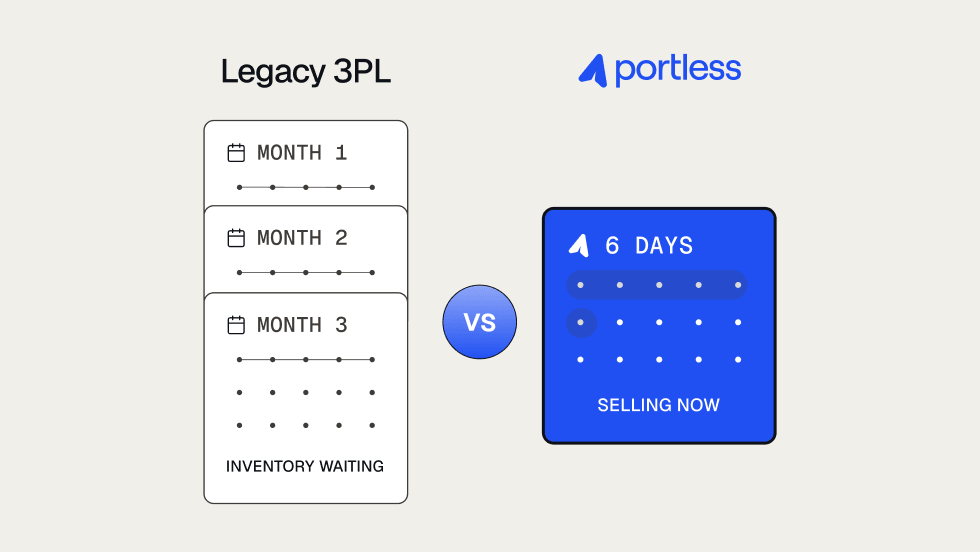
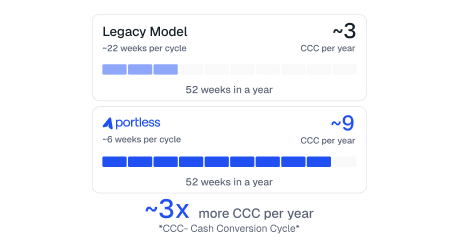
Build, buy, lease, or 3PL, the legacy model works the same way upstream. You pay the supplier, ship in bulk by ocean, pay duties at import, and wait for the stock to sell. That wait shows up in your cash conversion cycle (CCC), the number of days between paying for inventory and collecting cash from customers.
Duty timing widens the gap. Under the legacy bulk model, brands pay duty on entire containers months before the inventory sells, as Portless's de minimis threshold explainer notes. Portless's guide to common 3PL problems traces much of the strain on growing brands back to this tied-up cash.
Premium streetwear brand Foreign Resource felt that wait on sea freight, which let it turn its inventory only six times a year. After moving to Portless, Foreign Resource cut its manufacturing-to-shipping time from 21+ days to two and brought its cash conversion cycle close to negative.
A fourth option skips the domestic warehouse
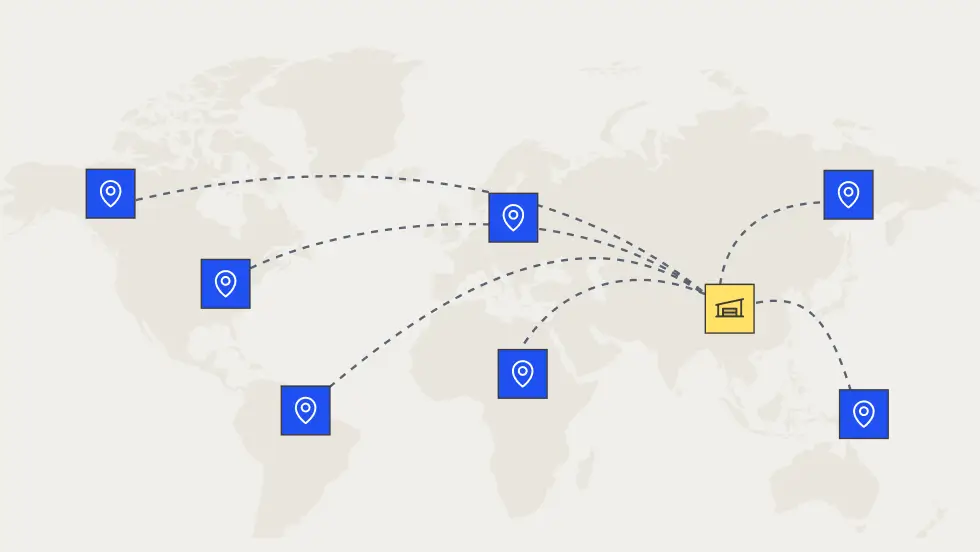
The direct fulfillment model ships each order from a fulfillment center near the factory straight to the customer. Inventory never crosses the ocean in bulk, so it never waits in a domestic warehouse. Duties apply per parcel at fulfillment, matched to that order's revenue.
Portless, a direct fulfillment platform, runs this model from its own fulfillment center in China, close to the point of manufacture. Each order travels by air as its own parcel, with duties handled under DDP, and reaches the customer through direct injection into local last-mile carriers. Portless serves 85+ countries from one hub, with five to eight days of average global delivery.
Direct fulfillment fits lightweight, non-regulated products. It's a poor fit for heavy or oversized goods, where air freight economics break down. It also can't match next-day domestic delivery, so brands that sell on next-day speed still need stock close to their customers.
Hybrid setups for brands that need both
A hybrid keeps a domestic node for heavy, bulky, or next-day SKUs and ships everything else direct from origin. Any multi-node fulfillment network splits inventory across locations, and the price is duplicate stock at every node. Placing one node at origin keeps the domestic share of that stock small.
DTC menswear brand &Collar ran this setup through its Father's Day peak. Its inventory was still in production in China, and sea freight couldn't deliver in time. The brand ran a dual-node setup between its Utah warehouse and Portless and rerouted about 40,000 units within 30 days. Skipping $8-per-unit air freight preserved nearly 20% of its margins on shirts priced under $50. According to co-founder Mark Brown, the split kept the brand from dropping to 5% in stock on its hero SKUs, and revenue rose 35% year over year during the sale. Read more about &Collar's dual-node setup.
See how Portless works
Owning a warehouse works when volume is high, steady, and fills the space all year. A 3PL works when you need flexibility and can't predict next quarter's orders. If your tightest constraint is cash tied up in inventory, ask where your stock waits before it sells as well as who runs the building.
Lorem ipsum dolor sit amet, consectetur adipiscing elit. Suspendisse varius enim in eros elementum tristique. Duis cursus, mi quis viverra ornare, eros dolor interdum nulla, ut commodo diam libero vitae erat. Aenean faucibus nibh et justo cursus id rutrum lorem imperdiet. Nunc ut sem vitae risus tristique posuere.
Get operator-level supply chain insights
Thank you! Your submission has been received!
Oops! Something went wrong while submitting the form.