“We generated $70K in package protection revenue in a single quarter by adding a simple $4 protection option at checkout — plus an additional $12K from cashbacks. Customers get peace of mind, and we're making a profit on every protected order with zero effort.”
“We generated $70K in package protection revenue in a single quarter by adding a simple $4 protection option at checkout — plus an additional $12K from cashbacks. Customers get peace of mind, and we're making a profit on every protected order with zero effort."
Your best seller sells out two weeks before your biggest sale. Customer service spends every Monday on "where is my order?" tickets. The storage invoice went up again. When those problems keep coming back, you need to decide whether to switch fulfillment providers, and how to make the move without breaking the orders already in motion.
Switch when the problems are structural
Switch fulfillment providers when the same failures repeat for two to three months in a row, and plan the move for a low-volume window. One late week in December is noise. Late shipments every week since spring are a pattern your current setup can't fix on its own.
Ecommerce fulfillment covers storing inventory, picking and packing orders, and shipping them to customers. Many growing DTC brands hand that work to a third-party logistics (3PL) provider. A switch moves those jobs to a new partner, along with your stock, your integrations, and your returns.
Before you shortlist partners, ask whether the provider or the model is the problem. If your stock crosses an ocean in bulk, waits in a domestic warehouse, and ties up cash for months, a new 3PL on the same model will hit the same limits.
Signs you've outgrown your fulfillment setup
Common 3PL problems tend to show up together, so check each sign against your last three months of data. Provider problems go away with a better partner. Model problems stay when you change warehouses.
::table
Sign;What it looks like;Provider or model problem
Late deliveries;On-time rate slips month after month;Usually provider
Stockouts on best sellers;Hero products sell out before peak while slow movers pile up;Model, because long lead times force early forecasts
Rising storage and fees;Invoices climb with no gain in service;Both
Cash tied up in inventory;Months pass between paying for stock and getting paid for it;Model
A new warehouse for each region;Every new market adds a 3PL and splits your stock;Model
Mis-picks and errors;Wrong items and missing units trend up;Provider
Poor visibility and slow support;Inventory updates in batches and tickets wait more than a day;Provider
:table
Late deliveries and missed SLAs keep repeating
A service level agreement (SLA) is the written promise your provider makes on speed and accuracy, such as shipping every order within one business day. When the provider misses its SLA month after month, customers notice before your dashboard does. In the Bringg 2025 delivery study of 1,000 US online shoppers, 35% said they permanently abandon a retailer after a late delivery.
Late parcels are also common. The Narvar post-purchase report, based on an August 2025 survey of US online shoppers, found that 74% had experienced a late delivery in the past year and 86% had at least one delivery issue.
Stockouts hit your best sellers before peak
A legacy supply chain makes you buy months before you sell. Production, ocean freight, and warehouse receiving all sit between the factory and the shelf, so you place your peak-season bet in summer. Guess low, and your best sellers run into stockouts in the weeks that matter most. Guess high, and cash sits in slow movers. A better warehouse can't shorten that lead time, so repeated stockouts on hero products point to the model.
Storage and fees rise without better service
Storage rates track warehouse rents. The Cushman & Wakefield industrial MarketBeat reported that US industrial asking rent growth reached 4% nationwide in Q3 2026, up from roughly 1% in the second half of 2025.
A fee increase with no gain in service is a reason to look elsewhere. Line items such as receiving fees, storage overages, and peak surcharges add up as well, as the breakdown of the hidden costs of cheap fulfillment shows.
Cash is tied up in inventory you haven't sold
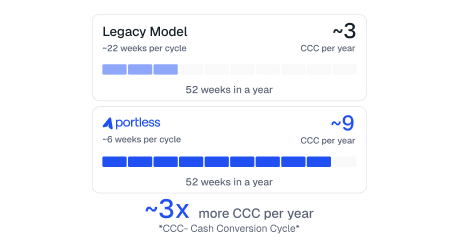
Your cash conversion cycle is the number of days between paying for inventory and collecting cash from the customers who buy it. In the legacy model, you pay for production, ocean freight, and storage months before the stock sells. Growth widens the gap, because each bigger order needs more cash up front.
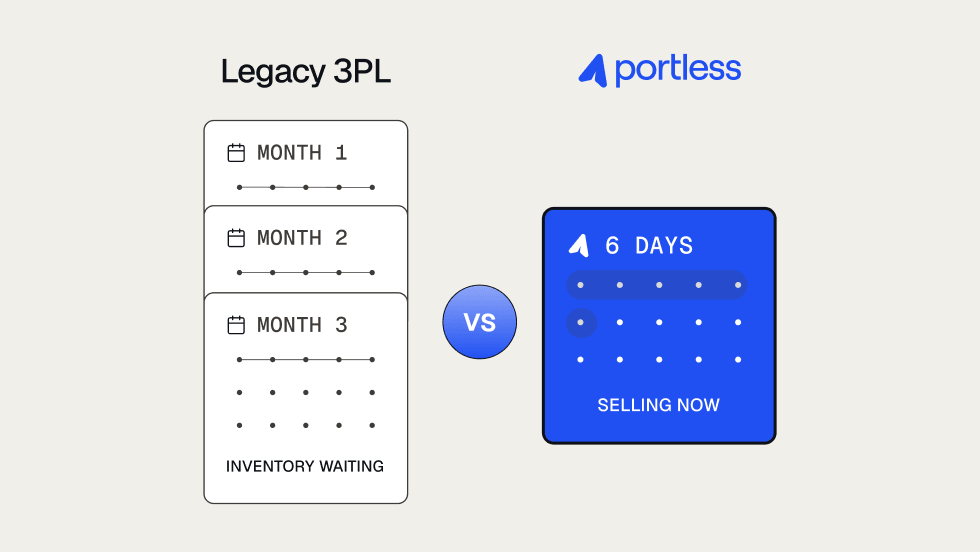
Cash pain rarely shows up on a 3PL scorecard, so it's easy to miss as a switching signal. On Portless, most brands go from about a 90-day cash conversion cycle to about six weeks, according to Portless's comparison with a legacy 3PL.
International growth means another warehouse
With a domestic model, selling in a new region usually means hiring a new 3PL in that region. Each warehouse needs its own stock, its own forecast, and its own integration, and your inventory splits a little further with every launch.
Australian swimwear brand Moana Bikini fulfilled every order from its Gold Coast headquarters until 2025. That year it added a North American 3PL and split its stock across two warehouses. After Moana Bikini's move to Portless, product travels from its manufacturer to the fulfillment center in under a day. The brand shipped 2,722 orders to 38 countries in 180 days, with exceptions below 0.5% of tracked orders.
Errors, poor visibility, and slow support
Mis-picks that trend up quarter over quarter point to labor or process problems inside the warehouse. Inventory counts that update in daily batches lead to overselling. Support tickets that wait more than 24 hours turn small problems into lost days. A stronger provider usually fixes these signs.
Provider problem or model problem?
If most of your signs are provider problems, a better 3PL can fix them. If most are model problems, a new 3PL with the same setup won't. For any setup you're weighing, ask where inventory sits before an order comes in and where each order ships from.
::table
Model;Where inventory sits;Where orders ship from;Best for
Self-fulfillment;Your own office or storage space;Your own space;Early brands with low order volume
Domestic 3PL;A warehouse in your main market, after bulk ocean freight;That warehouse;Brands selling mostly in one country
Multiple regional 3PLs;Split across a warehouse in each region;The nearest regional warehouse;Brands with steady, predictable demand in each region
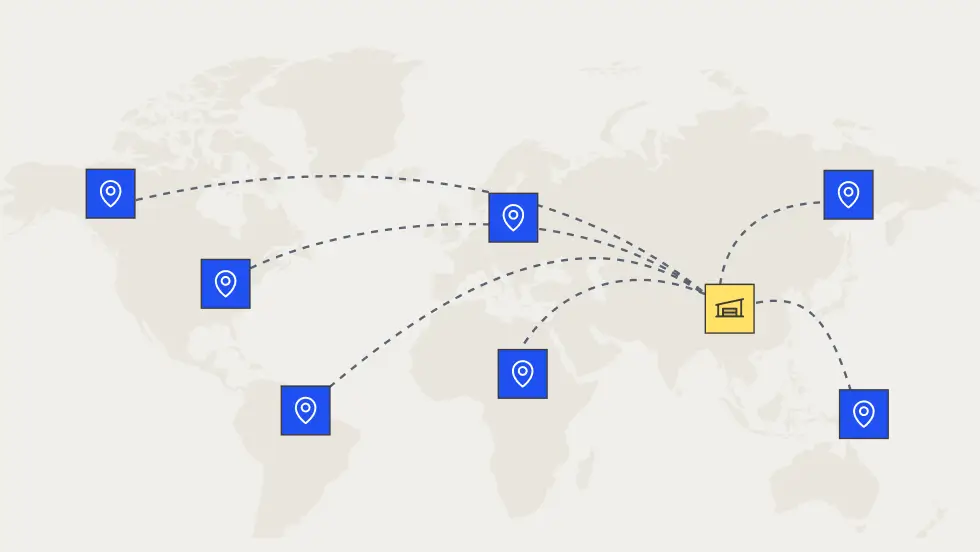
Direct fulfillment;One hub close to the point of manufacture;That hub, by air, then local carriers;Brands selling worldwide from one inventory pool
:table
Direct fulfillment ships individual orders from a fulfillment center near the point of manufacture to the end customer. Bulk ocean freight and domestic warehouses drop out of the chain. The right model depends on your revenue, catalog, and markets, and the breakdown of fulfillment by revenue stage shows how needs shift from $1M to $10M and beyond. For the cash side of the decision, compare how inventory and cash flow behave under each model.
Reusable water bottle brand memobottle shows what a model problem looks like. The company ran six regional 3PLs, and its cash conversion cycle passed 120 days.
"We actually weren't recouping any cash from sales for 120 days, if not more." — Jonathan Byrt, Co-founder at memobottle
For most DTC brands, January to March is the best window. Peak is over, volume is low, and last season's data shows what broke. May to July is the second-best window, as long as you finish well before peak. Avoid starting a switch between August and November, and treat December as a hard stop. Aim to finish the move at least six to eight weeks before peak, so the new setup has time to prove itself on normal volume.
The Adobe holiday shopping recap found that average daily online spending during the 2025 holiday season was 48% higher than in October 2025. Q4 also carries a large share of annual sales. US Ecommerce retail sales reached $365.2 billion in Q4 2025, about 30% of the year's total, based on our calculation from US Census Bureau Ecommerce retail sales data on FRED.
If you manufacture in China, plan around Chinese New Year as well. Many factories close for the holiday, which falls in January or February, so lock in production dates before the break. If you can't move before peak, use a Q4 inventory prep checklist to protect stock levels with the provider you have.
A targeted move, such as redirecting incoming stock, can work closer to peak than a full warehouse migration. DTC menswear brand &Collar needed stock for its Father's Day sale. In &Collar's peak-season switch, the brand onboarded with Portless and rerouted about 40,000 units, two full containers, in under 30 days.
"We would have been only 5% in-stock of our hero-SKUs had it been not for Portless." — Mark Brown, Co-founder at &Collar
&Collar avoided dropping to 5% in stock on its hero SKUs and grew revenue 35% year over year during the sale.
How long a switch takes
Most switches take one to three months. A small catalog sold through one store can move in about a month, while a large catalog across several channels and regions takes longer. The Ecommerce order fulfillment process itself stays the same. The switch changes who handles each step and where.
::table
Weeks;Focus;Done when
1–2;Discovery and contract;Pricing, SLAs, and exit terms are signed, and order and SKU data is shared
3–4;Integrations;Store, order management system, and carrier connections pass test orders
5–6;Inventory waves;The first SKU waves are received and counted at the new site
7–8;Parallel testing;Live orders for moved SKUs ship on time from the new site
9–12;Cutover and tuning;Every SKU ships from the new site and you review KPIs weekly
:table
A move to direct fulfillment changes the inventory weeks. Instead of trucking pallets between domestic warehouses, your factory sends its next production run to the hub.
How to switch without disrupting orders
A switch runs on a systems track and a stock track at the same time. The systems track connects your store, order routing, and carriers to the new partner. The stock track moves inventory in waves. Keep both tracks on one shared plan with dates, owners, and a rollback point, so a delay on one track doesn't stall the other.
Pick a migration method
Hard switch. You move everything on one cutover date. It's the fastest and cheapest method, but every problem lands at once. It fits small catalogs with low volume.
Parallel run. Both providers ship orders for a few weeks, split by SKU or by region. A parallel run costs more and needs clean order routing. It's the safest method for brands with steady volume.
Depletion. You stop sending new stock to the old provider, let its inventory sell through, and send all new production to the new partner. Depletion avoids moving pallets, which makes it a natural fit for a move to direct fulfillment. It takes longer, and you'll need routing rules so each order ships from wherever its stock sits.
Sequence SKUs by sales volume
In many catalogs, a small share of stock keeping units (SKUs) drives most orders. Use that pattern to order your move.
Rank every SKU by units sold over the last 90 days.
Move slow movers first. Mistakes on low-volume SKUs cost little and show you how the new partner receives, stores, and ships.
Keep best sellers live at the old provider until the new partner meets its accuracy and on-time targets for two to three weeks.
Move best sellers last, in one wave, during your lowest-volume week.
Connect systems and run test orders
Your order management system (OMS) sits between your storefront and your fulfillment operation, so it decides which provider gets each order. Set routing rules by SKU before the first inventory wave lands.
Then place real test orders across every shipping method, every major country you sell into, bundles, and discount codes. Check the label, packaging, tracking email, and inventory sync on each one.
Plan returns, in-transit stock, and customer messages
Reverse logistics breaks easily during a switch. Decide where returns go during the overlap, then update your return portal and return labels on the same day.
Update the ship-to address on every open purchase order, so factory shipments don't land at the old warehouse after you've left. Count stock at both sites before and after each wave.
Give customer service the cutover dates and a short script for delivery questions. If carriers or delivery times change, update your shipping page, checkout copy, and order emails before the first order ships from the new site.
What to look for in your next partner
Shippers are trimming their partner lists, which raises the stakes on each pick. The 2026 Annual 3PL Study findings show that 50% of shippers are consolidating the number of 3PL partners they use.
Accuracy and on-time rates in writing. Ask for measured pick-and-pack accuracy and on-time shipping over the last 12 months, plus the penalty if either slips.
Real-time inventory visibility. Stock levels should sync to your store as orders come in.
Transparent pricing. Get an all-in cost per order that includes receiving, storage, packaging, and peak surcharges.
Fast support. Ask who answers tickets, in which time zone, and how quickly.
Coverage for your markets. Count how many warehouses the provider needs to cover every country you sell into.
Cash impact. Compare how much cash each model ties up. The direct fulfillment ROI calculator models monthly cash flow under both setups.
If your signs point to a model problem, change the model when you change providers. Portless is a direct fulfillment platform. As how Portless works lays out, brands send finished goods to its fulfillment center close to the point of manufacture, and Portless inbounds them in one business day. Orders fly direct to the destination country and reach customers through direct injection into local last-mile carriers.
Portless reports 99.8% pick-and-pack accuracy, 99.8% of orders shipping within a day, and five to eight days average global delivery across 85+ countries. Book a demo to map your own switch.
FAQ
What should I check in my current contract before I switch?
Check the notice period, any termination or minimum-volume fees, and the terms for releasing your inventory. Get the release process in writing, including pallet fees and how unpaid invoices affect access to your stock.
Will shipping costs change if I move to direct fulfillment?
Per-order shipping can rise while storage and inventory costs fall. Reusable water bottle brand memobottle budgeted a 10–20% increase in shipping cost to customers, and the actual increase during its test was closer to 10%.
Does direct fulfillment suit every product?
Direct fulfillment works best for lightweight, non-regulated products and brands past roughly 1,000 orders a month.
How do I know the switch worked?
Track on-time shipping, order accuracy, "where is my order?" tickets, and stockout rate every week for the first 90 days, and compare each against your pre-switch baseline. Check your cash conversion cycle after a full quarter, because cash gains take longer to show than service gains.
Frequently asked questions
Heading
Lorem ipsum dolor sit amet, consectetur adipiscing elit. Suspendisse varius enim in eros elementum tristique. Duis cursus, mi quis viverra ornare, eros dolor interdum nulla, ut commodo diam libero vitae erat. Aenean faucibus nibh et justo cursus id rutrum lorem imperdiet. Nunc ut sem vitae risus tristique posuere.
Get operator-level supply chain insights
Thank you! Your submission has been received!
Oops! Something went wrong while submitting the form.