“We generated $70K in package protection revenue in a single quarter by adding a simple $4 protection option at checkout — plus an additional $12K from cashbacks. Customers get peace of mind, and we're making a profit on every protected order with zero effort.”
“We generated $70K in package protection revenue in a single quarter by adding a simple $4 protection option at checkout — plus an additional $12K from cashbacks. Customers get peace of mind, and we're making a profit on every protected order with zero effort."
Orders are up, and the founder is still packing boxes after dinner. At another brand, fulfillment went to a partner a year ago, and the mornings now go to chasing mis-shipped orders and invoices that don't match the quote. Both teams are asking when to switch to a third-party logistics (3PL) provider, or to a better one. Get the timing wrong and you pay in founder hours, in cash, and in customers who don't come back. Both teams also have an option most switching guides skip, which is shipping each order from close to where the product is made.
Switch when fulfillment starts limiting growth
Switch when fulfillment starts limiting growth. That happens when packing and receiving eat founder time, when errors reach customers, when costs rise faster than you can price them in, or when you can't keep up with peak season or a new market. Your monthly order volume is a prompt to start looking. No single order count works as a cutoff for every brand.
Revenue stage is a better guide. Portless's breakdown of fulfillment by revenue stage shows the constraint shifting as a brand grows. At $1M, the constraint is the founder's time. At $5M, it's coordination across people, vendors, and systems. At $10M and beyond, the inventory you hold becomes the largest use of cash in the business.
A 3PL stores your inventory, picks and packs each order, and ships it to your customer. Most also process returns, negotiate carrier rates, and handle custom kitting or inserts. If the model is new to you, start with how a 3PL works.
Moving to your first 3PL vs switching 3PL providers
A brand moving from in-house fulfillment to its first 3PL is solving for capacity. It has run out of hours, space, or people. A brand switching 3PL providers is solving for fit. The partner that suited 500 orders a month may struggle at 5,000, or once the brand sells in several countries.
The warning signs differ between the two moves. The cost math stays the same. In both cases you're comparing the total cost of one model with another, including the cash each model ties up in stock.
Plenty of brands are making one move or the other. In the 2027 Third-Party Logistics Study, released in October 2026, 86% of surveyed shippers said they were increasing their use of outsourced logistics. The same study found 74% were consolidating their 3PL partners, up from 50% in the previous edition. The consolidation figure matters for brands that sell worldwide. Many of them add a fulfillment partner in each new country, and every extra partner brings another inventory pool, contract, and invoice to manage.
Signs you've outgrown in-house fulfillment
Outsourcing fulfillment makes sense once in-house work starts crowding out growth work. The signs tend to show up together.
Founders spend their week on boxes instead of growth
At $1M in revenue, the founder's time is the tightest constraint. When receiving shipments, packing orders, and booking carriers take the hours that should go to product, marketing, and hiring, in-house fulfillment costs far more than the packing tape and labels.
Log one week to test it. Count the hours you and your team spend receiving, packing, labeling, and fixing shipping problems. Then price those hours at what you'd pay someone else to do the work.
Errors and delays are reaching customers
Mis-picks and late orders get more expensive as volume grows. Every error means a reship, a support ticket, and a customer who may not order again.
In the AlixPartners 2026 Home Delivery Survey of US consumers, more than 85% said a poor delivery experience reduces their willingness to buy from that retailer again. When errors climb in a spare room staffed by part-time help, compare your error rate against what a dedicated fulfillment operation can deliver.
Space, staff, and peak season are maxed out
Inventory fills the garage, then the spare room, then a small storage unit. A growing SKU count makes the squeeze worse, because every new color, size, or bundle needs its own shelf space and pick location.
Bigger space also costs more. The Cushman & Wakefield Q3 2026 industrial MarketBeat reported that US industrial asking rent growth reached 4% in Q3 2026, up from roughly 1% in the second half of 2025.
Peak season tests all of these limits at once. A packing process that works on a normal Tuesday breaks during a holiday sale, and Q4 leaves no time to hire and train extra staff.
You want to sell in new countries
Shipping worldwide from one in-house setup gets complicated fast. Every new market adds carriers, import paperwork, and different delivery expectations.
Many brands answer the problem by signing a fulfillment partner in each country. Wellness patch brand NATPAT took that route. It air-freighted pallets to the US, Australia, Canada, the UK, and other markets, and had to find a new fulfillment partner in each country. NATPAT later moved its inventory into one shared pool and expanded to more than 50 countries from it.
Signs your current 3PL is failing you
Some 3PL problems come from a weak provider. Others come from the legacy model itself, which asks you to forecast demand months ahead, ship stock in bulk, and pay for it long before it sells. Portless's guide to common 3PL problems covers the structural side in depth. Either cause can produce the same warning signs.
Accuracy is slipping below benchmark
The Warehousing Education and Research Council (WERC) surveys the distribution and fulfillment industry every year to benchmark warehouse performance. In the WERC best-in-class picking benchmark for 2025, best-in-class operations picked more than 99.68% of their orders correctly.
Ask your 3PL for its pick-and-pack accuracy rate in writing, measured every month. If the provider can't produce the number, or the number keeps sliding, the errors will keep reaching your customers.
Fulfillment costs exceed 15% of revenue. At that level, fulfillment is eating the margin you need for ads and product.
Q4 surcharges spike 15–30%. Peak pricing lands right when your volume and your ad spend are highest.
Returns processing fees keep climbing. Each return costs more to handle even when order volume holds steady.
Inventory counts and tech leave you blind
When the count in your 3PL's system doesn't match the shelf, you sell stock you don't have and miss stock you do. Both mistakes lead to stockouts on best sellers and cancelled orders.
The real cost of a stockout goes past the missed sale. A sold-out page sends shoppers to a competitor, and many of them don't come back. Search and social ads keep sending clicks to a product nobody can buy until someone pauses them.
Watch for CSV uploads in place of a live store integration, inventory that syncs once a day, and no view of an order after it leaves the shelf.
Support goes quiet when something breaks
When a shipment goes missing or a best seller runs short, you need an answer the same day. Slow replies, a new account manager every quarter, and tickets that close without a fix all show a provider that has stopped prioritizing your account. Portless's evaluation checklist treats team stability and communication as core criteria for that reason.
Your stock sits too long before it sells
Portless's ROI breakdown also flags inventory that sits 60–120 days before it sells. By the time that stock ships, you've already paid for manufacturing, freight, and duties. Until it sells, that money can't serve as working capital for ads, new products, or the next production run. Storage fees keep adding to the bill every month the stock sits.
When keeping fulfillment in-house still makes sense
In-house fulfillment is the right call for some brands.
Very early brands. A founder shipping a few orders a day learns a lot from packing them, and the cost is low.
Large brands with steady volume. A brand that keeps a warehouse full spreads the fixed costs across enough orders to make them pay.
Brands with complex custom work. Hand-finished gift sets, personalization, and unusual kitting can justify keeping direct control over every package.
The in-house fulfillment vs 3PL comparison comes down to fixed costs against variable ones. Portless's stage breakdown puts numbers on the trade-off. An in-house warehouse usually costs $18,000 a month or more in fixed costs, and in-house logistics rarely pays off below $15M in revenue. Below that line, price the outsourced options before you sign a warehouse lease.
How to do the math before you switch
Compare the total cost of each model instead of the per-order quote. Published benchmarks give a starting range. Extensiv benchmark data, cited in Portless's stage breakdown, puts typical 3PL fees at $15–$40 per pallet per month for storage and $2–$5 per order for pick-and-pack fees. The Fulfillment Advisor's 2026 3PL pricing survey of US and Canadian warehouses found an average DTC fulfillment fee of $3.21 per order (including one item) and average pallet storage of $19.37 a month.
Quotes vary because providers price on different things. The same survey finds that order volume, SKU count, inventory turnover, labor requirements, and account complexity all move the number. Two quotes with the same per-order fee can produce very different monthly invoices.
The quote also leaves things out. Portless's analysis of the hidden costs of cheap fulfillment lists receiving, extra-item, special packaging, inventory adjustment, and storage overage fees that show up after signing. Exit fees and storage charges on slow-moving stock can outweigh what you save on the per-order rate. Fulfillment agreements also typically cap what a provider owes for a lost or damaged order at the fulfillment fee for that order. Portless's ROI breakdown finds most brands' real cost runs 20–30% higher than they think.
Take a brand shipping 3,000 orders a month. At the survey's $3.21 average fulfillment fee, that's about $9,630 a month, or roughly $12,500 once you add a 30% gap between quote and real cost. An in-house warehouse starts at around $18,000 a month in fixed costs, before you pay anyone to pack an order or buy a single box. Storage and shipping sit on top of both numbers.
Build your comparison from every line a provider can bill.
Storage. Per pallet, bin, or cubic foot, plus overage charges in peak.
Pick and pack. Per order, plus a charge for each extra item.
Receiving. Per pallet, carton, or hour when stock arrives.
Shipping. Carrier rates plus fuel and peak surcharges.
Returns. Processing, inspection, and restocking.
Minimums. Monthly spend floors that still apply in slow months.
Exit fees. The cost of pulling your stock out when the contract ends.
Cash in inventory. Money paid for stock months before a customer buys it.
Most comparisons skip the cash line. Freight time plus days on the shelf decide how long your money stays locked in product. A lower per-order fee can still cost more overall if the model requires you to buy and ship stock months ahead of demand.
The option most switching guides skip
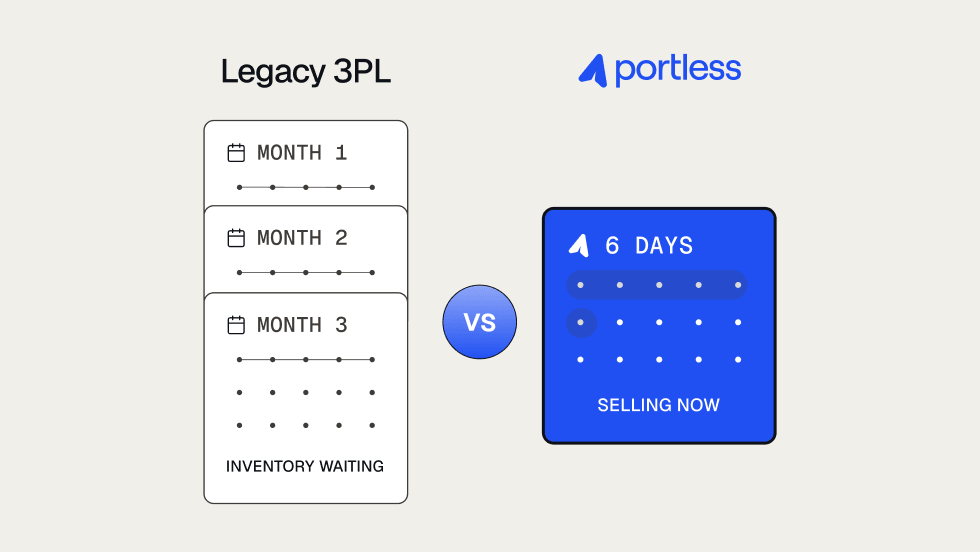
Most switching guides compare in-house fulfillment with a domestic 3PL, or one domestic 3PL with another. Both options sit inside the same legacy model. You order in bulk, ship by ocean freight, pay import duties upfront, and store the stock in a warehouse near your customers until it sells. Cash leaves when you pay the factory and comes back months later, after weeks at sea, receiving, and time on the shelf.
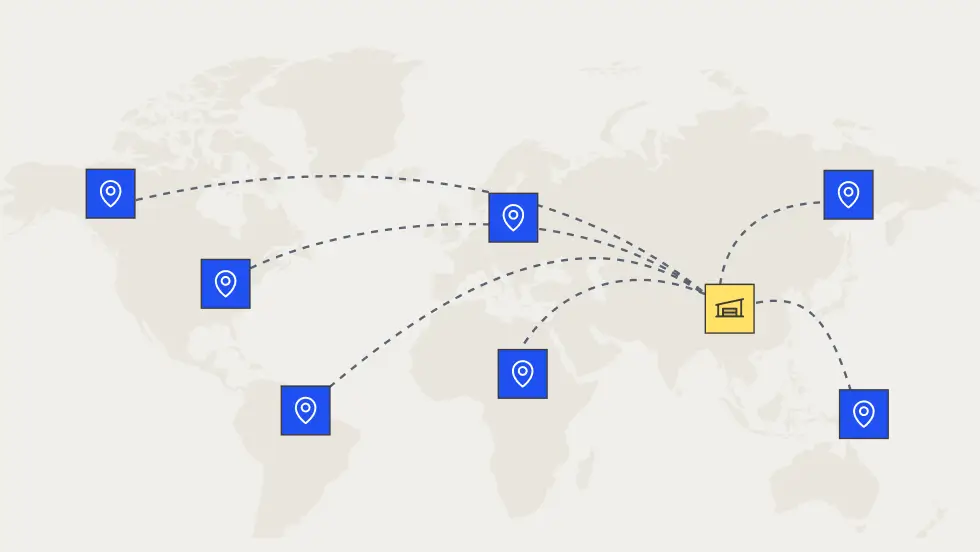
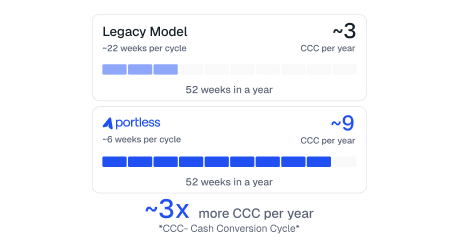
Direct fulfillment changes where the stock waits. Inventory stays in a fulfillment center close to the factory, and each order flies to the customer once it's placed. You skip the bulk ocean leg and the domestic warehouse. Because you stop funding months of stock in transit and in storage, your cash conversion cycle gets shorter.
::table
Model;Who holds the inventory;Who ships the order;Best for
In-house;You, in your own space;Your team;Very early brands, or large brands with steady volume that can keep a warehouse full
Legacy 3PL;A 3PL, in a domestic warehouse near customers;The 3PL;Heavy or bulky goods, and products that need next-day domestic delivery
Multi-region 3PLs;Several 3PLs, each holding part of your stock in its region;A different 3PL in each region;Markets that each have 2,000–3,000 stable orders a month
Direct fulfillment;A fulfillment center near the factory, holding one shared pool;The direct fulfillment provider, by air to each customer;Lightweight products made in Asia and sold in several countries
:table
What it looks like in practice
Craft kit brand Craft Club ran the legacy model first. Its stock was split across three warehouses, and each production run spent about five weeks on a boat before reaching a warehouse. Co-founder Nikos Maniaty described that setup as having "capital tied up on a boat doing nothing." After moving to Portless, Craft Club saw 3x revenue growth and a 3x drop in its cash conversion cycle.
The move doesn't have to happen all at once. Portless's guide to hard-to-reverse fulfillment decisions recommends keeping inventory upstream, near supply, while you validate demand. Forward-deploying stock to a local warehouse makes sense once a market has proven, repeatable demand of 2,000+ stable monthly orders.
How to choose your next fulfillment partner
The best 3PL for Ecommerce depends on your product, your margins, and where your customers live. Portless's 3PL evaluation checklist has the full scorecard. At minimum, check these points before you sign.
Accuracy in writing. Ask for the current pick-and-pack accuracy rate and how the provider measures it.
Peak performance. Ask how accuracy and ship times held up in the provider's last Q4, and how it staffs for peak.
Integrations and onboarding. Look for a live connection to your store and onboarding in two to four weeks. Eight weeks or more is a red flag.
Pricing transparency. Get the full fee schedule, including receiving, storage overages, and exit fees. Check whether the provider earns more when your stock sits longer.
Location. Measure the distance from your factory and from your customers. Both distances decide how long your cash sits in transit.
References at your size. Talk to brands shipping a similar order volume to similar markets.
Then match the model to the product. A heavy product, or one customers expect the next day, belongs with a domestic 3PL close to those customers. A lightweight product made in Asia and sold in several countries fits direct fulfillment, which ships each order from near the factory and keeps stock in one pool instead of several regional warehouses.
How to switch without disrupting orders
Read the exit terms. Check the notice period and exit fees before you give notice.
Reconcile inventory. Match your records against the current provider's count so you know exactly what's moving.
Test the integration. Connect the new provider to your store and run test orders before live orders flow.
Pilot a subset of SKUs. Confirm accuracy and delivery times on a small group before migrating the rest.
Overlap stock. Keep enough inventory at the old provider to cover orders until the new one ships reliably.
Track the first 90 days. Watch accuracy and on-time delivery weekly, and tell customers if delivery times change.
For the full timeline, the choice between a hard cutover and a parallel run, and how to handle returns mid-move, see Portless's guide on how to switch fulfillment providers.
See how Portless works
The question of when to switch to a 3PL usually starts with time and errors. As a brand grows, the bigger question becomes which model fits its stage and how much cash that model locks up in stock.
Portless is a direct fulfillment platform. It holds your inventory in its own fulfillment center in China, close to the point of manufacture, and ships each order by air to customers in 85+ countries in five to eight days on average. Parcels reach customers through direct injection into local last-mile carriers. Portless maintains 99.8% pick-and-pack accuracy and fits brands past roughly 1,000 orders a month that sell lightweight products.
Can a brand split fulfillment between in-house and a 3PL?
Yes. Some brands keep personalized or kitted orders in-house and send standard orders to a fulfillment partner, at the cost of two inventory pools to count and reorder.
How can you tell if a 3PL can handle your growth?
Ask how it handled its largest client's last peak season and whether it has room for double your current stock. If the provider can't answer either question, keep looking.
Frequently asked questions
Heading
Lorem ipsum dolor sit amet, consectetur adipiscing elit. Suspendisse varius enim in eros elementum tristique. Duis cursus, mi quis viverra ornare, eros dolor interdum nulla, ut commodo diam libero vitae erat. Aenean faucibus nibh et justo cursus id rutrum lorem imperdiet. Nunc ut sem vitae risus tristique posuere.
Get operator-level supply chain insights
Thank you! Your submission has been received!
Oops! Something went wrong while submitting the form.