When order volume doubles, stockouts, manual work, and cash tied up in inventory usually double with it. Best sellers sell out while the next production run sits on a ship, the team loses mornings to fixing orders by hand, and the bank balance falls even as revenue climbs. To scale Ecommerce operations, you have to fix the systems around fulfillment before volume exposes them. Lead time and cash matter as much as software in that work.
What it means to scale Ecommerce operations
Scaling Ecommerce operations means growing order volume and revenue faster than costs, headcount, and inventory investment. Plain growth adds revenue and expenses at roughly the same rate. Scaling widens the gap between them, so each new order costs less to fulfill, support, and finance than the one before it.
Ecommerce operations covers the work between a customer's click and a delivered parcel, plus the money that funds that work. For a direct-to-consumer (DTC) brand, operations includes inventory planning, order management, fulfillment and shipping, customer service, and finance.
Much of the usual scaling advice focuses on software and headcount. Inventory capital belongs on the list too. If every 20% rise in sales needs a matching 20% rise in stock sitting in transit or on shelves, the brand's cash needs grow at the same rate as its revenue.
Signs your operations are ready to scale (or about to break)
Operations are close to breaking when you see these patterns.
- Recurring stockouts: Best sellers run out before the next shipment lands, and ads keep sending traffic to empty product pages. The real cost of a stockout includes lost repeat customers and wasted ad spend on top of the missed sales.
- A fulfillment backlog: Orders wait days to leave the warehouse after a promotion or a peak weekend.
- Manual order handling: Someone on the team edits orders, copies addresses, or updates stock counts by hand every day.
- Support tickets growing faster than the team: "Where is my order?" messages rise faster than order volume.
- Sales growing while cash shrinks: Revenue is up, yet the bank balance keeps falling because each production run has to be paid for months before it sells.
The business is ready to scale when these conditions hold.
- Steady revenue growth: Sales have grown for several consecutive quarters, beyond a single viral spike.
- Positive unit economics: Contribution margin is positive for each stock keeping unit (SKU) after fulfillment, shipping, and ad costs.
- Healthy customer value: Customer lifetime value comfortably exceeds acquisition cost, and repeat buyers make up a growing share of orders.
The right fixes also depend on size. A $1M brand usually runs short on founder time, a $5M brand on coordination, and a $10M+ brand on capital. The fulfillment needs at each stage change with those constraints.
The systems that have to scale with your orders
Every order touches inventory, order management, fulfillment, the customer experience, and finance. Each system breaks at a different volume, and fixing the systems in the wrong order wastes money. Automated order routing won't help much if the stock it routes arrives late.
Inventory management and visibility
You need one accurate stock count across every sales channel, updated as orders come in. Set a reorder point for each SKU from its sales velocity and lead time. Track inventory turnover to see how fast stock converts back into cash.
Inventory lead time decides how much stock you have to fund. If a reorder takes 90 days from purchase order to goods ready to sell, you need roughly 90 days of stock on hand or in transit, plus a buffer. Cut the lead time to 15 days and the same sales volume needs a fraction of that inventory.
Holding stock costs money every month it sits. ERP provider NetSuite's inventory carrying cost estimates put carrying costs at 20–30% of total inventory value. The percentage varies with industry, how long items sit before they sell, turnover, warehouse location, and storage needs. A brand holding $500,000 of stock at a 25% carrying rate spends about $125,000 a year to keep it. Inventory holding costs break down into capital, storage, service, and risk.
Order management and automation
Spreadsheets and manual routing hold up at low volume. They fail once orders arrive from a Shopify store, a marketplace, and wholesale accounts at the same time, with stock in more than one location. An order management system (OMS) sits between your storefront and your fulfillment operation. The OMS collects every order in one place, routes each order to the right location, and syncs inventory back to every channel.
Start by automating the tasks that a predictable event triggers.
- Order routing: Send each order to the right warehouse or carrier based on destination and available stock.
- Stock updates: Push inventory counts to every channel after each sale so you don't oversell.
- Tracking notifications: Send customers a tracking link as soon as a label prints and again when the parcel ships.
- Reorder alerts: Flag a SKU when its stock drops below the reorder point.
Supply chain leaders expect automation to matter more. In MHI and Deloitte's 2026 annual industry report announcement, 39% of surveyed supply chain leaders rated the impact of robotics and automation as significant or greater, up 16 percentage points.
Fulfillment and shipping
Many brands move through the same sequence. Founders pack orders themselves, then hand storage and shipping to a third-party logistics (3PL) provider, then add warehouses in more regions to get closer to customers. Some brands move to direct fulfillment, where individual orders ship from a fulfillment center near the point of manufacture straight to the customer.
Watch pick-and-pack accuracy and the share of orders that ship within one day. Both numbers slip first when volume spikes.
Location is the bigger decision. Where you hold inventory sets your lead time, and lead time sets how much inventory you have to fund.
Checkout and customer experience
Checkout friction gets more expensive as traffic grows. A checkout that loses 2% more buyers costs little at 1,000 orders a month and a lot at 20,000. Cut extra form fields, show shipping costs early, and show international shoppers their full landed cost so duties don't surprise them at the door.
Keeping customers costs less than finding new ones. A 2014 Harvard Business Review article reported that acquiring a new customer is anywhere from five to 25 times more expensive than retaining an existing one, depending on the study and industry.
Fulfillment mistakes eat into that retention. A wrong item or a late parcel creates a support ticket, and a customer who has to chase an order is less likely to order again.
Finance and cash flow
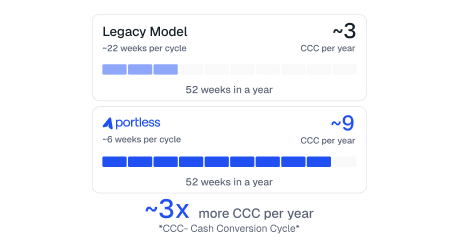
The cash conversion cycle counts the days between paying for inventory and collecting cash from selling it. Fast growth can drain cash because the cycle runs in a fixed order. You pay the supplier, wait weeks while goods cross the ocean, wait again while a warehouse receives them, and only then start selling. A bigger order stretches the same wait across more money.
Review contribution margin by SKU and by channel every month so you know which products pay for growth. Treat working capital as the budget for scaling. Every dollar locked in stock is a dollar that can't fund ads, hires, or a new market.
Where the legacy fulfillment model caps growth
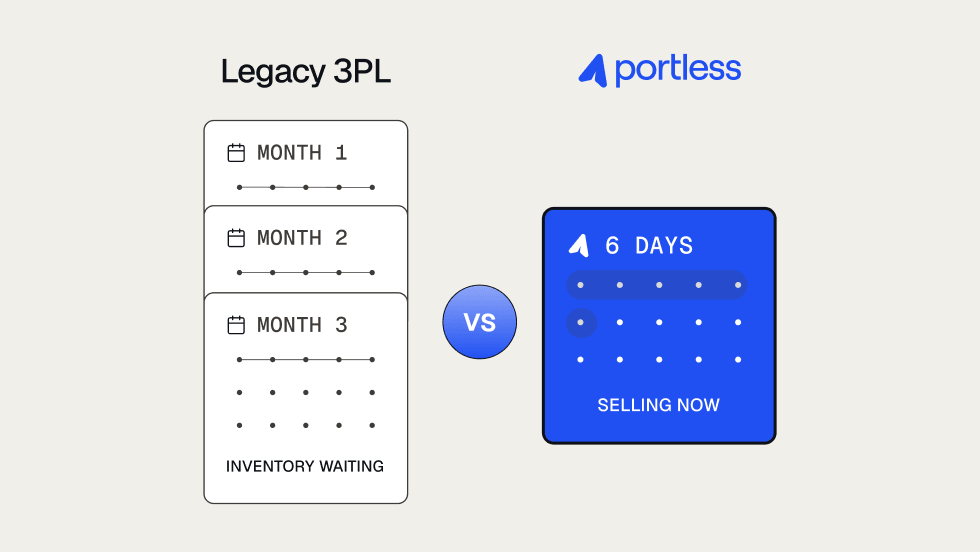
The legacy model follows a familiar path. A brand orders a large production run, pays for it, ships it by ocean freight, pays duties on the full shipment at the port, and stores it in a domestic warehouse. Cash leaves the business months before the first unit sells.
Adding regional warehouses compounds the problem. Each warehouse needs its own safety stock, so three regional 3PLs mean three buffers for the same SKU. The longer the replenishment lead time, the bigger each buffer has to be.
Kitchen tools brand Spartan Kitchen Products felt the cash side of this model. Inventory took more than six weeks to arrive from China, and each shipment needed upfront payments for freight, duties, tariffs, and packaging. When demand spiked, Spartan had to delay shipping or pause sales entirely. After Spartan moved fulfillment to Portless, a direct fulfillment platform that ships orders from its own fulfillment center in China, the founders reclaimed approximately 20+ hours a week of fulfillment work.
The same cash squeeze explains why Ecommerce brands keep hitting a growth ceiling.
How fulfillment models compare on inventory, shipping, and cash
The models differ on who holds the inventory and who ships the order. Those answers set lead time, the cash you tie up, and how far you can sell.
::table
Model;Who holds the inventory;Who ships the order;Time from production to sellable stock;Cash tied up in inventory;International reach;Best for
In-house;The brand, in its own space;The brand's team;Weeks to months with ocean freight;High;Limited and costly;Early brands shipping a few hundred orders a month
Domestic 3PL;The 3PL, in one domestic warehouse;The 3PL;Weeks to months, plus warehouse receiving;High;Strong at home, slow and expensive abroad;Brands selling mostly in one country
Multi-warehouse 3PL network;Several warehouses across regions;Each regional warehouse;Weeks to months for each region;Highest, with safety stock in every region;Good within the regions covered;Large brands with steady demand in each region
Dropshipping;The supplier or sourcing agent;The supplier or sourcing agent;Days;Low;Wide, with inconsistent delivery times;Testing products before buying inventory
Direct fulfillment;A fulfillment center near the point of manufacture;The fulfillment provider, using air freight and local last-mile carriers;Days after production;Low, because stock ships in smaller runs;Worldwide from one hub;Brands past roughly 1,000 orders a month selling lightweight, non-regulated products
:table
Direct fulfillment doesn't suit every product. Heavy or bulky goods and brands that need next-day domestic delivery do better with a domestic warehouse. For lightweight products made in Asia, direct fulfillment shortens the time between production and sale, which is where most scaling plans run out of cash.
How to scale internationally without adding warehouses
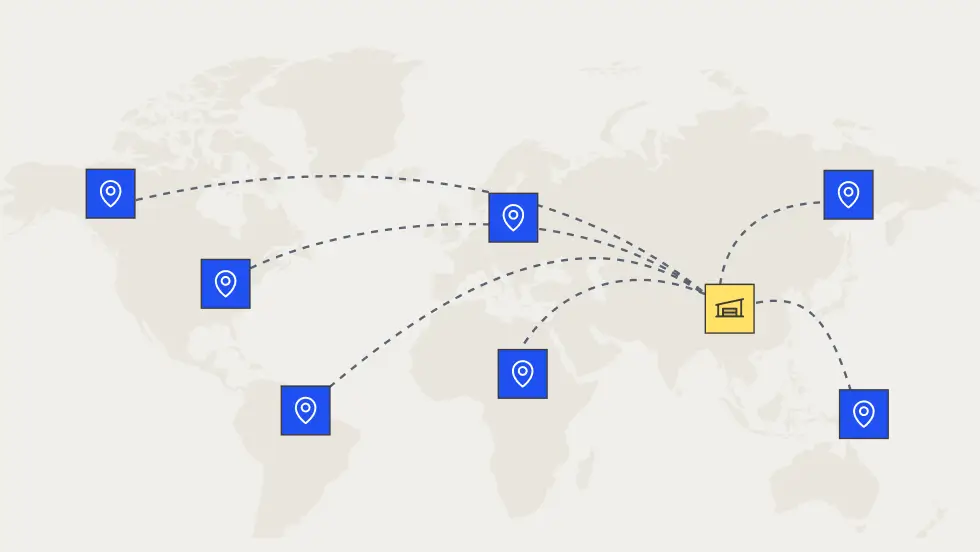
Entering a new country the legacy way means a new 3PL contract, a new stock pool, and a new safety stock buffer. One inventory pool can serve every market instead. Each order ships from a single hub, and local last-mile carriers deliver it through direct injection.
Duties follow the order. Under Delivered Duty Paid (DDP) terms, the seller covers duties and import clearance, so the customer pays nothing extra on delivery. Duty is paid per order at the time of shipment, and you only owe duty on orders that have already generated revenue.
UK cosmetics brand Qlear used one hub to expand into the US and Australia. Qlear reused the ad creative already working in the UK and added no new warehouses or 3PL contracts. In the three months after going live, Qlear shipped more than 12,000 orders into the new markets, and revenue rose 104% against its pre-expansion run rate.
Australian apparel brand Privacy Clo, based in Perth, took the same route on a wider scale. Within a matter of months, Privacy Clo began selling into 17 new countries, with Portless handling compliance, duties, and documentation for each destination market. Privacy Clo's founder described opening a new country as "genuinely the click of one button in our Meta account."
Market selection, localization, and landed-cost pricing all shape an international Ecommerce strategy. Brands unsure about demand can test new markets with small ad budgets before committing any inventory.
A step-by-step plan to scale your operations
- Audit your bottlenecks: List where orders stall, where staff repeat manual work, and which SKUs stock out. Record a baseline for your cash conversion cycle, contribution margin by SKU, and on-time ship rate.
- Fix unit economics: Reprice, rework, or cut SKUs with negative contribution margin before you push more volume through them.
- Centralize order and inventory data: Bring every channel's orders and stock counts into one OMS so every team works from the same numbers.
- Automate trigger-based tasks: Start with order routing, stock syncs, tracking notifications, and reorder alerts.
- Shorten lead time and reconsider fulfillment location: Use the direct fulfillment ROI calculator to compare the maximum cash outlay of your current supply chain against direct fulfillment.
- Test one new market: Pick one country with strong demand signals, run ads you already know convert, and check contribution margin per order before you add another market.
- Review every quarter: Rerun the audit each quarter, because the constraint moves as volume grows.
See how Portless works
Operations break when inventory and cash have to grow faster than orders. Portless removes that pressure by holding stock in its own fulfillment center in China, close to the point of manufacture, and shipping each order straight to the customer. Inventory inbounds in one business day, 99.8% of orders ship within one day, and parcels reach 85+ countries in five to eight days on average. Brands produce smaller runs, fund the next run from sales, and serve every market from one hub. Read how Portless direct fulfillment works, or book a demo to see what direct fulfillment would do to your cash conversion cycle.